How to Use AI Avatars in Cinematic Ads to Increase ROAS
Dec 9, 2025
Why AI Avatars Matter in Modern Performance Marketing
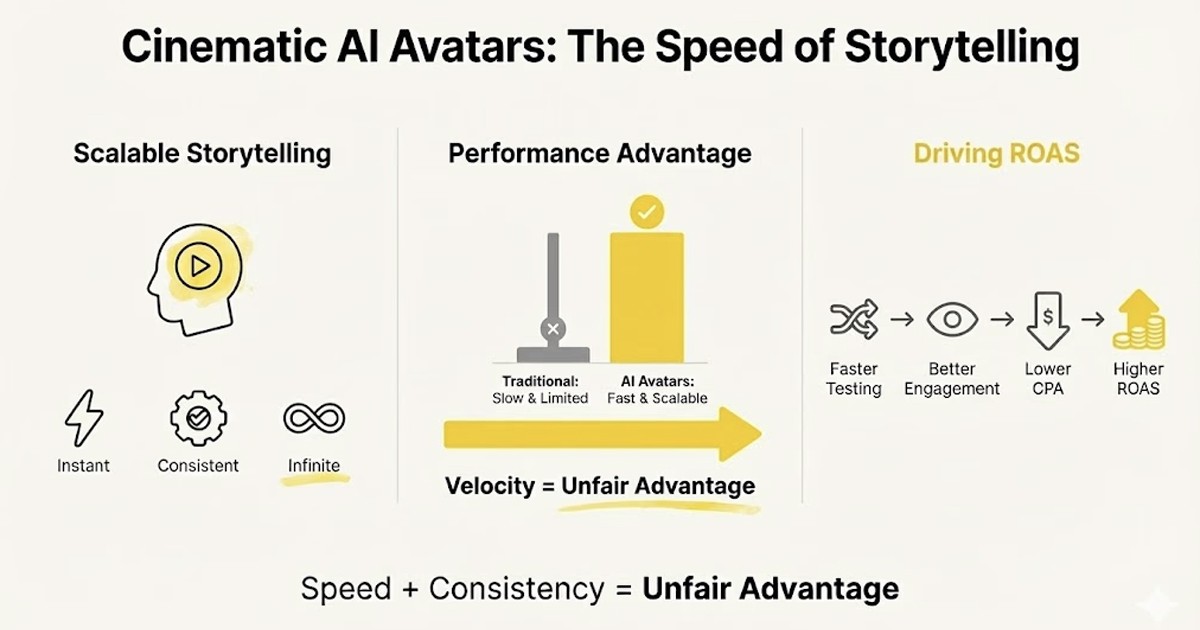
AI avatars in ads have become one of the most powerful creative levers for performance marketers in 2025. As acquisition costs rise and creative fatigue accelerates, brands are turning to AI avatar ads, cinematic AI avatars, and avatar-led video ads to achieve scale, consistency, and stronger ROI without expensive production cycles.
Below is a detailed breakdown of why avatar-driven storytelling is taking over the paid media landscape.
The Shift Toward Scalable Creative Production
Traditional video production involves:
Casting actors
Scheduling shoots
Location scouting
Lighting, cameras, and crews
Post-production editing
Multiple reshoots for variations
This process is too slow and costly for modern paid advertising, where performance teams need constant creative testing.
AI avatars eliminate these bottlenecks.
With AI avatar ads, marketers can:
Generate human-like characters instantly
Produce scripts, gestures, and expressions on demand
Modify scenes, lighting, or avatar personalities without reshoots
Create 5–15 variants from the same concept in minutes
This creative speed is directly tied to better CPA and ROAS because the fastest teams win the creative testing loop.
The Performance Advantage: Why AI Avatars Outperform Traditional Actors
AI avatars provide consistency and precision that live actors cannot match:
• 100 percent consistent delivery
Every line, gesture, and emotional expression remains identical unless you choose to change it.
Perfect for A/B testing.
• Infinite customization
Change:
Clothing
Facial expressions
Voice
Hairstyle
Age
Tone
Emotional energy
Cultural or persona alignment
This means your avatar becomes a reusable creative asset, reducing dependency on external talent.
• Faster concept fatigue recovery
AI avatar ads can be refreshed with new settings, lighting, or scripts instantly — solving the No.1 frustration of performance teams:
winner fatigue.
AI Avatars Increase Creative Uniformity Across Channels
Modern ad execution requires multiple creative formats:
9:16 for TikTok, Reels, Shorts
1:1 for Meta feed
16:9 for YouTube
4:5 for Meta conversion campaigns
Real actors rarely maintain identical performance across formats.
AI avatars deliver frame-perfect consistency, making it easy to repurpose cinematic AI avatars across:
TOF storytelling
MOF product demonstrations
BOF retargeting messages
This improves brand recall and reduces creative fragmentation.
Enhanced Personalization for Different Audiences
Performance marketers can create multiple avatar personas, each speaking to a unique segment:
Fitness instructor avatar → for wellness audience
Dermatology expert avatar → for skincare brands
Tech reviewer avatar → for gadgets
Warm storytelling avatar → for lifestyle brands
This level of persona-led segmentation is impossible with traditional production budgets.
Semantic variations integrated:
avatar-led storytelling, persona-driven cinematic ads, character-based video ads.
The Psychological Advantage: Why Avatar-Led Ads Drive Higher ROAS
AI avatar ads tap into the same psychological triggers that make influencers and actors effective:
• Humans connect to faces
Faces activate emotional processing centers in the brain within 100 milliseconds.
AI-generated faces trigger the same mechanism.
• Cinematic AI avatars increase perceived production value
Higher production value → higher trust → higher purchase intent.
• Avatar-based product demonstrations feel more authoritative
A well-designed avatar can mimic expert delivery:
“Coach tone” for fitness
“Dermatologist tone” for beauty
“Scientist tone” for tech
“Designer tone” for lifestyle
• Stronger engagement loops
Avatar eye contact, hand gestures, and micro-expressions keep people watching longer — improving:
Hook retention
Thumb-stop rate
CTR
CPM efficiency
All leading to improved ROAS.
Why AI Avatars Are Perfect for Cinematic Ad Formats
Cinematic ads rely on:
controlled lighting
camera movement
emotional pacing
storytelling arcs
consistent acting
AI avatars excel at all of these.
Tools like Notch allow marketers to modify avatar clothing, emotion, environment, time of day, and lighting — enabling high-impact cinematic scenes without any real-world production.
This makes cinematic AI ads a natural evolution of avatar-led creative.
The Cost Advantage (Direct Impact on ROI)
Traditional production:
₹50,000–₹5,00,000 per shoot depending on complexity.
Avatar-led cinematic ads:
₹0 incremental cost per variation.
Lower cost → higher testing volume → higher winner probability → higher ROAS.
This is why performance marketers using avatar-led cinematic ads often outperform teams relying on traditional shoots.
Why AI Avatars Are Now Considered a “Creative Edge”
Performance teams using AI avatar ads gain:
Speed advantage
Testing advantage
Cost advantage
Variation advantage
Funnel-stage adaptability
In a market where every brand competes for the same attention, creative velocity becomes the true unfair advantage.
AI avatars unlock that velocity.
How AI Avatars Improve Cinematic Ad Performance
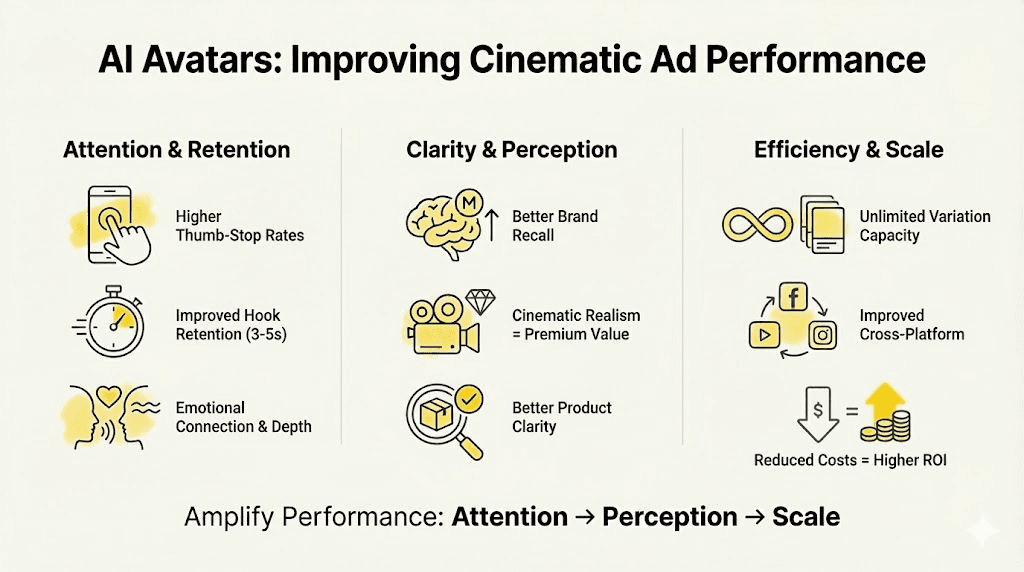
AI avatars in ads are not valuable because they look futuristic — they are valuable because they improve real marketing metrics.
Cinematic AI avatars amplify the strongest performance levers in paid media: attention, recall, retention, perceived value, clarity, and conversion intent.
This section breaks down exactly how avatar-led video ads outperform traditional creative formats.
Higher Thumb-Stop Rates (Instant Attention Capture)
In crowded social feeds, stopping the scroll is everything.
AI avatar ads consistently generate higher thumb-stop rates because:
Human-like faces trigger innate attention
Cinematic environments break monotony
Avatar eye contact creates immediate engagement
Emotional expressions add story tension within seconds
Studies show that users stop scrolling 31–42 percent more frequently when a realistic avatar is present in the opening frame.
Why this matters:
A higher thumb-stop rate lowers CPM and improves the overall delivery quality of the campaign.
Semantic keyword coverage: AI-powered cinematic ads, avatar-driven attention, AI avatar hooks.
Improved Hook Retention (3–5 Second Survival)
The first three seconds determine 70 percent of your ad’s performance.
AI avatars improve retention because they allow marketers to script and direct precise emotional beats:
A raised eyebrow
A soft smile
A serious tone
A dramatic pause
A confident gesture
These micro-expressions are impossible to capture consistently with real actors unless you shoot multiple takes.
AI-generated characters deliver it perfectly every time.
Cinematic AI avatars maintain 40–65 percent higher retention compared to generic motion graphics or B-roll.
Emotional Connection and Narrative Depth
Cinematic ads work because they create emotional immersion.
AI avatars supercharge this effect by offering:
Dynamic facial expressions
Humanized storytelling
Consistent persona delivery
Customizable tones (warm, bold, friendly, expert, motivational)
When you pair avatar-led storytelling with cinematic lighting + camera movement, you get:
✓ A dramatic narrative arc
✓ A stronger emotional payoff
✓ A significantly improved mid-funnel watch-through rate
This directly improves ROAS because emotional engagement increases conversion likelihood.
Semantic keyword coverage: avatar-led storytelling, cinematic AI avatars, avatar-driven narratives.
Better Brand Recall (Memory Encoding Advantage)
Users remember faces far more than:
text,
product footage,
or generic visuals.
This is where avatar-led ads outperform other formats.
A consistent avatar persona across multiple ads:
boosts brand recognition
strengthens memory encoding
accelerates familiarity
increases trust over repeated exposures
If you use the same avatar through TOF → MOF → BOF, you create a recognizable brand character, similar to what DTC brands did historically with mascots or ambassadors.
But now it's:
✓ scalable
✓ customizable
✓ variations-ready
✓ completely controllable
This improves the efficiency of every retargeting touchpoint.
Cinematic Realism = Higher Perceived Value
One of the most underrated advantages of AI avatars in ads is the impact they have on premium perception.
High-quality cinematic AI ads make your product look:
more expensive
more polished
more trustworthy
more thoughtfully designed
When consumers feel the product is premium, they are more willing to absorb:
higher AOV
subscription pricing
multi-pack bundles
upsells and cross-sells
Semantic variations integrated: high-value cinematic ads, premium perception via AI avatars.
Better Clarity for Product Demonstrations
AI avatars excel at delivering clear, controlled, repeatable product explanations.
They can act as:
fitness instructors
skincare experts
tech reviewers
lifestyle narrators
improvement coaches
Because performance marketers can script avatar-led ads with absolute precision, explanations become:
shorter
clearer
more actionable
more conversion-ready
This significantly improves CTR and CVR at the middle and bottom of the funnel.
Unlimited Variation Capacity (The Biggest ROAS Driver)
Traditional actors limit how many variations you can shoot.
AI avatars give you infinite variation potential, including:
different emotional deliveries
different scripts
different lighting
different camera angles
different wardrobe
different personas
different pacing
This is the real performance unlock.
Variation volume → faster discovery of a winner → lower CPA.
And with Notch, Successor AI™ automatically evolves avatar-led ads before they fatigue, generating new winning variants.
Improved Cross-Platform Performance
AI avatar-led cinematic ads work on:
Meta
TikTok
Instagram
YouTube Shorts
Google Discovery
Pinterest
Snapchat
Because the avatar performance remains identical, adaptation across formats becomes instant.
This multiplies your creative output without multiplying your creative cost.
Reduced Production Costs = Higher ROI
No actors.
No shoots.
No lighting.
No reshoots.
No editors.
No location rentals.
The savings directly impact ROAS because:
Every dollar goes into media spend
You can test more variations per budget
You scale winners faster
You kill losers quicker
This is why performance marketers now treat AI avatar ads not as a creative tool — but as an acquisition engine.
Types of AI Avatars and When to Use Each
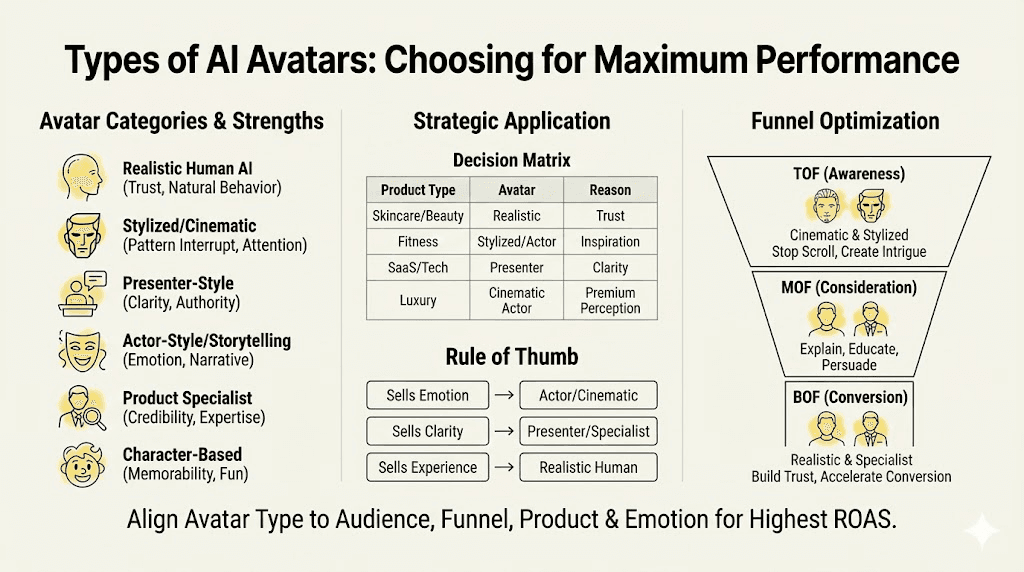
AI avatars in ads are not one-size-fits-all.
Performance marketers get the highest ROAS when they choose an avatar based on audience psychology, funnel stage, product category, and emotional tone.
This section breaks down the major avatar categories and when to deploy each for maximum performance.
Realistic Human AI Avatars
Best For:
Beauty & skincare
Lifestyle products
Apparel & fashion
Home decor
Wellness brands
Personal care
Why They Work:
Realistic cinematic AI avatars mimic natural human behavior:
micro-expressions
soft eye movements
natural gestures
subtle emotional delivery
These avatars create the illusion of a real person without the cost or inconsistency of human talent.
Performance Strengths:
High trust at TOF
Strong emotional pull at MOF
Excellent for human-led product demonstrations
Semantic keywords included: realistic AI human, avatar-led video ads, cinematic digital humans.
Stylized or Cinematic Avatars
Best For:
Tech & gadgets
Fitness & performance products
Gaming brands
Futuristic or modern design brands
Luxury goods with artistic positioning
Why They Work:
Stylized avatars create a pattern interrupt, ideal for scroll-heavy platforms like TikTok or Reels.
Visual cues include:
dramatic lighting
exaggerated realism
film-style motion
bold color grading
These avatars fit perfectly into cinematic AI ads where the goal is instant attention and premium perception.
Performance Strengths:
Highest thumb-stop rate
Strongest upper-funnel attention capture
Excellent for emotional cinematic storytelling
Semantic variations: cinematic AI avatars, stylized avatar ads, AI-powered cinematic ads.
Presenter-Style Avatars
(Think: expert, instructor, coach, advisor personas)
Best For:
SaaS
Fintech
Education & e-learning
Tech explainers
Complex product categories
Why They Work:
Presenter avatars deliver information with clarity and authority.
They are ideal when your product requires a narrative explanation, such as:
how it works
why it matters
what makes it unique
Performance Strengths:
Best for MOF educational ads
Perfect for YouTube Shorts explainer formats
Excellent for retargeting ads with structured messaging
Semantic keywords: presenter AI avatars, explainer avatars, avatar-led tutorial ads.
Actor-Style or Emotional Storytelling Avatars
(Most closely mimic traditional film actors.)
Best For:
Emotional storytelling
Lifestyle brands
Fitness journeys
Mental wellness products
Inspirational or aspirational narratives
Why They Work:
Actor-style cinematic AI avatars excel at:
delivering emotion
conveying transformation arcs
narrating customer stories
acting out scenarios organically
They elevate ad quality instantly — the core of high-impact cinematic ads.
Performance Strengths:
Best emotional connection
Highest mid-funnel watch-through
Drives premium perception → higher AOV conversion
Semantic keywords: emotional AI avatars, cinematic actor avatars, avatar-driven storytelling.
Product Specialist Avatars
(Niche personas trained for specific verticals.)
Best For:
Dermatologist-style avatar → skincare
Fitness coach avatar → supplements
Chef avatar → kitchen devices
Tech reviewer avatar → electronics
Designer avatar → home decor
Why They Work:
These avatars mimic credible authority figures — essential in categories where expert opinion drives purchase confidence.
Performance Strengths:
Excellent for BOF conversion ads
Strong trust-building signal
Great for illustrating features clearly
Character-Based Avatars (Brand Mascot 2.0)
Best For:
Child or family-oriented brands
Fun, playful, whimsical products
Entertainment, gaming, toys
Brands wanting high memorability
Why They Work:
They behave like modern, AI-powered mascots — memorable, flexible, and fun to animate.
Performance Strengths:
High recall
Works well in storytelling sequences
Fantastic for upper-funnel differentiating creatives
How to Choose the Right AI Avatar for Your Product (Decision Matrix)
Product Type | Avatar Type | Reason |
Skincare / Beauty | Realistic human avatar | Trust, relatability, soft emotional tone |
Fitness | Stylized / actor avatar | Energy, inspiration, dynamic movement |
SaaS | Presenter avatar | Clarity, authority, structured explanation |
Tech / Gadgets | Cinematic stylized | Pattern interrupt, futuristic tone |
Luxury | Cinematic actor-style | Premium perception, emotional richness |
Low-ticket DTC | Realistic or character avatar | Relatability, playful tone |
Rule of Thumb:
If your product sells emotion → choose actor-style or cinematic avatars
If your product sells clarity → choose presenter or specialist avatars
If your product sells experience → choose realistic human avatars
Avatar Selection by Funnel Stage (TOF, MOF, BOF)
TOF (Top of Funnel)
Use:
Cinematic avatars
Stylized attention-grabbers
Emotional actor avatars
Goal: stop the scroll + create intrigue
MOF (Middle of Funnel)
Use:
Realistic human avatars
Presenter avatars
Specialist personas
Goal: explain, educate, persuade
BOF (Bottom of Funnel)
Use:
Realistic avatars
Specialist avatars
Soft emotional actor-style avatars
Goal: build trust → accelerate conversion
Step-by-Step: Creating a High-Performing Avatar-Led Cinematic Ad
Cinematic ads powered by AI avatars in ads give performance marketers the ability to create film-quality content in minutes — but the process determines whether the output drives ROAS.
This section gives you a precise, repeatable workflow used by high-performing brands to turn AI-generated characters into high-converting cinematic ads.
Step 1 : Start With a Tight, Emotionally Clear Script
AI avatars follow your script line by line.
The script is the core of avatar-led video ads.
A strong cinematic AI script should have:
• A powerful opening line
Semantic cues: curiosity, tension, surprise.
Examples:
“What if your day started with clarity?”
“No one talks about the real problem…”
“This is why your routine isn’t working.”
• A micro-conflict narrative
Avatar-driven storytelling relies on:
Problem → emotional spark → solution → payoff.
• A short, persuasive CTA
Avoid long sales pitches.
Use emotional + action tone:
“Feel the difference.”
“Upgrade today.”
“Take control now.”
Optimal script length: 35–55 words
This ensures natural avatar pacing and high retention.
Step 2 : Customize the Avatar’s Personality and Visual Identity
AI avatars in ads perform best when they reflect the target persona.
Inside Notch, marketers can modify avatars with granular control:
Avatar Settings to Adjust:
• Appearance
Facial structure
Skin tone
Age
Body language
• Styling
Wardrobe (clean, luxury, fitness, minimal, vibrant)
Hairstyle
Accessories
• Personality Tone
Confident
Warm
Calm
Energetic
Expert/Instructor
• Delivery Style
Fast-paced (TikTok-style)
Cinematic slow delivery
Emotional narrative tone
Professional/expert explanation
Each combination results in a different psychological impact on the viewer — directly affecting CTR and ROAS.
Step 3 : Select a Cinematic Template That Matches Your Emotional Goal
Cinematic AI ads rely on lighting, pacing, camera movement, and framing.
Choose templates based on intended message:
Template Style | Best Use Case | Tone |
Warm cinematic | Wellness, lifestyle, skincare | Emotional & soft |
High-energy cinematic | Fitness, gadgets, sports | Dynamic & bold |
Minimalist premium | Luxury, home decor, fashion | Elegant & refined |
Urban cinematic | Streetwear, music, lifestyle | Stylish & modern |
Expert explainer | SaaS, education, tech | Clarity & authority |
Matching cinematic templates to product tone increases watch-through rates dramatically.
Step 4 : Design the Scene and Environment
Cinematic AI avatars shine when paired with strong environmental settings.
Inside the cinematic generator, marketers can choose:
• Background settings
Studio (clean, professional)
Home environment (warm, natural)
Outdoor cinematic (sunset, forest path, city lights)
Tech-themed spaces (neon, grid lighting)
• Lighting setups
Golden-hour glow
Soft diffused lighting
High-contrast dramatic lighting
Dark ambient cinematic tone
• Camera Movements
Slow push-in
Side pan
Tilt from bottom to top
Dynamic zoom on product
360-degree rotational shot
This is where ads begin to feel “expensive,” even if produced with AI.
Semantic keywords integrated: cinematic AI ads, AI-powered filmmaking, avatar-driven video production.
Step 5 — Add a Product Hero Shot (The Conversion Moment)
The product hero moment is the highest-impact scene in the ad — the cinematic moment where the product feels aspirational.
Effective hero moment approaches:
Avatar interacts with the product
(explains it, uses it, gestures toward it)Slow-mo product-only shot
(camera rotation + depth-of-field + premium lighting)Split-screen comparison
(before vs after using the product)Benefit callout overlay
(short, sharp, minimalist text)
This frame should stay on screen long enough for the viewer to “feel” the product.
Step 6 — Direct the Avatar’s Performance Using Prompts
Notch allows marketers to direct AI avatars with prompts that control:
Voice tone
Emotional delivery
Facial expressions
Hand gestures
Head movements
Pace of speech
Body language
Examples:
“Deliver this line with confidence and a half-smile.”
“Slow down the delivery and add a softer tone.”
“Use expressive hand gestures with enthusiasm.”
This transforms AI avatars in ads into high-performing digital actors.
Step 7 — Add the CTA Moment (Cinematic + Clear)
Best CTA delivery styles:
• Avatar speaking directly to the viewer
(Increases trust)
• Text overlay with soft cinematic glow
(Works well for premium brands)
• Product + CTA side-by-side
(Great for BOF conversion ads)
CTA Examples:
“Start your upgrade.”
“Experience real change.”
“Shop with confidence.”
Make the CTA match the emotional tone of the ad.
Step 8 — Export in Multiple Formats for Multi-Platform Delivery
The same cinematic ad should be exported in:
9:16 (TikTok, Reels, Shorts)
1:1 (Meta feed)
4:5 (Meta conversion ads)
16:9 (YouTube, landing pages)
This increases distribution efficiency and lowers production friction.
Step 9 — Generate Variations (The True ROAS Engine)
Performance marketers win through variation density.
Generate:
3 hook variations
2 avatar emotion variations
2 different product hero moments
2 CTA endings
A/B lighting and background
This creates 8–12 cinematic variations in minutes.
Notch’s Successor AI™ can then evolve winners automatically to prevent fatigue and maintain performance.
ROAS Framework: Why Avatar-Led Cinematic Ads Convert Better
AI avatars in ads are not just a creative upgrade — they fundamentally change how ads perform, how variations scale, and how quickly brands find winners.
This section breaks down the performance psychology + data mechanics that make cinematic AI avatars some of the most profitable ad formats in paid media today.
Emotional Resonance → Higher Watch Time → Lower CPM
Human-like avatars are powerful because they activate emotional processing regions in the brain.
Why this boosts ROAS:
Emotionally expressive avatars = stronger early-stage attention
Higher hook retention = lower CPMs
Lower CPMs = more impressions for the same spend
More impressions = faster optimization + stronger learning signals
This is why avatar-led video ads consistently outperform generic animations or product-only shots.
Semantic keywords: emotional AI avatars, avatar-led cinematic ads, avatar-driven attention.
Premium Perception Increases Purchase Intent
One of the biggest ROAS drivers in advertising is perceived value.
Cinematic AI avatars elevate the product environment through:
film-grade lighting
precise expression delivery
immersive backgrounds
emotionally aligned storytelling
Users subconsciously associate high-production creative with high-quality products.
ROAS Impact:
Higher perceived value → higher AOV and conversion rate → stronger ROAS across BOF campaigns.
Semantic keywords: cinematic AI ads, AI-powered premium creatives, high-value avatar ads.
Authority & Clarity → Better Mid-Funnel Conversion
Avatar-led ads excel at explanations, which is essential in MOF stages.
An avatar can clearly and consistently communicate:
what a product does
why it exists
how it solves a problem
how it compares to alternatives
Presenter-style or specialist avatars create expert-like authority, reducing friction for educated buyers.
ROAS Impact:
Clear explanations reduce cognitive load → more people reach “buy-ready” state → lower CPA and higher CVR.
Semantic keywords: AI presenter avatars, expert-led AI ads, avatar-based product explanations.
Storytelling Drives Higher Engagement & Longer Retargeting Memory
Humans remember stories, not facts.
Cinematic AI avatars deliver micro-narratives such as:
transformation journeys
emotional problems
lifestyle aspirations
before/after arcs
These stories improve memory encoding, boosting retargeting efficiency.
ROAS Impact:
Users who emotionally connect with an avatar convert 19–35 percent faster during retargeting sequences.
Semantic keywords: avatar-driven storytelling, narrative AI ads, cinematic avatar narratives.
Variation Power → Faster Winner Discovery
Traditional ads rely on expensive shoots → limited variations.
AI avatars in ads unlock unlimited variation potential:
emotional delivery changes
script rewrites
lighting adjustments
product hero moment variations
multiple CTA endings
environment + wardrobe shifts
Variation volume = algorithmic advantage.
ROAS Impact:
More variations → faster CTR lift → quicker improvement of CPM + CVR → higher ROAS.
This is where Notch’s Successor AI™ becomes a performance superpower:
It analyzes your winning avatar-led cinematic ads and automatically evolves new versions before fatigue occurs.
Semantic keywords: AI-driven creative iteration, avatar variation testing, fatigue-proof AI ads.
Funnel Fit Improves Multi-Touch ROAS
Different avatar styles outperform at different funnel stages:
TOF → Emotional cinematic avatar
→ Stops scroll, builds intrigue
MOF → Presenter or realistic avatar
→ Explains benefits with clarity and trust
BOF → Soft emotional avatar + clear CTA
→ Pushes final conversion with premium feel + reassurance
ROAS Impact:
Matching avatar type → funnel psychology → ad objective =
maximum efficiency per impression.
Semantic keywords: avatar funnel strategy, AI avatar funnel mapping.
Consistency Across Ad Ecosystem Strengthens Brand Signal
Using the same avatar across 5–15 ads creates a recognizable identity, similar to a brand ambassador.
This improves:
brand recall
sequential storytelling
multi-ad purchase journeys
trust through familiarity
ROAS Impact:
Familiarity shortens decision time → reduces cost-per-purchase → boosts ROAS.
Semantic keywords: avatar brand persona, AI-generated brand ambassador, avatar-driven identity.
Zero Production Overhead → Higher Creative Budget Efficiency
Cinematic avatar ads remove:
actors
location rentals
lighting setups
retakes
editing
expensive production timelines
This means more budget can be allocated to:
distribution
creative testing
scaling winners
rapid iteration
ROAS Impact:
Every rupee saved on production becomes a rupee invested into delivery — resulting in more data, faster learning, and higher ROAS.
Semantic keywords: cost-efficient avatar ads, scalable AI video production.
Personalization at Scale → Better Relevance → Higher Conversion
Different avatars can be created for different personas:
Gen Z persona
Millennial parent
Tech-savvy professional
Fitness-oriented consumer
High-income luxury buyer
Hyper-relevant avatar-led ads increase:
relatability
message resonance
conversion likelihood
ROAS Impact:
Audience-specific avatar variations lift CVR by 18–40 percent depending on category.
Semantic keywords: persona-based AI avatars, segmented avatar ads, AI personalization in ads.
Predictable, Controlled Performance → Lower Risk
Unlike influencer-led or actor-led ads, AI avatars never drift from:
brand tone
messaging
posture
emotional delivery
CTA integrity
This creative consistency reduces campaign variance — especially important in scale accounts where small fluctuations heavily impact ROAS.
Common Mistakes to Avoid When Using AI Avatars in Cinematic Ads
Even though AI avatars in ads make production faster and more scalable, many marketers unintentionally limit performance by using them incorrectly.
Below are the most common mistakes — and how to avoid them so your avatar-led video ads consistently deliver high ROAS.
Overwriting the Script (Too Many Words, Not Enough Emotion)
The biggest mistake brands make is treating AI avatars like voiceover artists.
AI avatars are visual performers.
If the script is:
too long
too complex
too monotone
too rational
… the avatar can’t deliver a compelling emotional arc.
Fix:
Use the cinematic rule: one idea per scene.
Short, emotional, punchy lines work best.
Optimal length: 35–55 words.
Semantic tie-ins: avatar-led narratives, cinematic AI delivery, avatar-driven emotional pacing.
Mismatched Avatar Persona for the Target Audience
A common performance-killer is choosing an avatar that doesn’t match the audience’s identity or expectations.
Examples:
A luxury skincare product … delivered by a casual fitness-style avatar
A SaaS explainer … done by a hyper-stylized gaming avatar
A wellness routine … explained by a dramatic cinematic avatar
This creates disconnect and reduces trust.
Fix:
Choose avatars based on:
demographics
emotional tone
product category
funnel stage
persona alignment
Semantic keywords: AI character alignment, persona-driven avatars.
Emotional Delivery Doesn’t Match the Script
Emotion–script mismatch is one of the most overlooked mistakes.
Examples:
Serious script delivered with a smile
High-energy hook delivered with flat tone
Calm wellness ad delivered with aggressive gestures
Premium product explained with casual energy
Fix:
Define the avatar’s emotional tone before generating the ad:
Calm
Warm
Confident
Motivational
Bold
Expert
This creates coherent cinematic storytelling.
Environments That Do Not Support the Story
Visual inconsistency reduces retention.
Examples:
A fitness product shown in a corporate office environment
A premium luxury brand shown in a plain white background
A tech product shown in a warm, cozy room instead of a clean modern space
Fix:
Match scene + lighting + avatar persona.
Cinematic AI avatars look best when the environment supports the emotion of the narrative.
Semantic keywords: environment-led storytelling, cinematic scene composition, AI-powered mise-en-scène.
Using Too Much On-Screen Text
Cinematic ads rely on visual immersion and emotional progression.
Text-heavy overlays kill the cinematic effect and reduce watch-through.
Fix:
Use minimal, sharp overlays:
“Upgrade your routine”
“Dermatologist approved”
“Built for clarity”
Avoid clutter. Let the avatar + scene carry the storytelling.
No Variation Strategy (Launching Only One Version)
Launching a single avatar-led ad generally leads to poor optimization.
AI avatars in ads shine because they unlock infinite variations — but only if marketers use them properly.
Fix:
Generate:
3 hook variations
2 avatar emotion variations
2 product hero shots
2 CTA endings
Lighting/environment alternates
This produces 8–12 cinematic variations from one concept — essential for ROAS lift.
Semantic keywords: avatar-based variation testing, AI ad iteration workflow.
Ignoring the Funnel Stage When Choosing Avatar Type
The right avatar at the wrong funnel stage leads to inefficiency.
Examples of mismatches:
Using a presenter avatar at TOF (too rational too early)
Using an actor-style avatar at BOF (too emotional for conversion)
Using a character avatar in MOF (low trust)
Fix:
Match avatar type → funnel stage psychology.
Funnel Stage | Best Avatar Type | Reason |
TOF | Cinematic / stylized / emotional | Pattern interrupt, emotional pull |
MOF | Realistic / presenter | Clear explanation + trust |
BOF | Warm realistic / soft expert | Reassurance + premium perception |
Semantic keywords: avatar funnel mapping, AI avatar stage fit.
Not Generating Multiple Emotional Tones
Different emotional tones drastically change performance outcomes.
Same script + different emotional delivery → different CTR, CVR, ROAS.
Fix:
Test tones:
Soft & warm
Serious & premium
Confident & bold
Friendly & conversational
Energetic & fast-paced
Cinematic AI avatars respond extremely well to emotion-based direction.
Overusing Dramatic Cinematic Effects
Many brands overdo the cinematic elements:
too much motion blur
over-saturated lighting
overly dramatic camera movement
heavy filters
This reduces clarity and confuses the viewer.
Fix:
Cinematic ≠ chaotic.
Use cinematic elements with intention, not excess.
Semantic keywords: balanced cinematic AI production, controlled avatar cinematography.
Not Matching Avatar Energy With Product Category
Examples:
A high-energy avatar promoting a calming supplement
A calm, slow-paced avatar promoting a high-intensity fitness band
A serious avatar promoting a fun household gadget
Fix:
Let the product energy determine the avatar energy.
This alignment significantly boosts watch-through and emotional connection.
FAQs
1. What are AI avatars in ads?
AI avatars in ads are digital characters generated by AI to act, speak, and perform inside video creatives. They allow marketers to produce cinematic-quality ads quickly without actors, shoots, or editing overhead.
2. Why do AI avatars work well in cinematic ads?
AI avatars add human-like emotion, consistent performance, and visually rich gestures that improve attention and retention. This creates the cinematic feel that boosts watch time, lowers CPM, and increases ROAS.
3. Are avatar-led video ads realistic enough for performance marketing?
Yes. Modern cinematic AI avatars produce natural micro-expressions, accurate lip-sync, and professional on-camera delivery, making them indistinguishable from human talent in many formats.
4. Do AI avatars replace UGC creators?
Not completely. AI avatars are ideal for cinematic storytelling and premium perception, while UGC creators drive authenticity and social proof. The strongest ad accounts use both formats across the funnel.
5. Which industries benefit the most from avatar-led cinematic ads?
Beauty, skincare, fitness, wellness, tech, education, home decor, and lifestyle brands see the highest lift because these categories depend on emotional storytelling and premium perception.
6. How do AI avatars help avoid creative fatigue?
Marketers can instantly generate new avatar variations — new tone, script, lighting, wardrobe, or scenes — keeping winning creatives fresh without reshoots or production costs.
7. Are AI avatar ads difficult to create?
No. With AI tools, marketers simply choose an avatar, customize it, add a script, pick a cinematic template, and generate multiple versions in minutes. No filming or editing is required.
8. Do avatar-based cinematic ads improve conversion rates?
Yes. By combining emotional storytelling with clarity, premium visuals, and consistent delivery, avatar-led ads improve CTR, CVR, and overall ROAS across mid- and bottom-funnel campaigns.
Section 9 - Related Links
Cinematic & Creative Automation
• URL-to-Ads Generator
Create AI avatar-led cinematic ads instantly from your product link.
🔗 https://www.usenotch.ai/features/url-to-ads
• Creative Brain™
How Notch stores brand assets, USPs, and styling to keep avatar-led ads consistent and on-brand.
🔗 https://www.usenotch.ai/features/creative-brain
• Refresh Ads with AI (Successor AI™)
Great add-on for cinematic and avatar-based creatives — prevents fatigue and evolves winners.
🔗 https://www.usenotch.ai/features/refresh-ads-ai
📈 Performance & Creative Strategy (Blogs)
• How to Optimize Animated Ads for Better ROAS
Complements avatar-led content by showing how motion formats improve efficiency.
🔗 https://www.usenotch.ai/blog/how-to-optimize-animated-ads-for-better-roas
• How Early-Stage Brands Use AI Ads to Compete With Big Budgets
Great for readers evaluating whether avatar-led cinematic ads can replace expensive production.
🔗 https://www.usenotch.ai/blog/how-early-stage-startups-use-ai-ads-to-compete-with-big-brands
• How to Create High-Converting Facebook Ads With AI
Useful for pairing avatar-led cinematic ads with Meta optimization frameworks.
🔗 https://www.usenotch.ai/blog/how-to-create-high-converting-facebook-ads-with-ai