Agentic Ads vs AI Ad Generators: What’s the Difference?
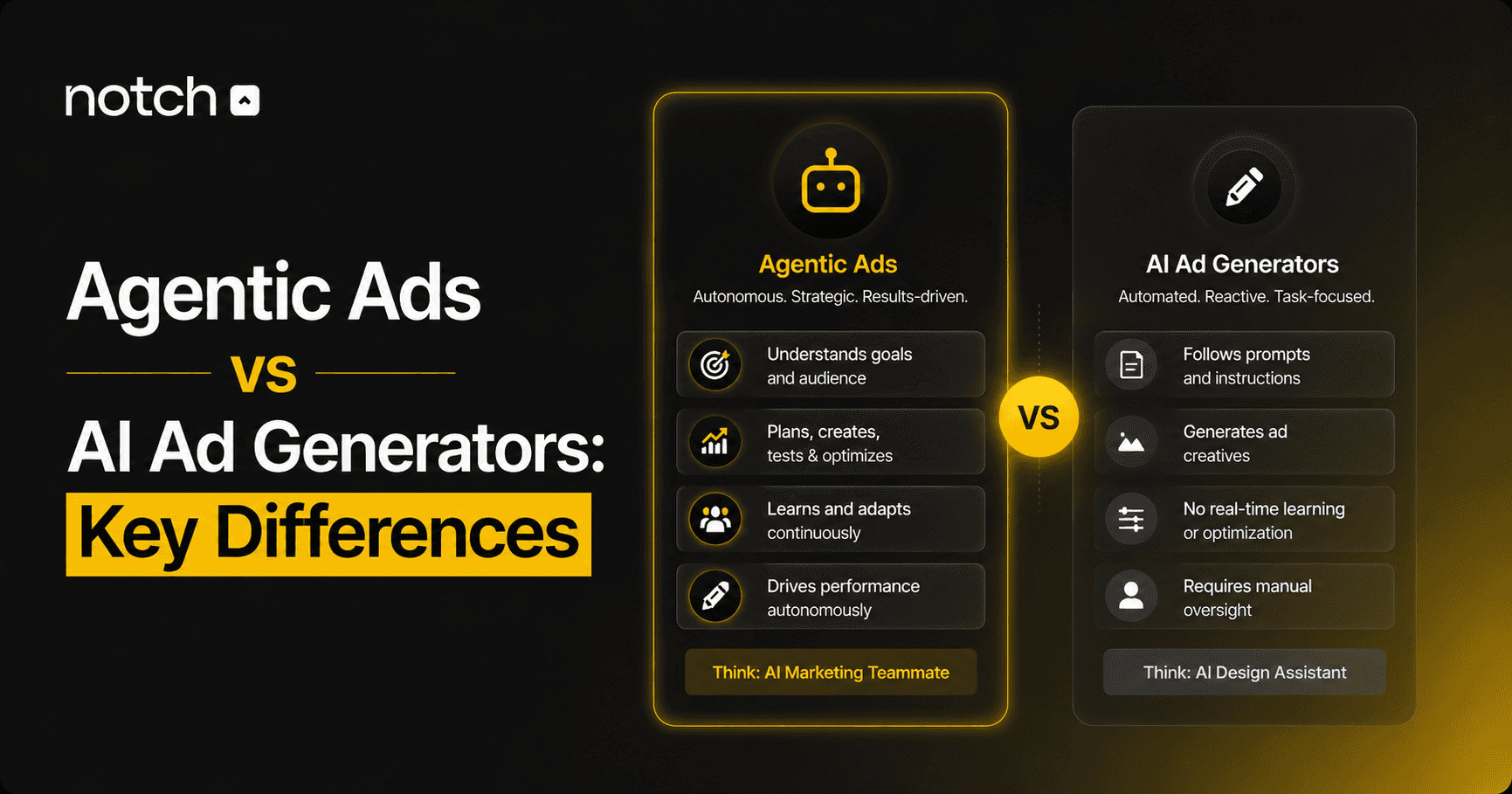
Agentic Ads vs AI Ad Generators: What’s the Difference?
If you’ve been researching AI-powered advertising tools, you’ve probably noticed two very different categories emerging: AI ad generators and agentic ads. On the surface, they sound similar. Both use AI. Both promise faster ad creation. But the underlying architecture — and the results you get — are fundamentally different.
This guide breaks down exactly what separates agentic ads from AI ad generators, where each category excels, and which approach fits your workflow.
Agentic ads vs AI ad generators in one sentence: AI ad generators run a model once to produce a single asset. Agentic ads use an AI agent that researches, scripts, generates, and edits a complete video ad autonomously — with your brand context permanently loaded across sessions.
What Are AI Ad Generators?
AI ad generators are tools that use machine learning models to produce ad creative from a prompt or input. (Here's a deeper look at how AI video ad generators actually work.) You provide a URL, a script, an image, or a brief, and the tool generates an output — a video clip, a static banner, an avatar talking head, or a cinematic shot.
The key characteristic: the model runs once. You give it input, it produces output, and the interaction is over. If you want something different, you run it again with new input.
Popular AI ad generators include tools like Creatify, HeyGen, Arcads, Runway, and AdCreative.ai. Each handles one part of the ad production process well. But each requires you to manage the broader workflow yourself.
Think of AI ad generators as power tools. A power drill is faster than a manual screwdriver, but you still need to know where to drill, what screws to use, and how the pieces fit together. The intelligence stays with you.
What Are Agentic Ads?
Agentic ads represent a fundamentally different architecture. Instead of a model that runs once, an AI agent takes multi-step actions to research, plan, generate, and assemble a complete ad — autonomously.
The key characteristic: the agent operates across a sequence of decisions. It doesn’t just generate one asset. It researches what hooks work in your category, writes a script with proper ad structure, generates the avatar, sources or creates B-roll, adds voiceover, edits everything together, and delivers a finished ad.
The difference between a generator and an agent is the difference between a calculator and an analyst. A calculator gives you a number when you press buttons. An analyst takes your goal, gathers data, runs calculations, interprets results, and delivers a recommendation. One is a tool. The other is a collaborator.
The Fundamental Architectural Difference
Here’s where it gets concrete. The gap between agentic ads and AI ad generators comes down to how intelligence is distributed in the workflow.
Capability | AI Ad Generators | Agentic Ads |
|---|---|---|
Research what hooks work | You do this manually | Agent researches and writes hooks |
Write a script | You write it or use a separate tool | Agent writes the script from your direction |
Generate avatar | Separate tool (e.g., HeyGen) | Agent generates avatar inline |
Source B-roll | You find it in stock libraries | Agent sources or generates B-roll contextually |
Create A-roll | You record or upload | Agent generates A-roll as part of the pipeline |
Add voiceover | You use another tool | Agent generates voiceover as a step |
Edit the video | You open a timeline editor | Agent edits on the fly as you direct |
Remember your brand | You re-upload assets every session | Brand context is permanently pre-loaded |
With generators, you are the agent. You connect the tools, manage the workflow, and hold the context in your head. With agentic ads, the AI is the agent. You direct; it executes.
Where AI Ad Generators Fall Short
AI ad generators work well for isolated tasks. But when you need a finished ad — from idea to publishable output — their limitations become clear.
Scenario 1: You Need a Hook-First UGC Ad
With a generator like Creatify, you paste a URL and get a short clip. The tool decides the structure, the hook, and the flow. You get what it gives you. If the hook doesn’t land, you regenerate and hope for something better. There’s no script control, no brand memory across sessions, and no ability to direct specific sections.
An agentic system would research what hook formats are performing in your category (even clone a competitor's winning ad), write a script with a proper hook-problem-solution-CTA structure, generate the avatar and B-roll, and assemble the full ad. If the hook isn’t punchy enough, you say so, and the agent rewrites and regenerates just that section.
Scenario 2: You Need Consistent Brand Ads at Scale
With HeyGen, you get excellent avatar generation and lip-sync. But you write the script. You upload assets. You manage the workflow. For a single talking-head clip, that’s fine. For 20 variations across a campaign, you’re spending hours on production management that has nothing to do with creative strategy.
An agentic system already knows your brand — colors, tone, product details, preferred personas, approved CTAs. You say “Give me 5 variations of this ad with different hooks” and get five finished videos without re-briefing anything.
Teams producing 30+ creative variants per week through agentic workflows see 2-3x faster creative testing cycles compared to manual multi-tool production.
Scenario 3: You Want Cinematic Quality in an Ad Format
Runway and Sora produce stunning cinematic video. But they have zero ad intelligence. No hooks, no script architecture, no CTA awareness, no brand context. You’d need to write the script elsewhere, generate clips in Runway, record voiceover in another tool, edit in Premiere or CapCut, and manage the entire pipeline yourself. The generation is impressive. The production workflow is 2019.
Scenario 4: You Need Static + Video Creative
AdCreative.ai is fast for static ad variations and banner templates. But it stops at static. No video. No scripting. No agents. The moment you need a video ad — which is where performance marketing has decisively moved — you’re back to juggling multiple tools.
According to Meta’s own recommendations, Advantage+ Shopping campaigns perform optimally with 50+ active creative assets — a threshold that manual production rarely sustains.
What Agentic Actually Means in Practice
The word “agentic” gets thrown around loosely in AI marketing. Here’s what it means in concrete terms for ad production:
1. Pre-loaded brand context. The agent doesn’t start from zero. Before you type a single word, it already knows your brand name, visual identity, product USPs, tone, and creative assets. This isn’t a session variable that disappears — it’s persistent memory.
2. Multi-step autonomous execution. The agent doesn’t generate one thing and stop. It takes a sequence of actions: research, scripting, asset generation, editing, and assembly. Each step informs the next. Context flows through the entire pipeline.
3. Conversational direction. You don’t operate the tool through menus and upload buttons. You direct it through natural language. “Make the CTA more urgent.” “Swap the B-roll in the middle.” “Shorter.” The agent adjusts without you touching a timeline.
4. Self-correction. When a generation doesn’t match the brief, the agent can recognize the gap and adjust. This is fundamentally different from a generator that gives you output and waits for you to decide what’s wrong.
5. Full production stack coverage. Script, avatar, A-roll, B-roll, voiceover, edit, output — all in one system. No tab-switching. No export-import loops. No context lost between tools.
Tool-by-Tool Comparison
Tool | Category | Strength | Limitation |
|---|---|---|---|
Creatify | AI Ad Generator | Quick UGC-style clips from a URL | No script control, no brand memory, no directability |
HeyGen | AI Ad Generator | Best-in-class avatar and lip-sync | Single capability — you build everything around it |
Runway | AI Video Generator | Cinematic video generation | No ad intelligence, no hooks, no brand context |
AdCreative.ai | AI Ad Generator | Fast static ad variations | Static only — no video, no scripting, no agents |
Notch Agentic Video Ads | Agentic Ads | Full-stack creative agent with pre-loaded brand context | First agentic ad platform |
The pattern across every generator is the same: each tool is a module. You are the glue between modules. You do the research, write the script, jump between tools, and manage the workflow. You are functioning as the agent.
Performance marketers report spending an average of 15-20 hours per week on operational ad tasks — uploading creatives, managing campaigns, and switching between tools — that could be handled by an agentic system.
Notch Agentic Video Ads replaces you as the agent. It covers the full production stack — from research to finished ad — inside a single conversational interface.
Which One Do You Actually Need?
The right choice depends on where you are and what you’re optimizing for.
Choose an AI ad generator if:
You need one specific capability (avatars, static banners, cinematic clips)
You have a production team that can manage the workflow between tools
You’re producing a small number of ads and don’t mind the manual assembly
You already have scripts, assets, and a clear creative brief ready to go
Choose agentic ads if:
You need finished, publish-ready video ads — not raw assets
You’re producing at volume and can’t afford hours of manual assembly per ad
You want brand consistency without re-briefing every session
You’re a performance marketer, e-commerce founder, or agency managing multiple brands
You want to direct creative strategy, not operate production tools
The market is moving from tools to agents. AI ad generators made individual steps faster. Agentic ads eliminate the need for you to manage those steps at all.
Frequently Asked Questions
Can agentic ads replace all my current AI ad tools?
For most video ad production workflows, yes. An agentic system consolidates scripting, avatar generation, B-roll sourcing, voiceover, and editing into a single pipeline. You may still use specialized tools for non-ad creative work, but for ad production specifically, an agent covers the full stack.
Are agentic ads more expensive than AI ad generators?
Agentic platforms typically cost more than a single-purpose generator, but less than the combined cost of 4-6 separate tools plus the production time to manage them. When you factor in the 15-20 hours per week saved on operational tasks, the ROI is significantly higher.
How do I know if I need an agent or a generator?
If you produce fewer than 5 ads per month and have a team to manage production, individual generators may suffice. If you need volume (20+ ads/month), brand consistency across campaigns, or faster testing cycles, an agentic system pays for itself in the first week.
Does an agentic system work for all ad formats?
Agentic video ad systems handle UGC-style ads, talking head formats, animated storytelling, product demos, before/after comparisons, and cinematic shorts. The agent adapts its production approach based on the format you request.
See Agentic Ads in Action
Notch Agentic Video Ads is the first platform built from the ground up as a creative agent, not a generator. Your brand context is pre-loaded. The agent researches, scripts, generates, and edits. You direct from a chat window and get finished ads in minutes.
Keep reading