What Are Agentic Video Ads?
If you’ve been in performance marketing or brand advertising for any length of time, you know the pain: scripting ads, jumping between five different tools, re-uploading brand assets every session, and stitching everything together manually. AI has made individual steps faster, but the workflow itself? Still fragmented. The average performance marketing team uses 4-6 separate tools to produce a single video ad, spending 3-5 hours per creative on tool-switching and manual assembly alone. Brands running 50+ creative variants per month through agentic systems report 60-70% reduction in production time compared to traditional multi-tool workflows. Meta’s Andromeda algorithm performs best with 50+ active creatives per ad account — a volume most teams cannot sustain with manual production.
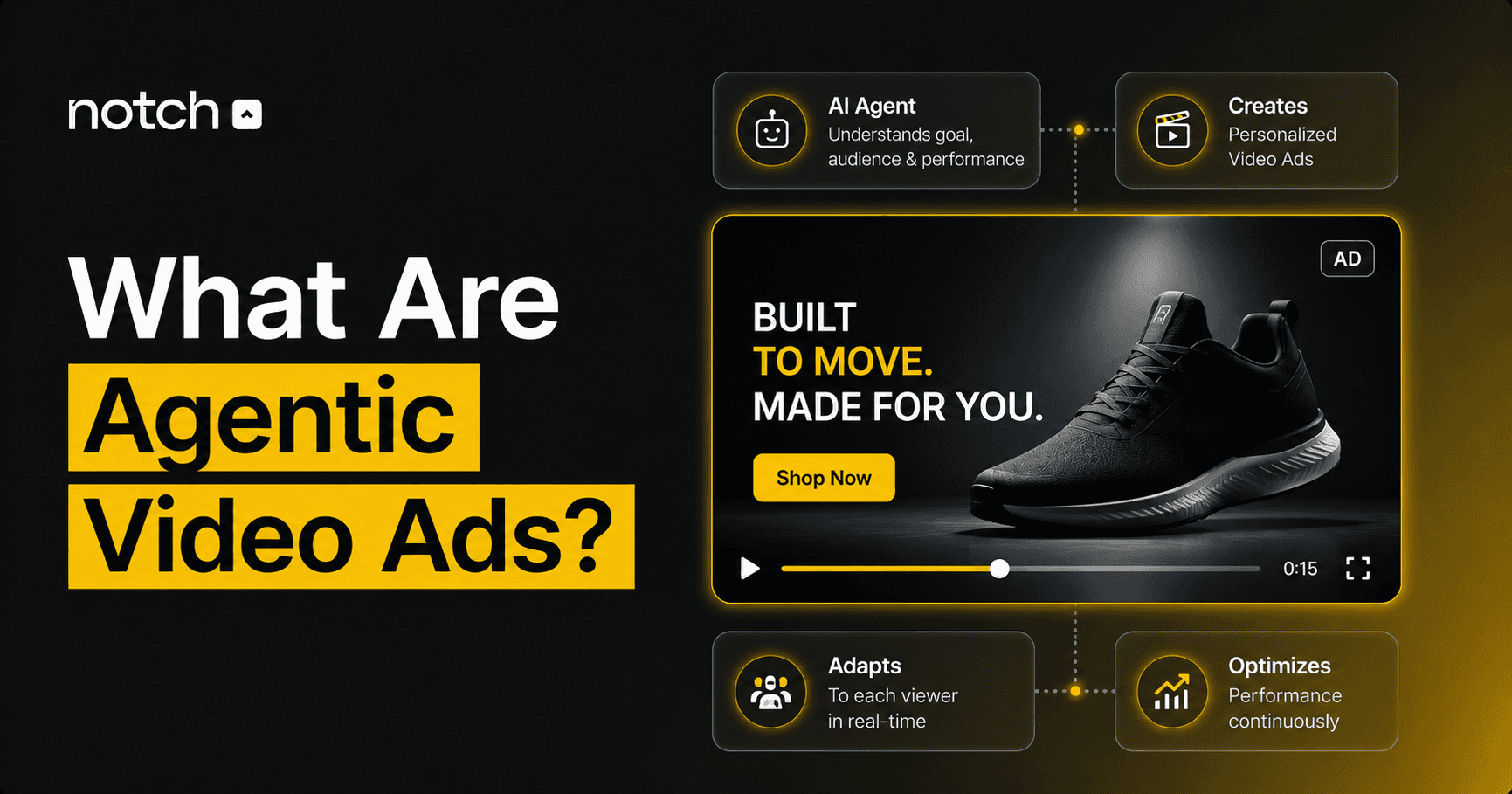
What are agentic video ads? Agentic video ads are video advertisements produced end-to-end by an AI agent that researches, scripts, generates, and edits a finished ad from a single direction. Your brand context is permanently pre-loaded. You direct; the agent handles everything from hook research to final edit.
That’s changing. A new category is emerging in 2026: agentic video ads.
This post breaks down what agentic video ads actually are, why the distinction matters, and how this shift is redefining what’s possible for marketers who need volume without sacrificing quality.
The Short Answer
Agentic video ads are video advertisements created end-to-end by an AI agent — not a single-purpose tool, but an intelligent system that researches, scripts, generates, and edits a finished ad from a simple direction.
The key word is agent. Not generator. Not template engine. Not editing assistant. An agent that holds your brand context, takes multi-step actions, and produces a complete, publish-ready video ad through conversation.
If you’ve used Claude Code for software development, you already have the right mental model. Claude Code doesn’t just write code — it reads your entire codebase, understands your architecture, researches what it needs, and produces working output with minimal hand-holding. Agentic video ads apply the same principle to ad production.
Agent vs. Tool: Why the Distinction Matters
Most AI video products on the market today are tools. They do one thing well — and understanding the differences between agentic ads and AI ad generators is critical:
HeyGen generates talking-head avatars with excellent lip-sync
Runway, Kling, and Sora produce cinematic video from text prompts
Creatify turns a URL into a short UGC-style clip (Notch takes this further with its URL-to-ads feature that produces complete video ads)
AdCreative.ai generates static ad variations from templates
Each of these is genuinely useful. But each is a module — one piece of a larger production workflow. There’s a reason AI ad generators alone aren’t enough. You still have to be the glue.
You research what hooks are working. You write the script. You generate an avatar in one tool, source B-roll from another, record voiceover somewhere else, and edit the final cut in yet another app. You are the intelligence connecting these modules.
An agent flips that. Instead of you orchestrating multiple tools, the agent orchestrates the entire workflow itself. You provide direction. The agent handles execution.
With tools, you operate. With an agent, you direct.
That single shift — from operator to director — is what makes agentic video ads a fundamentally different category.
What an Agentic Video Ad Workflow Looks Like
Here’s what happens when you give an agentic video ads system a direction like: “Make me a 30-second hook-first ad for our summer drop, UGC-style, targeting Gen Z.”
The agent runs through seven steps autonomously:
1. Research
The agent investigates what hook formats, angles, and structures are performing in your product category right now. It doesn’t guess — it actively researches before it writes a single word.
2. Script
Based on its research and your brand context, the agent writes a complete ad script. Not a generic template — a script built around your product’s USPs, your brand’s tone, and the structure most likely to convert for your audience.
3. Avatar Generation
The agent generates or selects the right on-screen presenter. If you’ve already created a named avatar for your brand, it uses that. If not, it generates one that fits the tone and audience of the ad.
4. B-Roll Selection
The agent pulls in relevant B-roll from your pre-uploaded assets or generates contextual visuals. It knows which footage fits which part of the script because it understands the narrative structure it just wrote.
5. A-Roll Generation
Where needed, the agent generates primary footage — product shots, lifestyle scenes, or motion-driven visuals that serve the story.
6. Voiceover
The agent generates voiceover aligned with the script, matching the tone and pacing required by the ad’s structure.
7. Assembly and Editing
The agent edits everything together into a finished video. Hook, body, CTA — all assembled with transitions, pacing, and brand-consistent styling. No timeline. No export. No switching tabs.
The result is a complete, ready-to-run video ad. And if something isn’t right, you don’t start over — you just direct a change: “Make the hook punchier” or “Swap the B-roll in the middle section.” The agent adjusts in-conversation.
How Existing Tools Compare
To understand why agentic video ads represent a category shift — and for a direct Notch vs. Creatify comparison — it helps to see how the current landscape stacks up:
Dimension | AI Tools (Generators) | Agentic Video Ads |
|---|---|---|
Intelligence | Runs a model once, returns output | Agent researches, decides, acts across multiple steps |
Brand Context | Re-entered every session | Permanently pre-loaded via Creative Brain |
Output | Raw asset (clip, image, avatar) | Finished, publish-ready video ad |
The pattern is clear: existing tools require you to manage intelligence across multiple platforms. An agentic system centralizes that intelligence in one place.
The Claude Code Analogy
For anyone in tech, the most intuitive way to understand agentic video ads is through the Claude Code analogy.
Before Claude Code, developers used AI as a code-completion tool. You’d prompt it for a function, copy the output, paste it into your editor, debug it, and repeat. The AI was helpful, but you were still the orchestrator.
Claude Code changed that. It reads your entire repository. It understands your architecture, dependencies, and patterns. You say “Add authentication to this API” and it figures out which files to modify, what patterns to follow, and how to implement it end-to-end.
Agentic video ads are the same leap, applied to advertising. Before this, you used AI as a generation tool — one prompt, one output, one piece of the puzzle. Now, the agent understands your brand holistically and produces complete ads from a single direction.
The shift is identical: from using AI as a tool to working with AI as a collaborator that holds context and takes autonomous action.
Three Shifts That Define the Category
From Tools to an Agent
You stop operating multiple tools and start directing one intelligent system. The cognitive overhead of managing a fragmented workflow disappears. Your job becomes creative direction, not production management.
From Re-Briefing to Pre-Loaded Context
Every traditional tool starts from zero each session. You paste a URL. You upload a logo. You explain your brand voice. Again.
An agentic system uses a persistent brand memory to store your brand permanently — name, colors, visual identity, tone, product details, approved hooks, CTAs, and uploaded assets. The agent reads all of it before you type your first message.
From Generation to Production
Other tools give you a clip. An agent gives you a finished ad — researched, scripted, assembled, edited, and ready to publish. The output isn’t raw material you need to refine. It’s a complete deliverable.
Who Benefits Most
Performance marketers who need high ad volume without quality degradation. When you can produce dozens of variations through conversation instead of manual production, your testing velocity transforms.
E-commerce founders who want production-quality ads at startup speed. You no longer need an agency or an in-house team to produce professional video ads.
Brand teams who need creative consistency across campaigns. The agent maintains your brand guidelines automatically — no brief required.
Agencies managing multiple clients who need to context-switch instantly. Each brand’s context lives in the system. Switch clients, and the agent already knows everything about the next brand.
Why This Matters Now
The ad industry has been adopting AI incrementally — a trend explored in depth in our guide to agentic AI for marketing. A better generator here, a faster editor there. But the fundamental workflow hasn’t changed. Marketers still operate like project managers, coordinating between fragmented tools.
Agentic video ads represent the first time the entire ad production pipeline has been unified under a single intelligent system. That’s not an incremental improvement. It’s a structural shift in how ads get made.
The question for marketers isn’t whether this shift is coming. It’s whether you’ll be early enough to benefit from the speed advantage before it becomes table stakes.
Ready to see agentic video ads in action? Explore how Notch is building the category and find out what it looks like when an AI agent produces your entire ad — from idea to finished video — in minutes.
Frequently Asked Questions
What is the difference between an AI ad generator and agentic video ads?
An AI ad generator runs a model once to produce a single output like a video clip or static banner. Agentic video ads use an AI agent that takes multi-step actions — researching hooks, writing scripts, generating assets, and editing the final video — all from one direction, with your brand context permanently loaded.
Do I need technical skills to use agentic video ads?
No. Agentic video ads work through natural conversation. You describe what you want in plain language — “30-second UGC ad targeting Gen Z for our summer drop” — and the agent handles the entire production pipeline.
How long does it take to produce an ad with an agentic system?
A finished, publish-ready video ad can be produced in minutes through an agentic system. Traditional multi-tool workflows typically take 3-5 hours for a single ad. Agentic production reduces this to under 15 minutes including review and refinement.
What tools do agentic video ads replace?
Agentic video ads consolidate the functions of multiple tools into one system: script writing (ChatGPT/Jasper), avatar generation (HeyGen), video generation (Runway/Sora), stock footage sourcing, voiceover tools (ElevenLabs), and video editing (CapCut/Premiere). The agent handles all of these as steps in a single workflow.
Keep reading