Ad Hooks in 2026: ACES Framework and 73 High Performing Examples
Dec 8, 2025
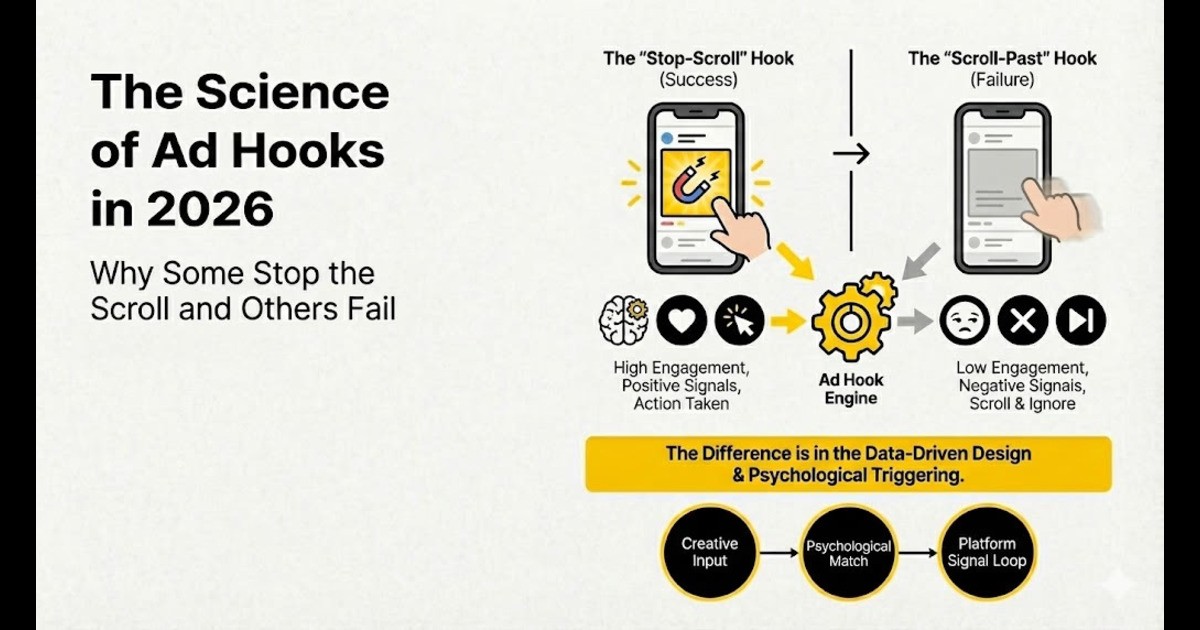
The Science of Ad Hooks in 2026: Why Some Stop the Scroll and Others Fail
Why Ad Hooks Work in 2026: Attention Science and User Behavior
Modern ads live or die in the first two seconds. That moment decides whether the brain chooses to invest attention or skip. Understanding what drives that choice is the foundation of all hook performance. This section breaks down the exact psychological and platform level forces shaping hooks in 2026.
1. The Two-Second Attention Window
Across Meta, TikTok, and YouTube Shorts, the average user decides to stay or skip within two seconds. This micro window forces the hook to carry the entire burden of:
relevance
surprise
payoff expectation
emotional pull
If these signals are not detected instantly, the ad is ignored.
Why this matters
The hook is no longer a stylistic choice.
It is the performance engine of the entire creative.
2. The Brain Is Optimised to Ignore Almost Everything
Human attention is built to filter out predictable, repetitive, and low-value information. When a hook feels like every other ad, the brain treats it as noise.
Two cognitive filters to beat
A. Predictability filter
If the opening line sounds like a brand broadcast, the brain assumes there is nothing new.
B. Effort filter
If the hook is hard to understand, vague, or conceptual, the brain rejects it to save mental energy.
Takeaway
High performing hooks are short, concrete, and persona specific.
3. Expectation Violation Increases Watch Time
Expectation violation is when the brain encounters something slightly unexpected and shifts from autopilot to active processing. This is the heart of modern hooks.
High performing hooks often use:
a surprising line
a confession tone
a contradiction
a story teaser
a pattern break
Each of these momentarily disrupts scrolling behaviour and commands attention.
4. Value Must Be Visible Immediately
Viewers want to know what they will gain before they invest their time. The best hooks reveal a payoff without giving everything away.
Signals of value
clear outcome
timeframe
transformation
tension
relief from a pain point
a problem they recognise instantly
When the value is obvious, the viewer leans in. When the value is hidden or slow to surface, the viewer leaves.
5. Hooks Perform When They Solve the Identity Test
Before a viewer continues watching, they subconsciously ask:
Is this for someone like me?
Identity alignment is stronger than logic. If a viewer cannot recognise themselves in the hook, the message loses power.
Identity alignment tactics
name the persona
name a familiar struggle
use the language of the user
reference a tool, niche, or scenario they know
Identity aligned hooks outperform generic ones across platforms.
6. Emotion Predicts Whether the Viewer Stays
People pay attention to emotion more than to raw information. The most effective hooks carry an emotional charge.
Emotional drivers that increase retention
fear of missing out
fear of doing it wrong
desire for achievement
desire for recognition
relief from frustration
regret driven tension
pride in expertise or identity
Without emotional resonance, even a clever hook feels empty.
7. Platform Behaviour Now Shapes Hook Requirements
Each platform has trained users to expect a certain rhythm of information.
Meta: likes specificity and transformation. Time framed outcomes often win.
TikTok: rewards pattern breaks, vulnerability, and story intros.
YouTube Shorts: favors authority driven openings and curiosity loops.
Instagram: pushes visual contrast and fast payoff setups.
A hook that works on one platform often needs adaptation for another. Modern teams create multi-variant hooks tailored for each channel.
8. Creative Fatigue Is Faster, So Hooks Must Refresh Faster
Audiences see similar formats more often, so hooks burn out quicker.
Signs of fatigue
lower watch time
lower first frame retention
lower CTR
rising CPC
declining conversion intent
Refresh cycles in 2026 are shorter than ever. Brands increasingly rely on systems that generate fresh angles and rotate hooks weekly, not monthly.
9. Hooks Are Now Performance Assets, Not Creative Lines
A hook is not a clever opener. It is a strategic lever that influences:
watch time
thumb stop rate
CTR
cost per result
overall ROAS
A strong hook can uplift the same creative by 15 to 40 percent. A weak hook can destroy performance even if the rest of the ad is strong. Treat hooks as testable performance assets.
Section 1 summary
High performing hooks in 2026:
break predictable patterns
reveal value quickly
trigger curiosity
speak to a clear identity
carry emotional weight
remain platform aligned
refresh before fatigue sets in
The ACES Hook Science Framework: Attention, Curiosity, Emotion, Specificity
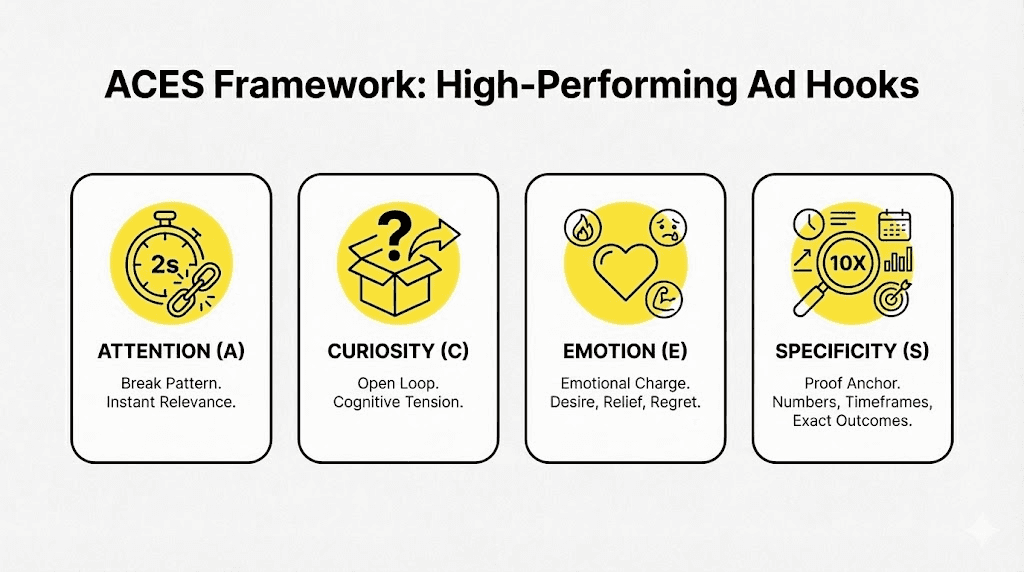
Most marketers know hooks matter. Few know why they work. Almost no one uses a model to engineer them consistently. ACES turns hook creation from guesswork into a system.
A = Attention
C = Curiosity
E = Emotion
S = Specificity
These four elements are the psychological engines behind every high performing hook on Meta, TikTok, YouTube, and Instagram.
1. ATTENTION: The Pattern Break That Stops the Scroll
Attention is the first gate. If you fail here, nothing else matters.
Components
Pattern break
disrupts scrolling autopilot with unusual openings, confession tones, bold contrast, fast reveals, direct challenges, or visual mismatch.
Personal relevance
answers the subconscious question “Is this for me?” with persona specific lines like:
“If you run DTC ads, listen.”
“Founders, this will hurt.”
Relevance plus disruption equals immediate focus.
2. CURIOSITY: The Open Loop the Brain Wants to Close
Curiosity creates cognitive tension. It is not hype. It is the desire to close an unfinished question.
Curiosity triggers
“How I…”
“I tested X…”
“This one mistake…”
“The part nobody talks about…”
“Here is what changed everything…”
“This should not have worked but…”
If your hook does not create an unfinished question, it will not generate forward momentum.
3. EMOTION: The Force That Makes People Care
Information does not create action. Emotion does. The five emotional drivers dominating high performing ads are:
Desire
Frustration
Pride
Relief
Regret prevention
Emotion keeps viewers invested long enough for conversion to begin.
4. SPECIFICITY: The Proof Anchor That Builds Trust
Specificity converts interest into belief.
Specificity elements
numbers
timeframes
exact personas
exact pain points
exact outcomes
quantifiable improvements
tool names
niche references
Examples:
“How I got 7 percent CTR in fourteen days”
“I tested 17 workflow automations”
“This one angle cut our CPA by 41 percent”
Every detail makes the story feel real.
The ACES Pyramid: How High Performing Hooks Are Built
Think of ACES as a stack:
Base: Attention and Curiosity (pull the viewer in)
Middle: Emotion (keeps them engaged)
Top: Specificity (proves the payoff)
A strong hook aligns psychology, clarity, and credibility in one tight line.
Why ACES outperforms old formulas
Old models rely on shock, clickbait, vague promises, or overused templates. ACES prioritises fast clarity, real value, persona relevance, emotional resonance, measurable outcomes, and narrative tension — mapping both cognitive science and platform algorithms.
Section 2 summary
Attention stops the scroll
Curiosity pulls the viewer in
Emotion makes the message matter
Specificity builds trust and proof
With ACES, hook creation becomes systematic.
Why Most Ad Hooks Fail: ACES Pyramid Breakdown
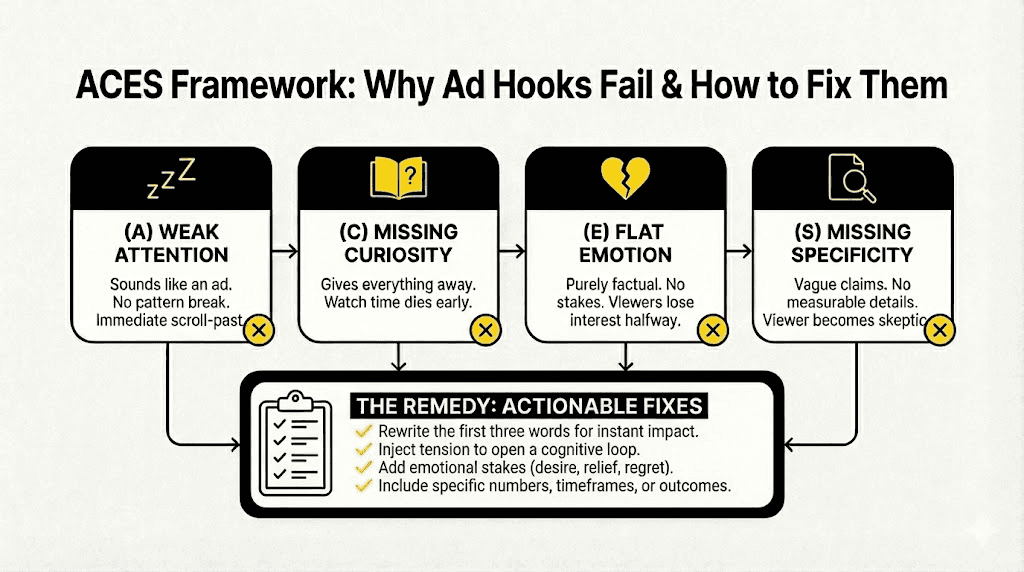
The ACES model shows that every powerful hook works on four layers. When a hook collapses, it is almost always because one of these layers is missing. Use this section as a diagnostic toolkit.
1. How Hooks Collapse When Attention Is Weak
Attention is the most fragile layer. Fail here and viewers never enter the cognitive loop.
Common failure points
The hook sounds like an ad (e.g., “Introducing our new product”)
No pattern break
No clear persona signal
Result
Immediate scroll past. Watch time never forms.
2. How Hooks Collapse When Curiosity Is Missing
Curiosity gives the hook forward pull. Without an open loop, there is no reason to continue.
Common failure points
The hook gives everything away
Benefits are communicated without mystery
No setup for a reveal or conflict
Result
Watch time dies early.
3. How Hooks Collapse When Emotion Is Flat
A hook may be understood but not felt. Feeling is what keeps viewers from abandoning halfway.
Common failure points
Purely factual hooks
No stakes or identity tension
No emotional resonance
Result
Viewers lose interest after the first line.
4. How Hooks Collapse When Specificity Is Missing
Specificity is the trust engine. Without it, a hook sounds generic and unproven.
Common failure points
Vague claims like “game changer” or “this strategy changed everything”
No numbers, timeframes, or details
No niche or tool references
Result
The viewer becomes skeptical and leaves.
5. The Combined Failure Pattern Most Marketers Miss
Most weak hooks fail on two or more layers at once. The deadly outcome is a hook that feels forgettable and damages performance.
6. The ACES Pyramid as a Diagnostic Tool
Checklist for underperforming hooks:
Did attention break the pattern? If not, rewrite the first three words.
Does the hook create a question? If not, add tension.
What emotion does the viewer feel? If none, inject desire, frustration, pride, or regret.
Can the claim be measured? If not, add numbers, timeframes, or context.
One pass through this diagnostic removes most hook failures.
7. Why Most Teams Never Fix Failing Hooks
They treat hooks as “creative lines” instead of infrastructure.
They test visuals instead of hooks.
They refresh too late; hooks now fatigue in days, not weeks.
Section 3 summary
Hooks fail when ACES layers collapse. Use the ACES Pyramid to pinpoint failures and rewrite hooks with precision.
73 High Performing Ad Hook Templates for 2026
These templates are ACES optimised. Each activates at least two psychological layers. Plug in your niche, persona, or data to generate variations.
A. Attention First Hooks (12)
Hooks that break patterns instantly.
Stop doing this if you run ads
If you are a founder, you need to hear this
This will hurt if you manage paid campaigns
Everyone does this wrong when scaling ads
I cannot believe this actually worked
Start your ads like this, not like that
If your ads are dying fast, listen closely
Most advertisers miss this tiny detail
Never launch ads without doing this first
This will shock every performance marketer
Pause your scroll if you manage Meta ads
If you struggle with high CPA, watch this
B. Curiosity First Hooks (12)
Hooks that pull via open loops.
13. Here is the one thing that changed everything
14. I tested 21 tools and one beat all the rest
15. I tried a crazy experiment and the results shocked me
16. You will not believe what happened after 14 days
17. This simple change increased our ROI instantly
18. Nobody talks about this part of scaling ads
19. What I found next made zero sense
20. I was wrong about this one thing
21. This technique is weird but works insanely well
22. Something surprising happens when you try this
23. This tiny tweak flipped our performance overnight
24. I changed only one thing and everything improved
C. Emotion First Hooks (12)
Hooks that land by triggering feeling.
25. I was tired of losing money on ads until I learned this
26. Nothing worked for months and then this happened
27. The most painful mistake I kept repeating
28. It hurt to realise I was doing everything wrong
29. If you are overwhelmed, try this
30. I wish someone told me this earlier
31. This is why your ads feel stuck
32. I used to fear scaling ads until I learned this
33. This mistake cost me more than money
34. I was scared to test this but it changed everything
35. Your frustration is valid. Try this instead
36. I still cannot believe this worked
D. Specificity First Hooks (12)
Hooks that build trust instantly with details.
37. How we got 7 percent CTR in only 12 days
38. The exact hook that cut our CPA by 41 percent
39. I tested 17 optimization methods for SaaS ads
40. The angle that increased Shopify ROAS to 2.8
41. This hook increased our watch time by 39 percent
42. The 3 mistakes killing your Meta account right now
43. What happened when we switched headlines at 20k spend
44. The targeting tweak that saved us 28 percent cost
45. How this one UGC structure increased retention by 31 percent
46. The exact script that brought in 1.3 ROAS bump
47. Why our 18 second ads beat our 32 second ads
48. The best performing intro line after testing 64 variations
E. Hybrid ACES Hooks (25)
Hooks that hit 3 or 4 ACES layers at once.
49. I tested 14 hooks for DTC brands and this one won by 29 percent
50. Three years ago I had zero traction. Now this strategy gets 7 percent CTR
51. If you are a media buyer, stop scrolling. This saved me thousands
52. I tried something unusual and it cut my CPA in half
53. Nobody warned me about this mistake and it cost me weeks of results
54. I learned this the hard way after losing 10k in ad spend
55. If you are scaling to 50k a month, avoid this one trap
56. I changed three words in the hook and CTR jumped 41 percent
57. This felt illegal to try but it boosted our ROAS instantly
58. I copied a competitor’s angle and it outperformed ours by 38 percent
59. Your audience is ignoring you because of this one mistake
60. This idea looked stupid until it worked better than anything else
61. If your ads keep failing at scale, try this instead
62. We finally cracked 3 ROAS after 19 failed variations
63. The story behind our best performing hook this year
64. I tested every headline style and this format won
65. Here is the truth every performance marketer learns too late
66. This trick will save your ad from dying in seven days
67. I rewrote the first three seconds and everything changed
68. The angle that won even though it should not have worked
69. Your creative fatigue is not about design. It is your hook
70. Our worst looking creative outperformed the polished one by 2.1 ROAS
71. We turned one static image into a top performing ad with this hook
72. This insight changed how we write every hook now
73. Here is the formula behind our best performing ads this quarter
Section 4 summary
This database gives you ready to use hook templates that can be adapted for any product, platform, or niche. Each hook is built using one or more ACES layers to maximise attention, watch time, and performance.
Why Ad Hook Performance Drops and How to Reset It
Even the strongest hook will eventually stop working. This is a psychological and platform driven inevitability. To maintain performance, you must understand why hooks fatigue and how to reset them before they crash your metrics.
1. Hook Performance Drops Because Audiences Adapt
Every time someone sees a style of hook, their brain becomes slightly better at filtering it out. Expectation adaptation means:
what surprised people last month is normal now
what felt fresh last quarter feels predictable
what worked at small spend stops working at scale
2. Creative Fatigue Now Starts at the Hook Level
Data shows the first three seconds fatigue faster than anything else.
Signals of hook fatigue
falling thumb stop rate
lower first frame retention
declining watch time
rising CPC
CTR dropping even when visuals stay the same
3. Algorithmic Distribution Accelerates Fatigue
Platforms push your best creatives aggressively, causing rapid saturation of similar audiences. This makes hooks burn out in days even at moderate spend.
4. Most Hooks Break Because the ACES Layers Become Predictable
Attention fades when pattern breaks are no longer novel.
Curiosity weakens when questions feel familiar.
Emotion flatlines if the feeling no longer lands.
Specificity becomes repetitive when claims repeat.
Fatigue is the collapse of novelty across ACES.
5. Scaling Spend Exposes Weakness in the Hook
Scaling shows your hook to colder, less aligned audiences and reveals structural weaknesses not visible in small tests.
6. Mistake: Teams Refresh the Creative but Not the Hook
Replacing visuals while reusing the same hook retains the same cognitive signal. New visuals cannot save a fatigued hook.
Rule
Refresh the hook first. Refresh the creative second.
7. How to Reset Hook Performance Before It Dies
Reset blueprint used by top teams:
A. Rewrite the first five words
B. Flip the angle (mistake→desire, discovery→transformation, persona→confession)
C. Add or change the emotion (pride, frustration, fear, relief, surprise)
D. Change the specificity element (numbers, timeframes, outcomes, scripts, spend levels)
E. Build 3 variant hooks for the same concept
8. Why AI Based Refresh Cycles Are Becoming Critical
Manual refresh cycles are too slow for 2026. Teams need systems that detect fatigue and regenerate new angles automatically.
Capabilities to look for
automatic angle discovery
proactive hook evolution
brand aligned variation generation
Modern performance creative is about evolving winners intelligently.
How Notch AI Generates High Performing Ad Hooks at Scale
Modern ad performance requires systems that evolve ideas, refresh angles, and generate winning hooks before fatigue kills results. Notch is built to solve this.
1. Creative Brain: The Foundation for Intelligent Hook Generation
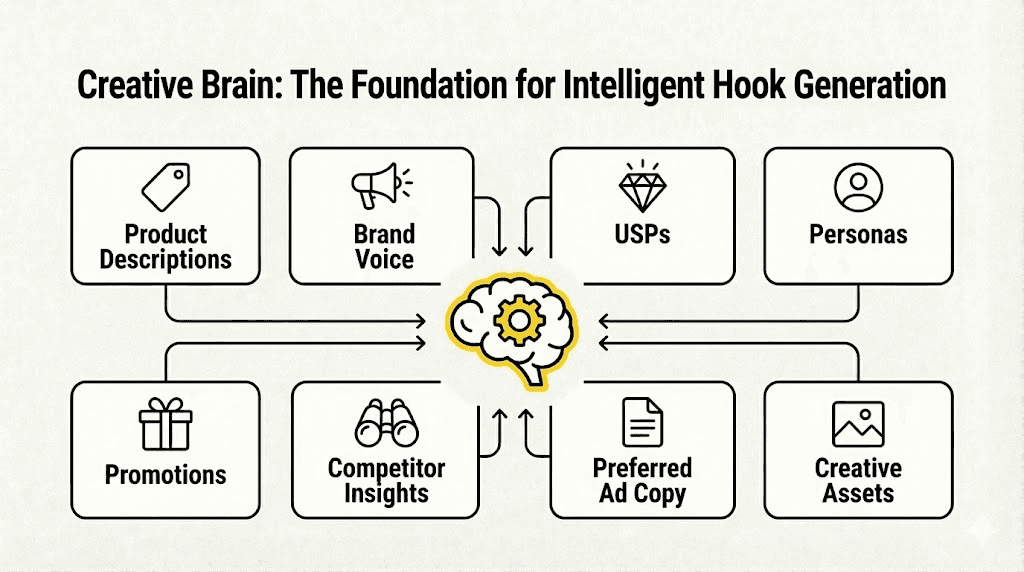
Creative Brain stores:
product descriptions
brand voice
USPs
personas
promotions
competitor insights
preferred ad copy
creative assets
Because the system uses your brand data, Notch generates hooks that are brand aligned, persona specific, consistent, grounded in product value, and instantly reusable.
2. Breakthrough AI: Generates New Angles and Untested Hook Concepts
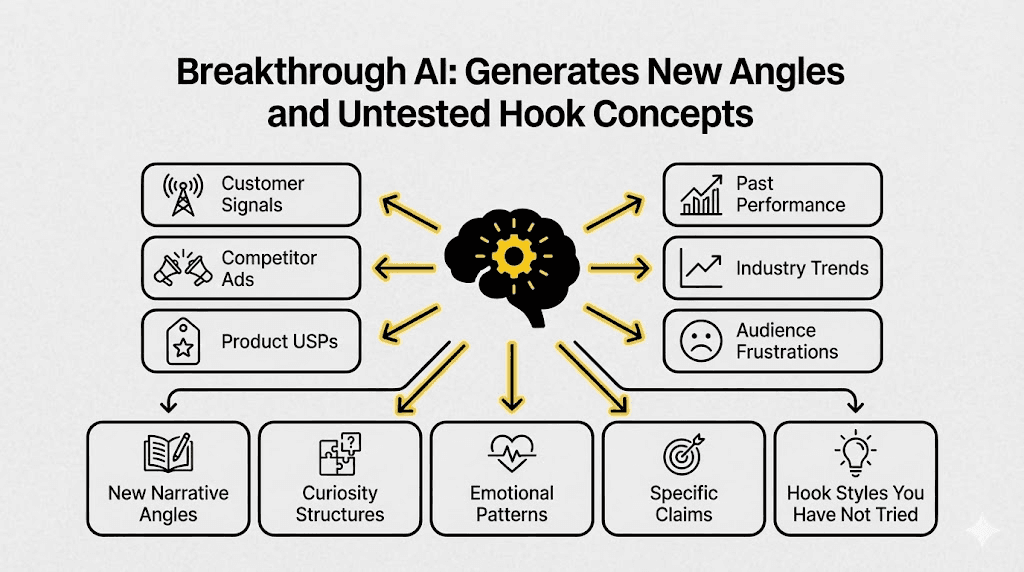
Breakthrough AI analyzes:
customer signals
past performance
competitor ads
industry trends
product USPs
audience frustrations
persona goals
It proposes new narrative angles, curiosity structures, emotional patterns, specific claims, and hook styles you have not tried.
3. Competitor Ads Scan: Discover Proven Hook Formats
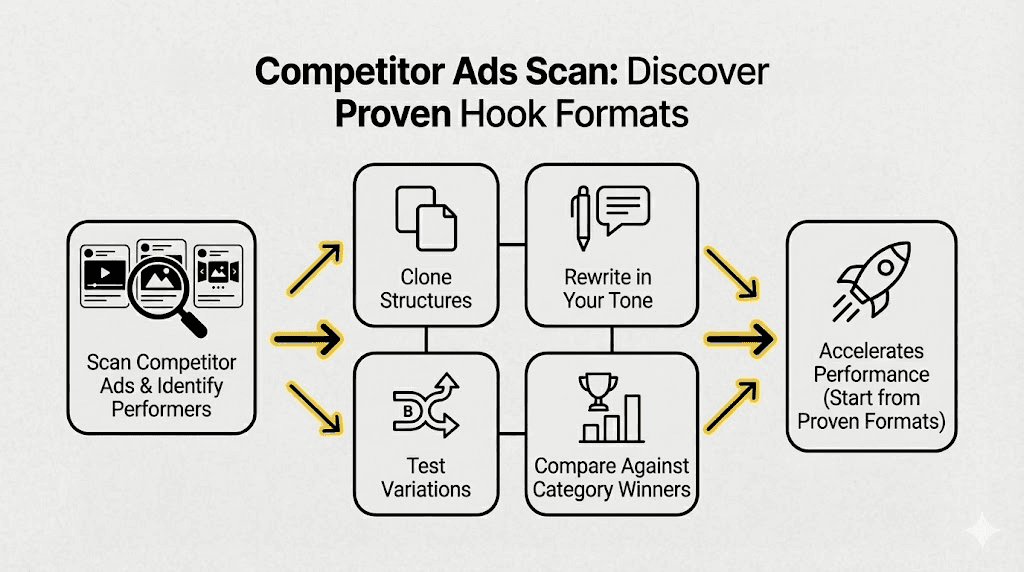
Notch scans competitor ads, identifies what performs, and lets you:
clone structures
rewrite in your tone
test variations
compare against category winners
This accelerates performance by starting from proven formats.
4. Successor AI: Evolves Your Best Hooks Before They Fatigue
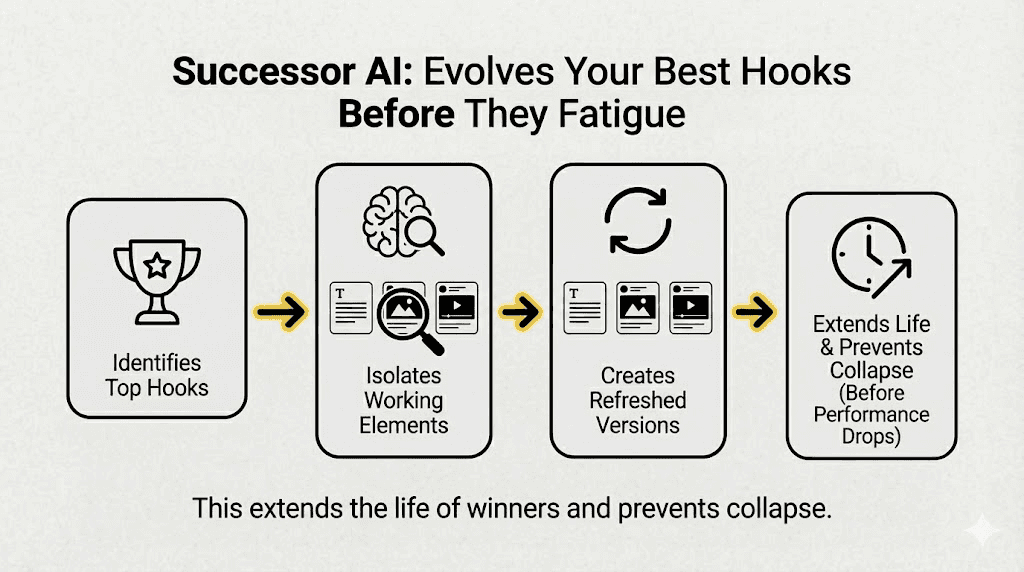
Successor AI identifies top hooks, isolates the working elements, and creates refreshed versions before performance drops. This extends the life of winners and prevents collapse.
5. URL to Ads and Product Fetch: Hook Creation at High Speed
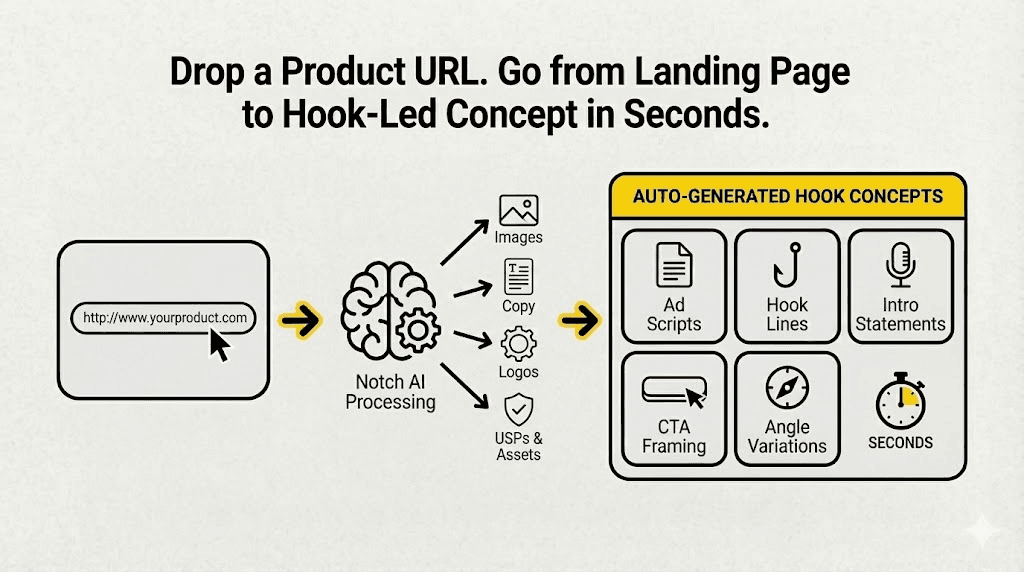
Drop a product URL. Notch fetches images, copy, logos, USPs, and creative assets, then auto generates:
ad scripts
hook lines
intro statements
CTA framing
angle variations
Go from landing page to hook led concept in seconds.
6. Inspiration Hub: Browse and Adapt Top Formats
Inspiration Hub contains 1,000+ top performing ads. Filter by vertical, format, platform or style, click an ad and Notch generates a brand aligned version for you.
7. Remix and Variation Tools: Scale Hooks Without Losing Consistency
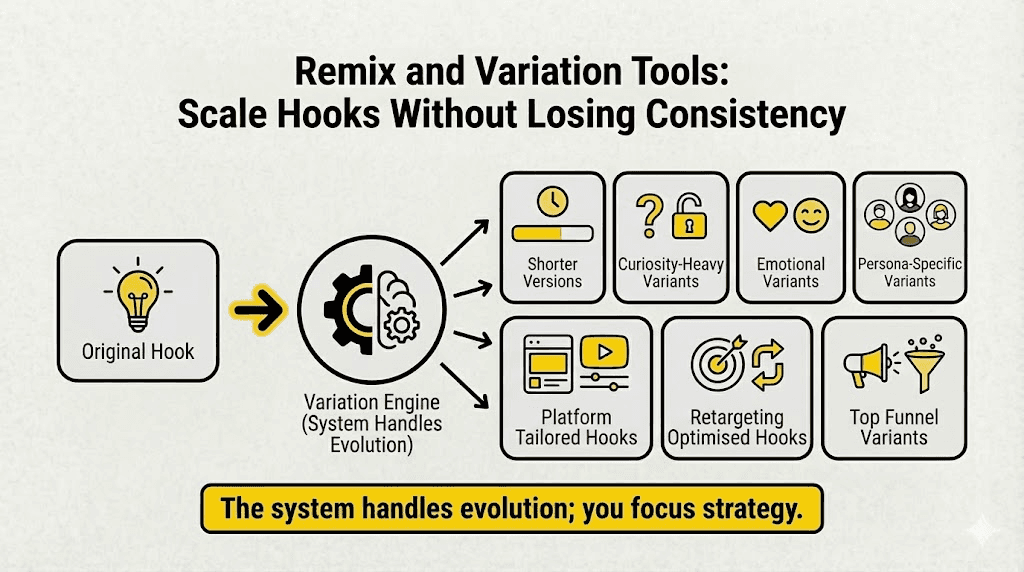
Generate:
shorter versions
curiosity heavy variants
emotional variants
persona specific variants
platform tailored hooks
retargeting optimised hooks
top funnel variants
The system handles evolution; you focus strategy.
8. StyleGuard: Ensures Every Hook Stays Within Brand Rules
StyleGuard enforces:
tone consistency
language rules
compliance guidelines
legal requirements
brand vocabulary boundaries
Every hook passes guardrails so evolution never damages brand safety.
The 2026 Creative Shift: How Marketers Must Evolve Their Hook Strategy
Ad performance in 2026 is determined by how well a brand operationalises hook intelligence. Treating hooks as isolated lines will lose. Treating hooks as performance infrastructure will win.
1. Hooks Are Your Creative Architecture, Not an Add-on
Previously hooks were the opening line or a flourish. Now they are:
the foundation of the entire ad
the driver of watch time
the largest lever for CTR
an early predictor of ROAS
the first sign of fatigue
the fastest variable to optimise
2. Creative Strategy Has Shifted From Ideas to Systems
Now it is about:
building a hook engine
evolving winners automatically
using data to find new angles
refreshing hooks before results drop
cloning competitive formats intelligently
analysing hook structure like targeting
Your advantage is your system for generating and evolving hooks.
3. The Hook Loop: A High Performance Workflow
Step 1: Extract what works (patterns that drive CTR and watch time)
Step 2: Generate variants (emotion, curiosity, persona, specificity)
Step 3: Evolve before fatigue (proactive refresh)
Step 4: Scale the winners (multi format rollout)
Step 5: Reset when patterns flatten (use data or AI to create new angles)
4. AI Is the Only Scalable Way to Refresh Hooks Fast Enough
Humans cannot manually:
detect fatigue early
test dozens of hook variants weekly
align every hook with brand rules
analyse competitor insights in real time
AI handles pattern discovery, evolution, adaptation, and scale. Humans set strategy.
5. Hook Intelligence Is a Competitive Advantage
Winning brands have:
documented hook patterns
libraries of angles and templates
consistent refresh cycles
tech for rapid experimentation
alignment between paid, creative, and data teams
Losing brands rely on intuition and sporadic testing.
6. The Future of Performance Creative Is Predictable Creativity
What you need:
ACES style frameworks
predictable hook testing systems
predictable refresh engines
predictable angle generation tools
predictable multi format rollouts
This frees creative energy to use insights that matter.
Conclusion: The Future of Performance Creative Is Hook Intelligence
Hooks are not creative accessories. They are the psychological triggers that determine whether your ad enters a viewer’s mind or gets ignored in the first two seconds.
The ACES framework shows high performing hooks combine:
Attention
Curiosity
Emotion
Specificity
When these four signals align, your ad becomes a cognitive event the viewer cannot skip. 2026 rewards teams who document, test, evolve, and scale hook structures.
You now have
the science behind modern hooks
the ACES model
a diagnostic to fix failing hooks
73 templates to use instantly
a system level view of why hooks win or fail
insight into how AI helps evolve hooks at scale
Final call to action
If you want to generate, test, and evolve hooks with speed and brand consistency, consider tooling that supports Creative Brain, automated angle discovery, and proactive hook evolution.