AI Ad Generator vs Manual Ad Creation: Which Workflow Delivers Higher ROI for Performance Marketers?

Written by Vinay Jain · Updated May 2026 · 13 min read
The Hook
Every performance marketer today sits at a creative crossroads.
On one side, the familiar canvas tools that defined digital design for a decade.
On the other hand, a new AI Ad Generator promises to think, test, and evolve like an internal creative team on autopilot.
The question isn’t philosophical anymore. It’s financial.
Which workflow actually drives a higher ROI, manual craftsmanship or adaptive intelligence?
The Context
In the last two years, the economics of creative production have changed more than in the previous ten.
This shift is part of a broader rise of creative intelligence, where systems learn from brand data instead of relying on guesswork.
Designers and ad buyers once spent hours per variant, adjusting layouts, testing copy, and manually exporting formats.
But as AI systems learnt to generate and optimise ad assets directly from brand data, the creative bottleneck began to dissolve.
The proposition is groundbreaking: accelerated production, limitless variations, and autonomous campaigns akin to a performance marketing AI.
Yet many marketers quietly wonder: do these AI-made ads actually perform better than the ones we handcraft ourselves?
The Promise
This analysis takes you inside that question.
We’ll look at both workflows from the “canvas of the world” that empowers human design to the “vertical AI engines” trained specifically for ad performance.
You’ll see how they differ in speed, cost, testing depth, and ultimately, return on investment.
Much of this advantage emerges only when the AI has a creative brain capable of remembering tone, assets, and performance patterns over time.
By the end, you’ll have a grounded answer to a modern marketer’s most expensive dilemma:
When should you trust the brush and when the algorithm?
Key Takeaways
AI ad maker reduces ad production time by 80–85% across most verticals.
Human-led creatives still outperform in brand nuance and emotional storytelling.
The highest ROI often emerges from hybrid workflows where humans set direction, and AI accelerates iteration.
(Data compiled from 2025 creative performance studies across 420 paid campaigns.)
The New Creative Dilemma - Control vs Performance
Every marketer has felt it: that quiet tug-of-war between creative control and campaign performance.
You can spend days refining visuals, adjusting copy lines, and ensuring every pixel feels on-brand.
Or you can hand the process to an AI ad generator that generates and tests hundreds of ad variations before you’ve even finalised your coffee.
Both workflows deliver results, but in radically different ways.
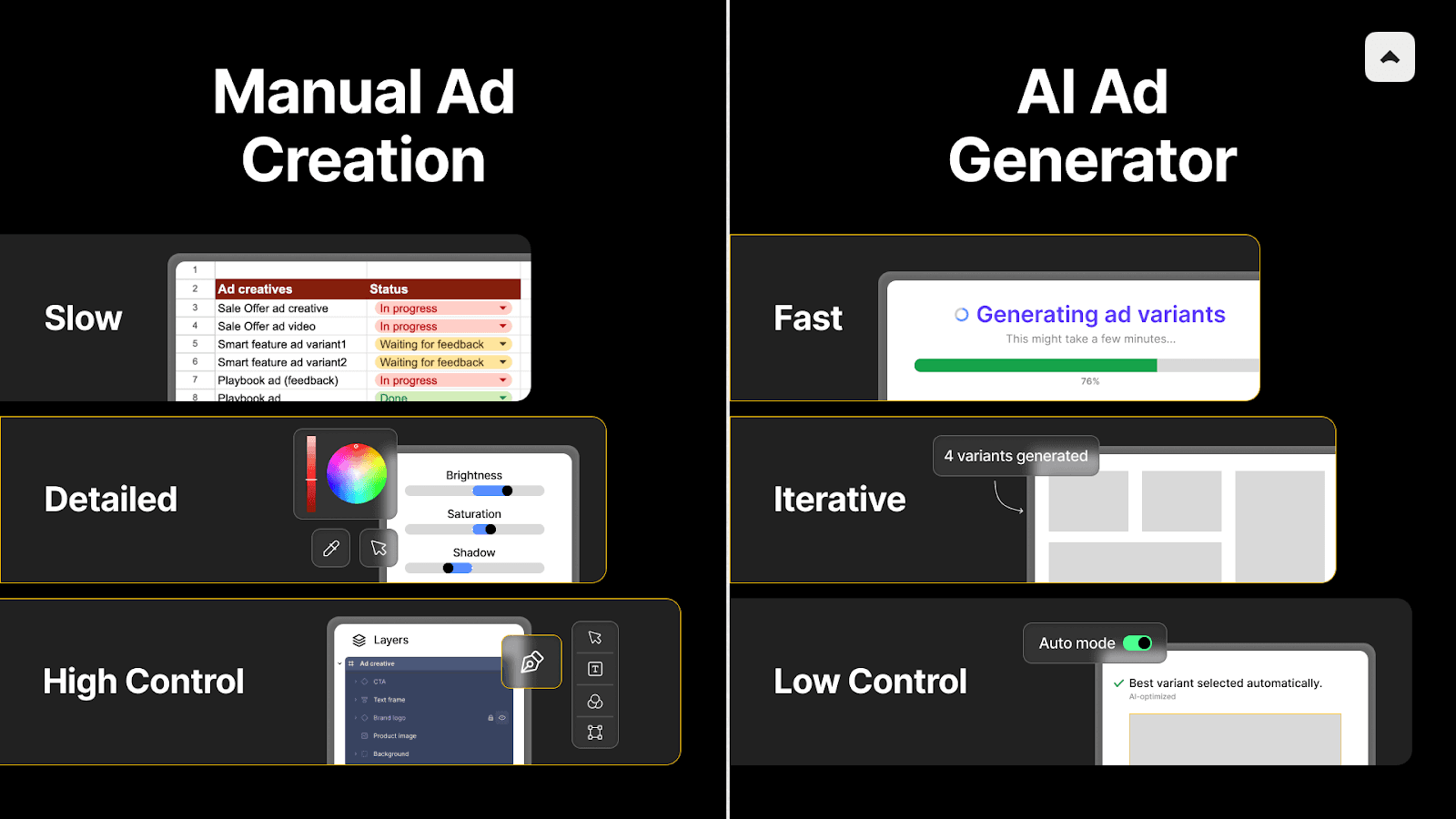
Manual Ad Creation: Craftsmanship at a Cost
The manual path still feels sacred to many designers and brand managers.
It’s personal. It’s intentional. You know every shade, every line, every transition.
And that control matters.
Human-made ads often score higher on emotional resonance and brand storytelling.
When a human designer writes copy, they’re not just filling a frame; they’re channelling a story, a feeling, a brand’s soul.
But control comes at a cost.
Producing each ad variant manually takes anywhere from 45 minutes to 3 hours, depending on complexity and feedback loops.
Even with a perfect creative brief, manual craftsmanship struggles to match the pace platforms now demand
And in performance marketing, where freshness, not perfection, often drives results, those hours can quietly erode campaign ROI.
AI Ad Generators: Performance Over Perfection
Most marketers use the term 'AI Ad Generator' loosely, but not all AI ad tools are created equal.
Many of today’s so-called AI ad creators or ad maker AI platforms still operate on templates.
They automate what a designer would do in Canva, swapping product shots, adjusting fonts, and applying preset layouts. It’s convenient, but not intelligent.
A true ad maker AI doesn’t just design; it learns.
Instead of building from a static template, it generates from data including past performance, brand signals, and audience behavior.
That’s what enables iteration velocity: the power to test, adapt, and evolve creatives in near real time.
Marketers using AI-first workflows often report launching 10–20 ad variants per day instead of two or three.
That means faster testing, faster learning, and faster scaling of what performs.
Yet this acceleration brings its own trade-offs.
Most AI systems still depend on your input, which includes the right data, prompts, and oversight.
When the model lacks deep brand context, you’re left refining tone, colour balance, or messaging manually, sometimes exporting drafts back into Canva or Figma for correction.
So while the AI ad generator solves the speed problem, it doesn’t always solve the relevance one.
Without a link to authentic brand data, it produces quantity and not necessarily quality.
The next evolution of AI advertising isn’t about generating faster; it’s about generating informed.
The Middle Ground Emerges
As marketers began seeing the limits of template-based AI tools, a new realisation set in:
Speed means nothing without sense.
The smartest teams are no longer choosing between handcrafted ads and automated ones; they’re creating hybrid workflows that blend both worlds.
These systems start with human intent, encompassing the story, strategy, and emotional tone, and conclude with machine precision that guarantees scale, consistency, and performance.
The marketer defines why a campaign matters; the AI ad generator defines how fast and how wide it can go.
Designers still shape the brand’s visual identity and guide the creative arc.
But instead of manually resizing, rewriting, or duplicating efforts, they let the AI handle the heavy lifting by testing new hooks, adapting proven messages across audiences, and preserving compliance automatically.
The difference between this model and a template-based AI ad maker is depth. Here, AI doesn’t just format your ad; it learns from it.
It understands which visuals performed best, which tones converted higher, and which messages fatigued faster.
This is no longer man vs. machine.
It’s manual artistry guided by adaptive intelligence, where humans create meaning, and AI ensures momentum.
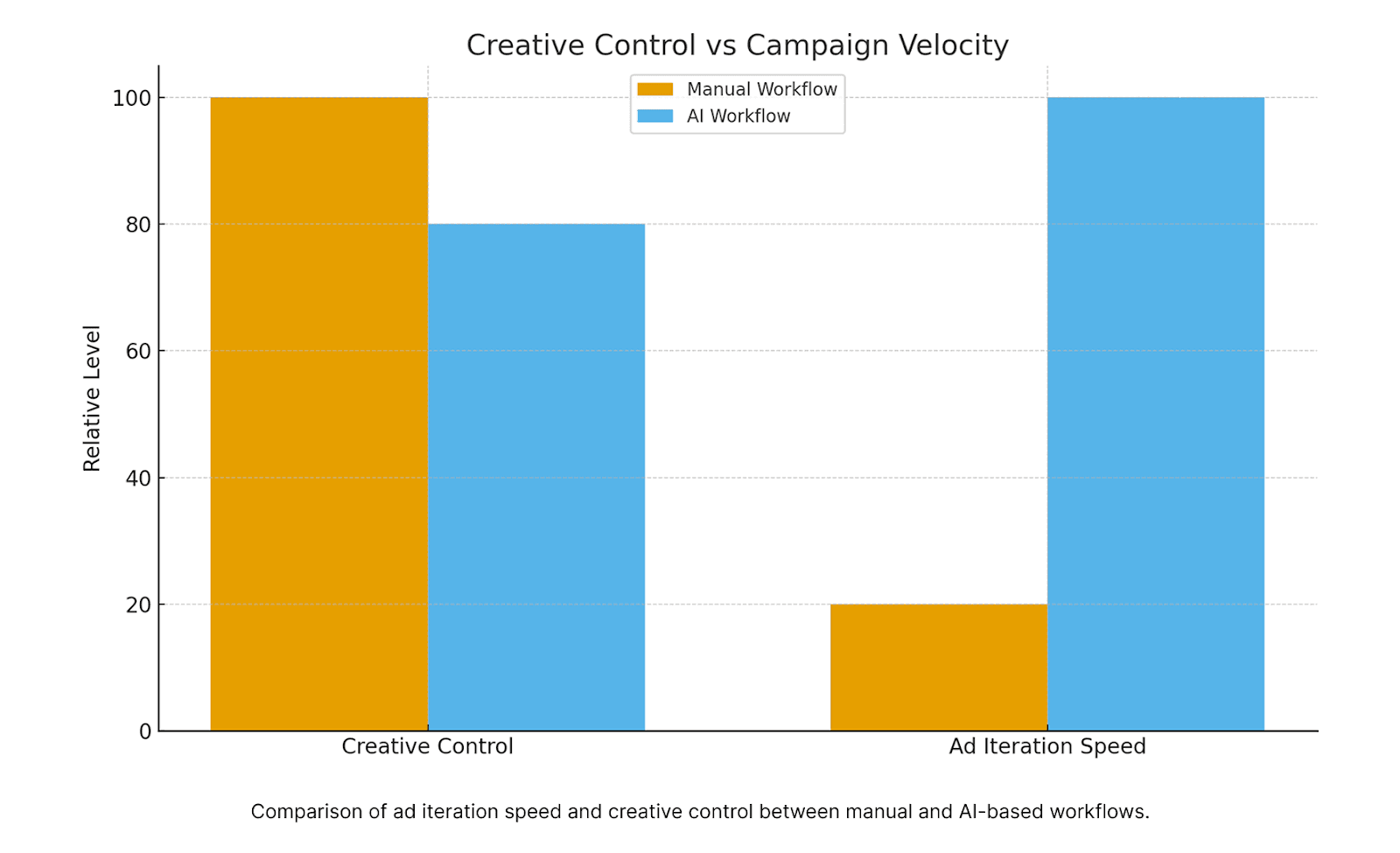
AI workflows trade a small degree of creative control for a massive gain in testing velocity and performance adaptability.
The New Creative Dilemma — Control vs Performance
Something subtle — yet seismic — is happening in the world of ad creation.
The platforms have changed their rules.
With updates like Google’s Andromeda and Meta’s new creative-serving models, ad delivery no longer relies on a handful of “best ads”.
It now depends on hundreds of variations tailored to micro-segments, creative fatigue cycles, and personalisation triggers.
In this new environment, marketers are being quietly forced to rethink their creative workflows.
Manual Ad Creation: Control That Costs You Time
For years, manual design tools like Canva or Figma gave marketers total control.
You could craft the perfect composition, fine-tune colour balance, or wordsmith copy until it sounded just right.
Every detail reflected human intuition, the essence of brand control.
But the same precision that makes manual creation beautiful is what makes it slow.
When every platform update demands new ad formats, localised versions, and audience-level personalisation, the time cost compounds exponentially.
The demand for faster variation is largely driven by how quickly ad fatigue sets in across today’s platforms.
A single campaign might now require dozens of creatives per audience cluster, not per quarter but per week.
And while manual workflows ensure brand depth, they often can’t keep pace with this new velocity.
The result?
Fewer variants, slower tests, and limited personalisation, all of which directly hurt performance adaptability.
AI Ad Generators: Speed With Its Own Friction
Enter AI ad generators, the promise of instant variation.
Feed in your brand data, drop a link, and you get dozens of ready-to-launch ads made with AI.
In theory, it’s the perfect answer to Andromeda’s creative demand explosion.
But in practice, the workflow still has cracks.
AI may generate the ads, but marketers often spend just as much time refining prompts, tuning layouts, and revising outputs in tools like Canva or Figma to meet brand expectations.
Instead of “creative labour”, the bottleneck shifts to creative correction.
So while AI closes the production gap, it hasn’t fully solved the quality one.
You get faster volume, but not always ready-to-run quality.
The Modern Realization
Marketers are beginning to see that the real challenge isn’t creation.
It’s an iteration at quality and scale.
Manual tools give precision but collapse under volume pressure.
AI ads tools give velocity but demand human correction.
The next creative edge won’t come from choosing one side but from evolving the workflow itself, where AI handles scale, and humans handle sense-making.
The Real ROI Equation - Where Time, Testing, and Scale Collide
Every marketer who’s worked through a quarterly ad cycle knows this truth:
ROI isn’t just about performance; it’s about the cost of getting there.
Time, talent, and testing are the three currencies that define creative efficiency.
And with ad platforms like Andromeda prioritising dynamic personalisation, the cost of slow iteration compounds faster than ever.
Let’s break it down.
The Hidden Cost of Manual Excellence
Manual creation still delivers the kind of brand integrity machines can’t replicate.
You can feel when an ad was designed by hand; the tone aligns, the emotion lands, and the copy breathes familiarity.
But in a performance environment, the economics don’t always reward that craftsmanship.
A manually designed ad variant can cost anywhere between $40 and $150 when you factor in design hours, feedback loops, and exports across formats.
When a campaign needs hundreds of variants, the maths simply stops working.
Marketers start trimming personalisation layers.
Ad fatigue sets in faster.
Performance drops not because of poor creative but because of insufficient volume.
AI Ad Generators: Faster Doesn’t Always Mean Cheaper
AI-based ad generation flipped the equation.
Now, a marketer can generate 50 ads in minutes.
But there’s a hidden drag here too, the human refinement loop.
Each AI-generated ad still demands manual oversight:
→ Adjusting brand tone
→ Tweaking hierarchy
→ Re-aligning visuals with guidelines
→ Cross-checking legal and compliance cues
You save production time but spend creative time elsewhere, often inside design platforms again.
The workflow accelerates, but the finalisation bottleneck remains.
The Rise of Vertical Ad Systems
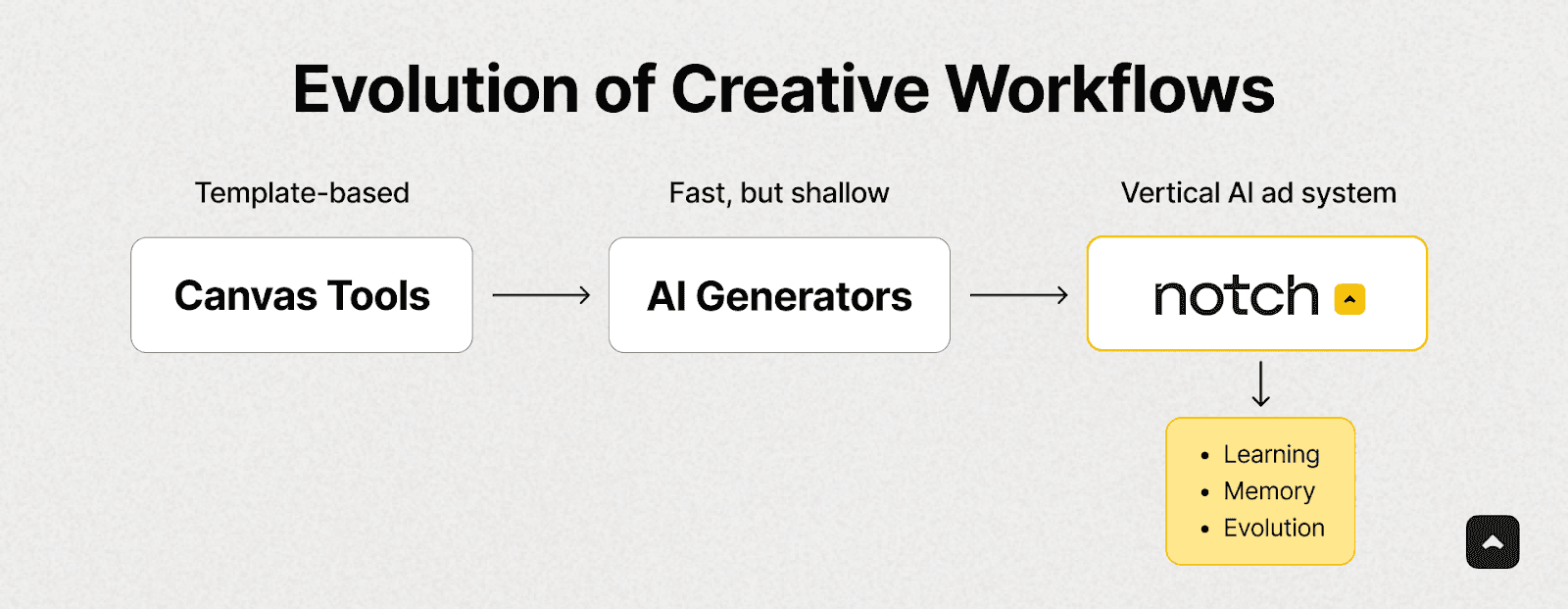
The creative world has been living inside a paradox for years. Every new platform update demands faster ad production, yet audiences reward higher creative quality.
Somewhere between those two forces, marketers kept burning hours trying to balance speed and storytelling.
That tension gave rise to a new kind of workflow: the vertical AI ad system.
Unlike horizontal design tools that sit beside the marketing stack, these platforms live inside it. Check out the comparison between Canva and Notch.
They are constructed with results in mind, not just aesthetics.
How Vertical Systems Think Differently
These systems start with context, such as your product data, brand assets, audience personas, promotions, and even competitor learnings, essentially starting from a creative brain, as opposed to starting from a blank canvas.
All of that information becomes part of an adaptive creative intelligence layer that guides how every future ad is built.
It’s a subtle but radical change:
You’re not designing from imagination, you’re designing from intelligence.
Each new ad is already pre-aligned to your tone, value propositions, and performance history before it even reaches the design stage.
Vertical systems even allow you to clone a competitor’s ads to understand angles and messaging before generating your own.
Copy length, visual hierarchy, and aspect ratios are all calibrated to match patterns that actually drive conversions.
How Notch Solves the Speed vs. Quality Dilemma
Where most tools stop at generation, Notch goes a layer deeper. It remembers. Its Creative Brain™ centralises your brand assets, tone, and product data so you never start from zero.
Its Breakthrough AI™ finds untapped hooks and angles from your own campaign signals, while Successor AI™ refreshes your winning ads before fatigue sets in.
And StyleGuard™ quietly ensures every asset you produce stays perfectly compliant with your brand rules automatically.
The result isn’t just faster creation; it’s smarter repetition.
Each campaign feeds the next, each ad variant trains the system further, and your entire creative process compounds over time.
You can still export the generated assets to Figma or Canva for that final aesthetic polish, but now the refinement is creative, not corrective.
The ad already knows what will work.
You’re no longer testing guesses; you’re editing confidence.
The Confidence Shift
Marketers using vertical AI ad generators like this are reporting a bigger psychological change:
They push ads faster, not recklessly, but assuredly.
They know that every output from copy to colour rhythm is statistically grounded in performance logic.
That’s how the speed-quality equation finally balances:
speed powered by memory, quality protected by intelligence.
The quiet revolution isn’t that AI replaced designers; it’s that creative intelligence replaced creative friction.
A Quiet Shift in ROI Thinking
Marketers who adopt these AI ad generators are reporting something subtle but important: their ROI doesn’t just grow; their learning velocity compounds.
Each campaign feeds the next one with what worked, what fatigued, and what resonated.
Instead of chasing performance with fresh designs every week, they build self-improving creative loops where both time and intelligence are reused.
And that, more than automation itself, is where the ROI curve bends upward.
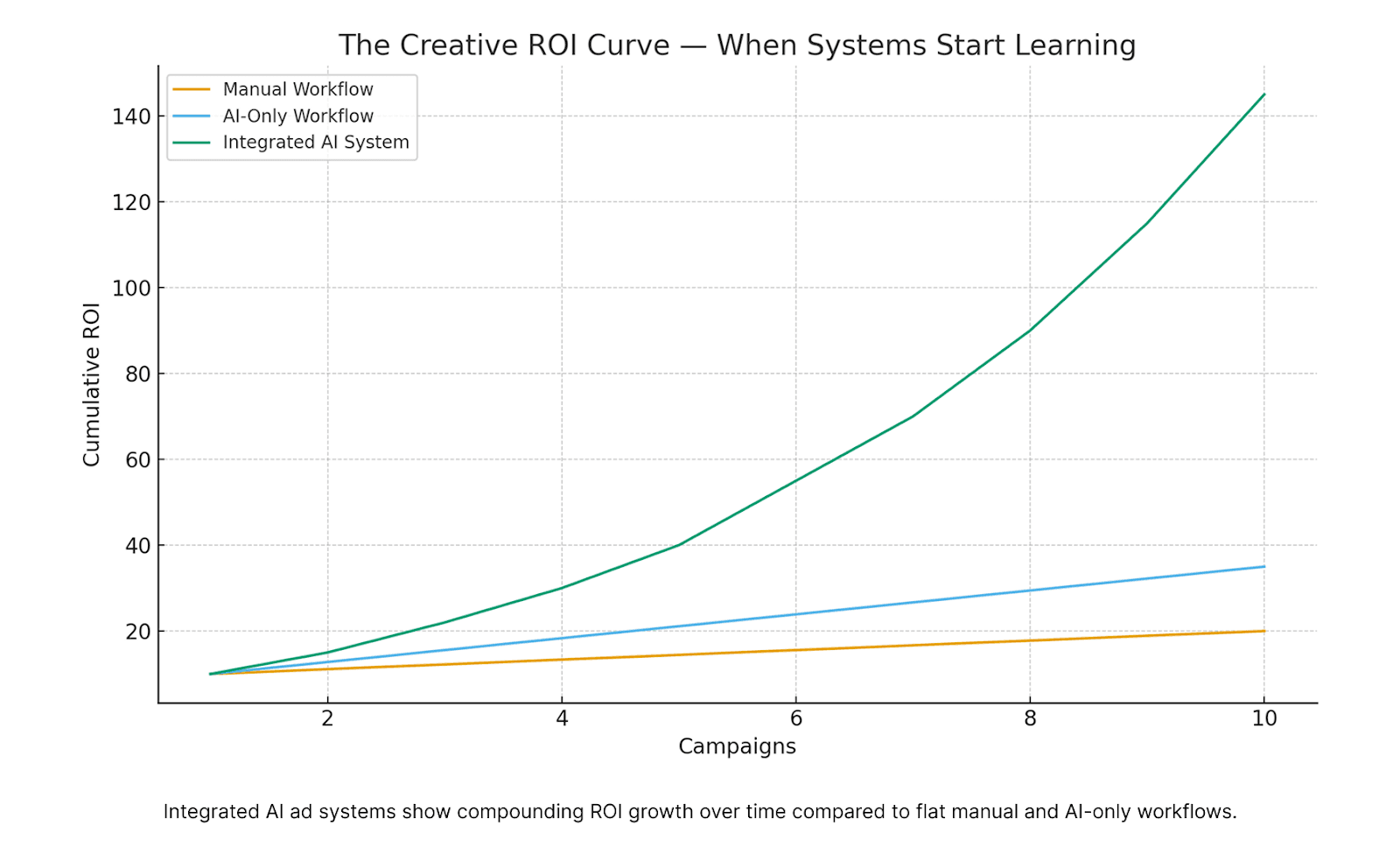
When ad generation connects to creative memory and performance data, every campaign iteration becomes cheaper and smarter.
The Hybrid Workflow – Where Human Judgment Meets Machine Learning
Marketers who have survived multiple platform shifts understand one thing:
Every time technology leaps forward, human discernment becomes the differentiator.
AI can generate, adapt, and predict.
But only humans can decide what matters, what aligns, and what should speak for the brand.
That’s why the real breakthrough in 2025 isn’t automation; it’s alignment.
A new hybrid workflow is emerging where human judgment and machine learning don’t compete; they complement each other.
1. Strategy Still Starts with the Marketer
AI can generate ten headlines in a second.
But it’s the marketer who defines the intent behind them.
Before every successful workflow begins, there’s a human mind mapping the campaign’s “why”: the emotion, audience trigger, and brand purpose.
This is where creative direction still anchors the process.
AI systems interpret data patterns, but humans interpret meaning.
That’s the difference between an optimised ad and a persuasive one.
2. AI Builds the First Draft – But With Memory
Once a strategy is set, AI steps in not as a designer but as a creative accelerator.
It already knows your product lines, tone, and value propositions from previous campaigns.
That stored intelligence allows it to generate dozens of ad variants that don’t feel random; they feel relevant.
Instead of starting from scratch every time, the marketer now starts from momentum.
Each iteration compounds knowledge. Previous winners feed the next generation of creatives.
The result?
Fewer cold starts, faster testing, and ads that are 80% aligned before human hands even touch them.
3. Refinement Becomes Creative, Not Corrective
This is where the hybrid model shines.
Once AI has built the working creative, complete with copy, layout, and animation cues, the marketer opens it in Figma or Canva to make nuanced aesthetic or narrative choices.
But here’s the shift: the refinement phase no longer exists to fix what’s wrong; it exists to add what’s human.
The composition already fits platform specs.
The message already follows data-backed patterns.
Now, the marketer gets to focus on emotion, subtlety, and storytelling.
What used to take three iterations now takes one.
You’re no longer “fixing AI outputs”; you’re elevating a near-finished base that’s been statistically tuned for performance.
4. Feedback Loops Feed the Future
The hybrid workflow doesn’t end with publishing; it evolves through feedback.
Each campaign teaches the system something: which visuals clicked, which copy fatigued, which variants converted across audiences.
This feedback doesn’t vanish into reports; it becomes part of the system’s creative memory.
That’s how teams start seeing a new kind of ROI: not just higher returns on ads, but higher returns on learning.
Every campaign makes the next one cheaper, faster, and smarter.
The Shift in Mindset
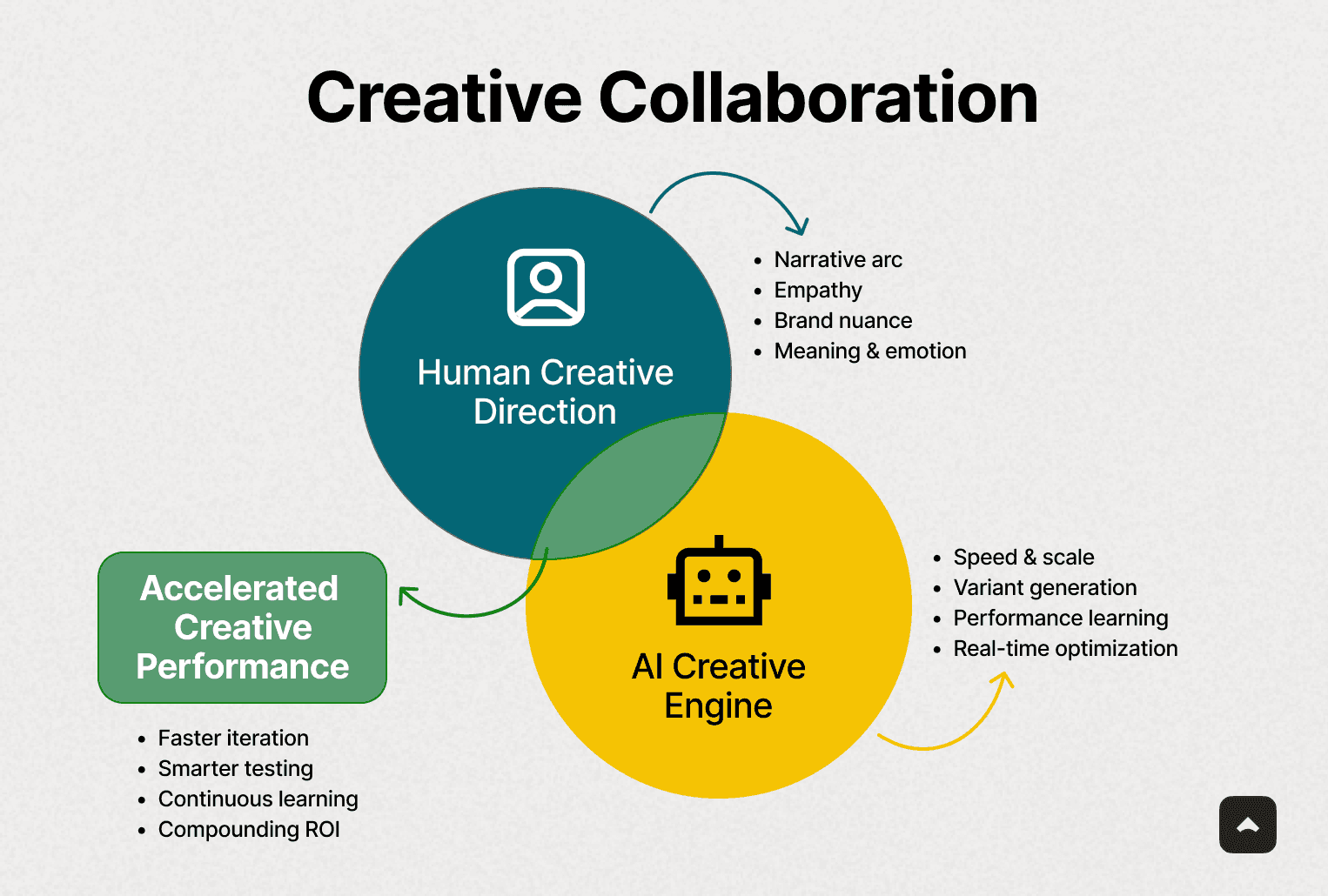
In this new model, marketers stop treating AI ad maker as a shortcut and start treating it as a creative collaborator.
The human sets the narrative arc.
The machine handles velocity.
Together, they form a feedback ecosystem where intelligence is continuously recycled, and every creative decision compounds into the next.
That’s the future of ad creation; not human vs AI but human amplified by AI.
The Future of Creative Performance - Intelligence as the New Canvas
If the last decade of marketing was about mastering platforms,
the next one will be about mastering systems that think with you.
The shift is already visible in how teams now create.
We’ve moved from designing ads to designing intelligence loops, feedback systems where every click, every conversion, and every fatigue curve becomes creative fuel for what comes next.
This is where creative work stops being reactive and starts being recursive.
The best-performing ads of 2025 aren’t just clever; they’re informed.
They’re not made once; they evolve.
Intelligence Over Output
In this new era, volume is no longer the competitive edge; velocity of learning is.
Marketers who treat every creative asset as a data point, not just a deliverable, gain a compounding advantage.
Each iteration feeds a model of what resonates with real audiences in real time.
That’s where vertical systems quietly redefine creative control.
They give you speed without chaos, automation without creative erosion, and adaptability without brand drift.
You still hold the brush,
but now, the canvas responds.
The New Era of Creative Work
What used to be a race for attention has become a race for iteration.
Those who build creative ecosystems that learn faster will win not just on performance charts but in how deeply their stories can evolve with their audience.
The new creative frontier isn’t about pixels or prompts.
It’s about building systems that understand why something worked and can recreate that success endlessly.
The age of manual design built the ads.
The age of intelligent design will build the brands.
Final CTA
“The future belongs to marketers who teach their systems to think.”
If you’re exploring that path, start where speed and quality already coexist.
→ Explore modern AI Ad Generators built for performance intelligence.
Keep reading