Cinematic AI Ads Explained: How Marketers Use Them for Better ROI

Written by Vinay Jain · Updated May 2026 · 10 min read
Key Takeaways
Cinematic AI ads outperform traditional social ads in attention, emotional recall, and ROAS.
Marketers use cinematic AI tools to automate avatars, scripts, lighting, and variations — reducing production time from weeks to minutes.
Cinematic formats work across TOF, MOF, and BOF, improving retention, perceived value, and conversion.
AI engines like Notch generate cinematic ads directly from URLs, pulling brand assets and ensuring on-brand consistency.
Successor-style iteration models help maintain ROI by evolving winners before they fatigue.
1. Cinematic Ads vs Traditional Social Ads: What the Data Shows
Cinematic AI ads aren’t just visually superior — they behave differently in data. Performance marketers care about numbers, and cinematic formats deliver measurable gains across attention curves, recall, CPM efficiency, and engagement.
Attention Curves
Cinematic AI ads generate stronger three-second retention because:
AI-crafted lighting and movement create instant pattern interruption
The “film-like” style keeps users watching longer
Algorithms reward ads with high retention by pushing them deeper into delivery
Result: 35–60 percent higher hook retention compared to UGC or static.
Emotional Recall
Cinematic AI ads tap into storytelling and emotional cues:
Higher memory encoding
Stronger mid-funnel lift
Better sequential messaging performance
This makes cinematic formats ideal when you need lasting impact, not just a quick scroll-stop.
CPM Efficiency
Because cinematic AI ads retain attention longer, platforms classify them as high-quality creative:
CPMs often drop 8–18 percent
Delivery stabilizes sooner
Learning phases shorten
More efficiency → more impressions for the same spend.
Engagement & Thumb-Stop Rates
Cinematic visuals break scrolling patterns:
Users stop because the ad “looks like a movie.”
Engagement rises 20–35 percent
Downstream CTR benefits from stronger early attention
This is where cinematic AI ads create performance marketers’ favorite compounding effect:
Better thumb-stop → better CTR → better CPM → better ROAS.
2.Where Cinematic AI Ads Fit in a Paid Funnel
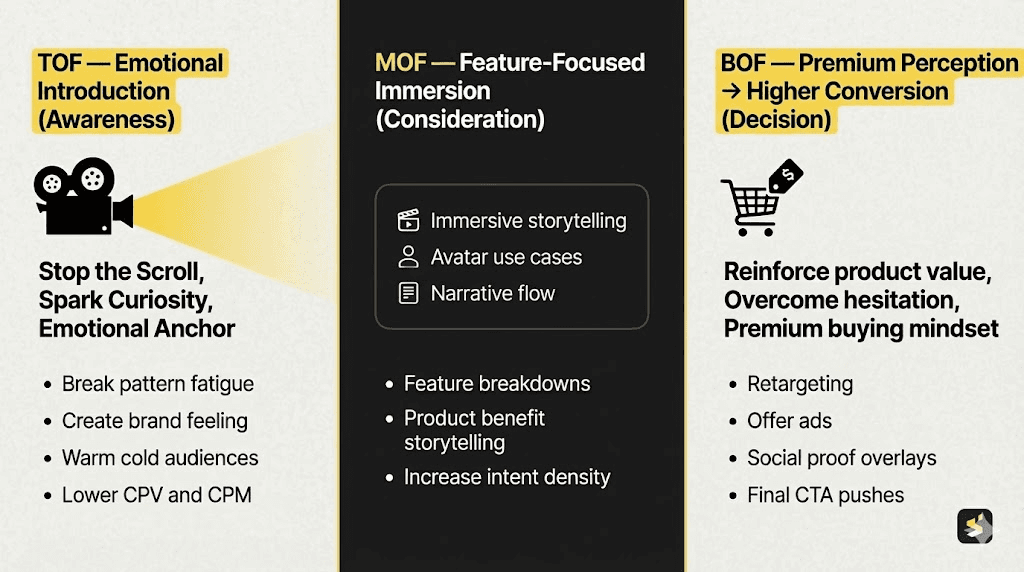
Cinematic AI ads aren’t just eye-catching assets — they are funnel accelerators.
Performance marketers use them strategically across TOF, MOF, and BOF because each stage benefits from cinematic depth, emotional weight, and higher perceived value.
Below is the funnel-optimized breakdown.
TOF — Emotional Introduction (Awareness)
Goal: Stop the scroll, spark curiosity, and create an emotional anchor.
Cinematic AI ads excel here because:
Their film-like visuals break pattern fatigue
They create brand feeling before brand information
They warm cold audiences faster, lowering CPV and CPM
Best used for:
Brand introductions
Product launches
Seasonal campaigns
Category education (“This changes how you…”)
Why it works:
Humans respond to emotion before logic. Cinematic intros build that emotional priming immediately.
MOF — Feature-Focused Immersion (Consideration)
Now your viewer knows who you are — cinematic AI ads help them understand why you matter.
Mid-funnel cinematic ads help marketers:
Showcase product features with immersive visual storytelling
Use avatars to demonstrate use cases
Add narrative flow that increases watch-through rates
Best used for:
Feature breakdowns
Product benefit storytelling
“Why this product exists” explanations
Cinematic AI scenes + controlled camera movement help your product feel real and aspirational, increasing intent density.
BOF — Premium Perception → Higher Conversion (Decision)
At the bottom of the funnel, cinematic AI ads shift perception from “should I buy this?” to “this feels worth paying for.”
They help performance marketers:
Reinforce product value
Overcome hesitation with emotional payoff
Create a premium buying mindset
Support price justification (especially for higher AOV products)
Best used for:
Retargeting
Offer ads
Social proof overlays in cinematic format
Final CTA pushes
Consumers convert when the product feels premium, trustworthy, and emotionally aligned — cinematic AI ads create that effect instantly.
3. How Cinematic Ad Generators Actually Work
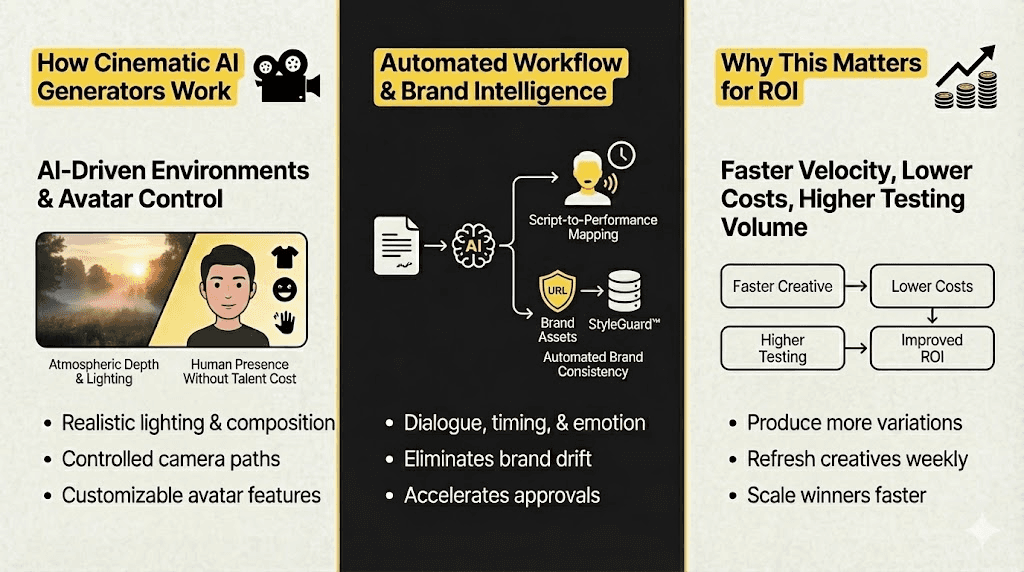
Cinematic AI ad generators replace what used to be an entire production crew — director, cinematographer, lighting artist, voice actor, editor — with a single automated workflow.
For performance marketers, this means faster creative velocity, lower costs, and higher testing volume, which directly improves ROI.
Below is the breakdown of how these engines work under the hood.
AI-Driven Environments
Cinematic AI tools simulate the elements that give film its emotional weight:
Realistic lighting
Atmospheric depth (fog, haze, sunset bloom)
Controlled camera paths
Scene composition and perspective
This creates ads that feel like premium film productions, instantly separating you from UGC-heavy feeds.
Avatar Control
Instead of hiring actors, AI generates them — and performance marketers can control everything:
Clothing and styling
Facial expressions
Gestures and emotional tone
Location, time of day, and environment
Notch takes this further by letting marketers modify clothing, hairstyle, setting, lighting, or environment directly through prompt instructions.
This gives cinematic ads human presence without the cost or logistics of real talent.
Script-to-Performance Mapping
The marketer writes a simple script.
The AI turns that into:
Avatar dialogue
Scene timing
Emotional pacing
Animations and movement
Matching camera angles
This is where cinematic ads get their storytelling arc. The AI chooses how the avatar delivers the line — tone, motion, context — which previously needed skilled direction and editing.
Automated Brand Consistency
The biggest fear for performance marketers:
“What if the ad looks nothing like our brand?”
Cinematic AI tools solve this with brand intelligence systems.
In Notch:
You paste your homepage or product URL
The system pulls all brand assets, copy, images, and USPs automatically
Creative Brain™ stores these for re-use across every future cinematic ad
StyleGuard™ ensures every output stays visually and tonally on-brand
This eliminates brand drift, accelerates approval cycles, and ensures cinematic ads scale without breaking guidelines.
Why This Matters for ROI
Because the generator automates actors, cameras, lighting, scripts, scenes, and branding, performance marketers can:
Produce more variations
Refresh creatives weekly
Test multiple hooks, angles, and arcs
Scale winners faster
Maintain consistency at volume
Your return comes not from one cinematic ad, but from the speed and intelligence behind generating many.
4. Framework: How to Build a High-Performing Cinematic Ad
Every cinematic AI ad that performs well follows a repeatable structure.
Performance marketers don’t rely on “creativity” — they rely on frameworks that scale, and cinema-style storytelling maps perfectly into CRO logic.
Use this five-part framework to build cinematic ads that drive ROI, not just views.
1. Opening Frame (Hook)
Your first 1–2 seconds decide everything.
A high-performing cinematic hook should include:
A dramatic close-up
Unique lighting (sunset, neon, silhouette)
A pattern interrupt (slow-motion, wide-angle, fast push-in)
A curiosity line (“What if your daily routine felt different?”)
Goal:
Stop the scroll, lock attention, and earn the algorithm’s early boost.
2. Narrative Arc
This is where cinematic AI tools shine.
A simple, effective arc:
Problem moment
Emotional escalation
Solution reveal
Transformation or payoff
Why this works:
Narratives increase watch-through rates, which improve CPM and CTR downstream.
3. Product Hero Moment
Here’s where you show the product with maximum cinematic value.
Use:
Slow motion
Rack focus
Rotational camera movement
Environmental lighting that frames the product
Close-up avatar interaction (Notch supports avatar-led demonstrations)
Goal:
Make the product feel premium, desirable, and worth the click.
4. CTA Moment
Your final scene should feel like a natural conclusion to the story.
Effective cinematic CTA strategies:
Keep the tone aligned with the ad’s mood (soft, bold, energetic)
Use a single, clear directive (“Experience the upgrade”)
Overlays should be minimal and cinematic, not flashy or cluttered
Consider Avatar CTA delivery for emotional reinforcement
Goal:
Blend persuasion with production quality, not interrupt it.
5. Variation Strategy (The ROI Engine)
Performance marketers rarely win on the first version.
They win through structured variation volume.
Build:
3 different opening hooks
2 narrative arcs (problem-led vs benefit-led)
2 hero moments
2 CTA styles
This creates 5–10 testable variants from a single concept.
Using Notch’s Successor AI™, marketers can evolve these winning variants automatically, generating fresh versions before ad fatigue starts.
This framework + AI iteration = sustainable performance lift.
How Performance Marketers Should Use Cinematic AI Ads Day-to-Day
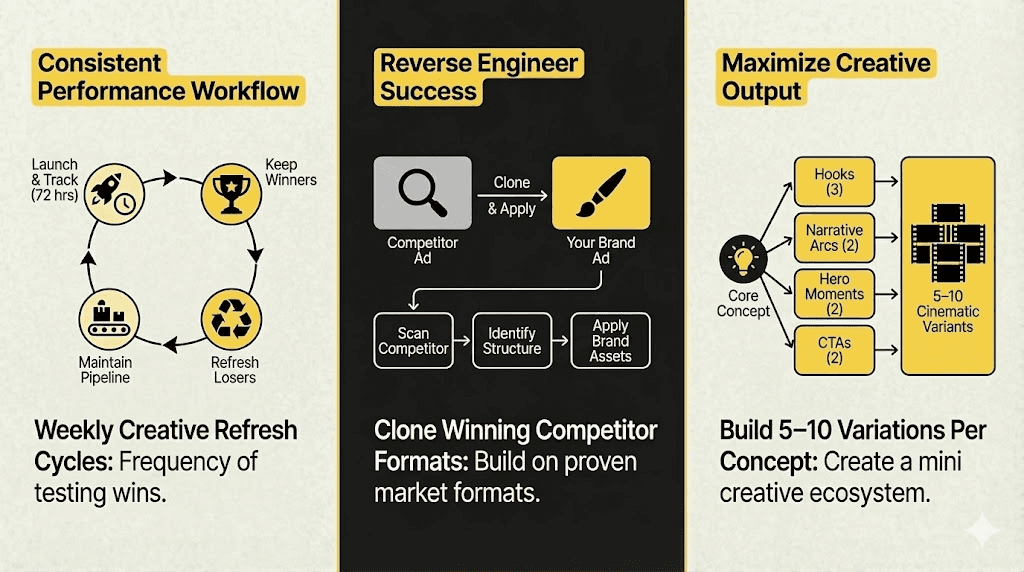
Cinematic AI ads are not a one-off creative stunt.
They become powerful when used inside a consistent performance workflow where testing, refreshing, and scaling happen automatically.
Use these four operating principles to integrate cinematic AI ads into daily performance routines.
1. Weekly Creative Refresh Cycles
Modern ad performance is won through frequency of testing, not just quality of ideas.
Your weekly workflow should look like:
Launch 5–10 cinematic variants each week
Track hook retention, CTR, and CPM within the first 72 hours
Keep winners active
Refresh losers with new hooks, arcs, or hero shots
Maintain a rolling pipeline of new cinematic concepts
Cinematic AI ads make this possible because production time shrinks from days to minutes.
2. Use Successor-Style Automated Iterations
Fatigue kills ROI.
Cinematic ads hit harder, but they also decay faster if not refreshed.
Tools like Notch automate this problem using Successor AI™, which:
Analyzes your best-performing cinematic ads
Identifies why they’re working (visuals, pacing, message)
Generates optimized variations before results decline
Keeps your creatives evolving based on real performance data
This eliminates the “creative dead zone” where ads plateau and costs rise.
3. Clone Winning Competitor Formats
Performance marketers don’t guess — they reverse engineer.
With cinematic AI, you can:
Scan top competitor ads
Identify winning structures (emotional tone, openings, transitions)
Clone the format
Apply your own brand assets, script, and voice
Notch automates this by fetching competitor ads and allowing you to generate your version instantly.
Why it works:
You’re building ads on formats the market already proves are converting.
4. Build 5–10 Variations Per Concept
A single ad concept should create a mini creative ecosystem.
Variation matrix:
Variable | Options | Expected Output |
Hooks | 3 | New pattern interrupts |
Narrative arcs | 2 | Emotional vs rational |
Hero moments | 2 | Product-led vs avatar-led |
CTAs | 2 | Soft vs direct |
Total = 5–10 cinematic variants from one core idea.
This increases your chances of finding a breakout winner — the kind that drops CPMs, increases CTR, and lifts ROAS across the entire ad set.
When to Use Cinematic Ads vs UGC vs Static
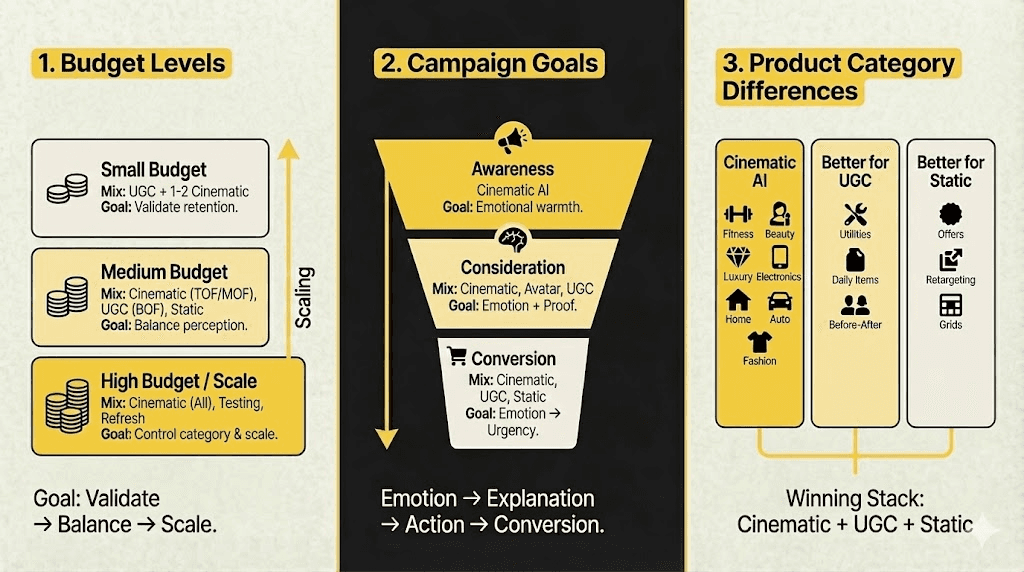
Not every campaign needs cinematic AI ads.
Performance marketers win by choosing the right creative format at the right moment in the funnel.
Below is the clearest, ROI-focused breakdown.
1. Budget Levels
Small Budget (₹/low spend accounts)
Best mix:
UGC for efficiency and social proof
1–2 cinematic AI variations for testing high-impact angles
Goal: Validate whether cinematic retention lifts your early CPM and CTR before scaling.
Medium Budget
Best mix:
Cinematic AI ads for TOF/MOF
UGC for BOF retargeting
Static ads for specific offers
Goal: Balance premium perception with authenticity.
High Budget / Scale Accounts
Best mix:
Cinematic ads across all funnel stages
High-volume variation testing
Successor-model refresh cycles
Competitor cloning for new angles
Goal: Control category perception and win attention at scale.
2. Campaign Goals
Awareness
Cinematic AI ads dominate here.
They generate:
Higher thumb-stop rates
Better retention curves
Lower CPMs
Use cinematic first touches to warm audiences emotionally.
Consideration
Use a mix of:
Cinematic AI demonstrations
Avatar-led product explanations
UGC testimonials for credibility
Goal: Blend emotional resonance with proof.
Conversion
Best mix:
Cinematic BOF ads for premium perception
UGC for authenticity + objection handling
Static for urgency messaging (discounts, expiry timers)
Goal: Stack emotion → clarity → urgency.
3. Product Category Differences
Ideal for Cinematic AI Ads
These categories benefit the most because perception and emotion drive purchase intent:
Fitness gear
Skincare & beauty
Luxury & lifestyle brands
Electronics & gadgets
Home decor
Automobiles / accessories
Fashion
Wellness / mental health
Cinematic depth elevates the product, increasing AOV and ROAS.
Better for UGC
Functional utilities
Low-ticket daily-use items
Products requiring social proof
“Before-after” driven categories
UGC works because authenticity > aesthetics for these.
Better for Static
Pure BOF offer ads
Retargeting reminders
Price-focused campaigns
Product grids for ecommerce
Static = clarity, speed, and cheap delivery.
The winning creative stack for most performance marketers:
Cinematic (TOF/MOF) + UGC (MOF/BOF) + Static (BOF)
This creates a full-funnel path where:
Emotion → Explanation → Action → Conversion
play in sequence.
Related Resources You May Find Useful
Cinematic & Creative Production
Cinematic Ads Generator (Feature Page)
Create cinematic ads directly from your product URL using avatars, scenes, and AI direction.
Creative Brain™ — How Your Brand Style Is Stored for Cinematic Ads
Perfect for readers curious about how Notch fetches assets, scripts, and USPs for high-quality cinematic outputs.
AI Ads Strategy & ROI
How to Optimize Animated Ads for Better ROAS
Supports the cinematic narrative by showing how animation + motion improve retention and cost efficiency.
How Early-Stage Brands Use AI Ads to Compete With Big Budgets
Great contextual link for marketers scaling production fast with cinematic formats.
How to Create High-Converting Facebook Ads With AI
For readers who want to plug cinematic creatives into Meta campaign structures.
FAQs About Cinematic AI Ads
1. What are cinematic AI ads?
Cinematic AI ads are film-style video creatives generated using AI engines that simulate lighting, camera motion, avatars, and scene composition. They deliver higher attention, emotional recall, and better ROAS than traditional social formats.
2. Why do cinematic AI ads perform better than UGC or static ads?
They create stronger pattern interruption and emotional impact. Cinematic visuals increase hook retention, improve thumb-stop rates, lower CPMs, and raise perceived product value — especially useful for TOF and MOF campaigns.
3. Are cinematic AI ads expensive to produce?
No. AI tools automate avatars, scripts, environments, and brand styling, removing the need for actors, shoots, and editing. Platforms like Notch generate cinematic ads in minutes by pulling your brand assets directly from a URL.
4. Can I generate cinematic ads directly from my website’s product pages?
Yes. With URL-to-Ad systems, you paste a product link and the AI extracts logos, USPs, images, brand styles, and copy automatically — then converts them into cinematic video ads.
5. How do I keep cinematic ads from fatiguing?
Use automated variation engines like Successor AI™, which analyze winning ads and generate refreshed versions before performance drops. This keeps costs stable and ROAS predictable.
6. Should I replace UGC with cinematic ads?
No. Cinematic ads work best alongside UGC.
Ideal stack:
Cinematic (TOF/MOF) + UGC (MOF/BOF) + Static (BOF).
This captures emotion, trust, and clarity across the full funnel.
Keep reading