How Agencies Scale AI Ads Across 20+ Clients Without Losing Quality or Control


Written by Vinay Jain · Updated May 2026 · 13 min read
TLDR
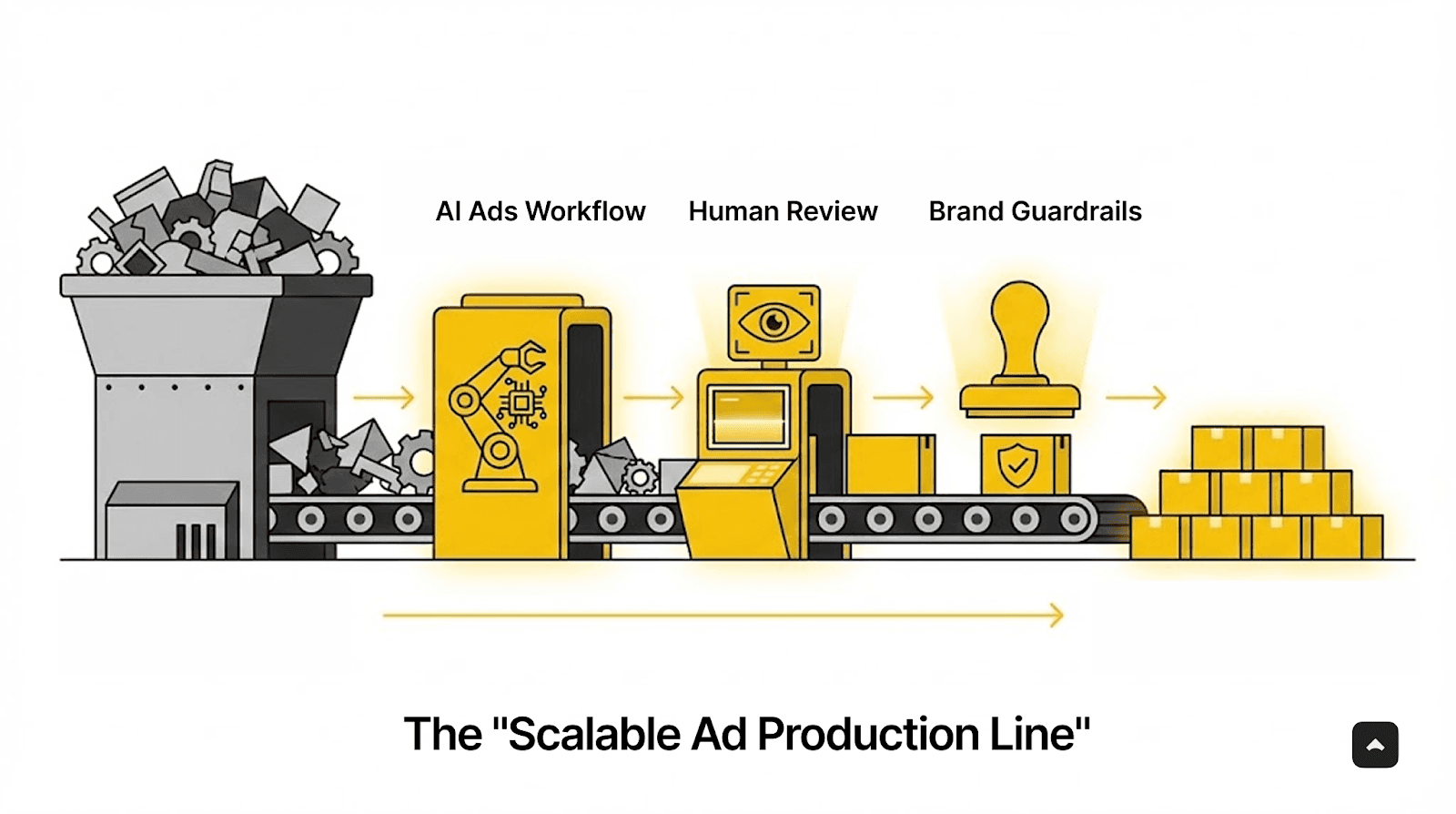
Agencies struggle to scale AI ads across 20+ clients not because AI tools are weak, but because ad production systems do not scale. AI works only when agencies redesign workflows around AI ad makers, human review, and brand guardrails. This guide breaks down how modern agencies use AI for ad creation, AI ad optimization, and coordination via AI ad manager–style workflows, while avoiding low-quality output and brand drift. It also clarifies where a free AI ad generator fits and where it becomes a liability.
Introduction: Why Scaling Ads Across 20+ Clients Is an Operations Problem
Most agencies do not lose clients because of poor strategy or bad media buying.
They lose clients because they cannot produce and iterate ads fast enough once they cross 15–20 active accounts.
At that scale:
Designers become bottlenecks
Creative feedback cycles explode
Brand consistency starts breaking
Teams spend more time coordinating than creating
AI entered the agency world with the promise of solving this. But most agencies adopted AI ad makers the wrong way.
They treated AI as a faster designer instead of a production system.
As a result:
Output increased
Quality dropped
Client confidence eroded
This article explains how agencies that successfully scale AI ads across 20+ clients actually operate. Not tools. Not prompts. Systems.
Why Scaling Ads for 20+ Clients Breaks Traditional Agency Models
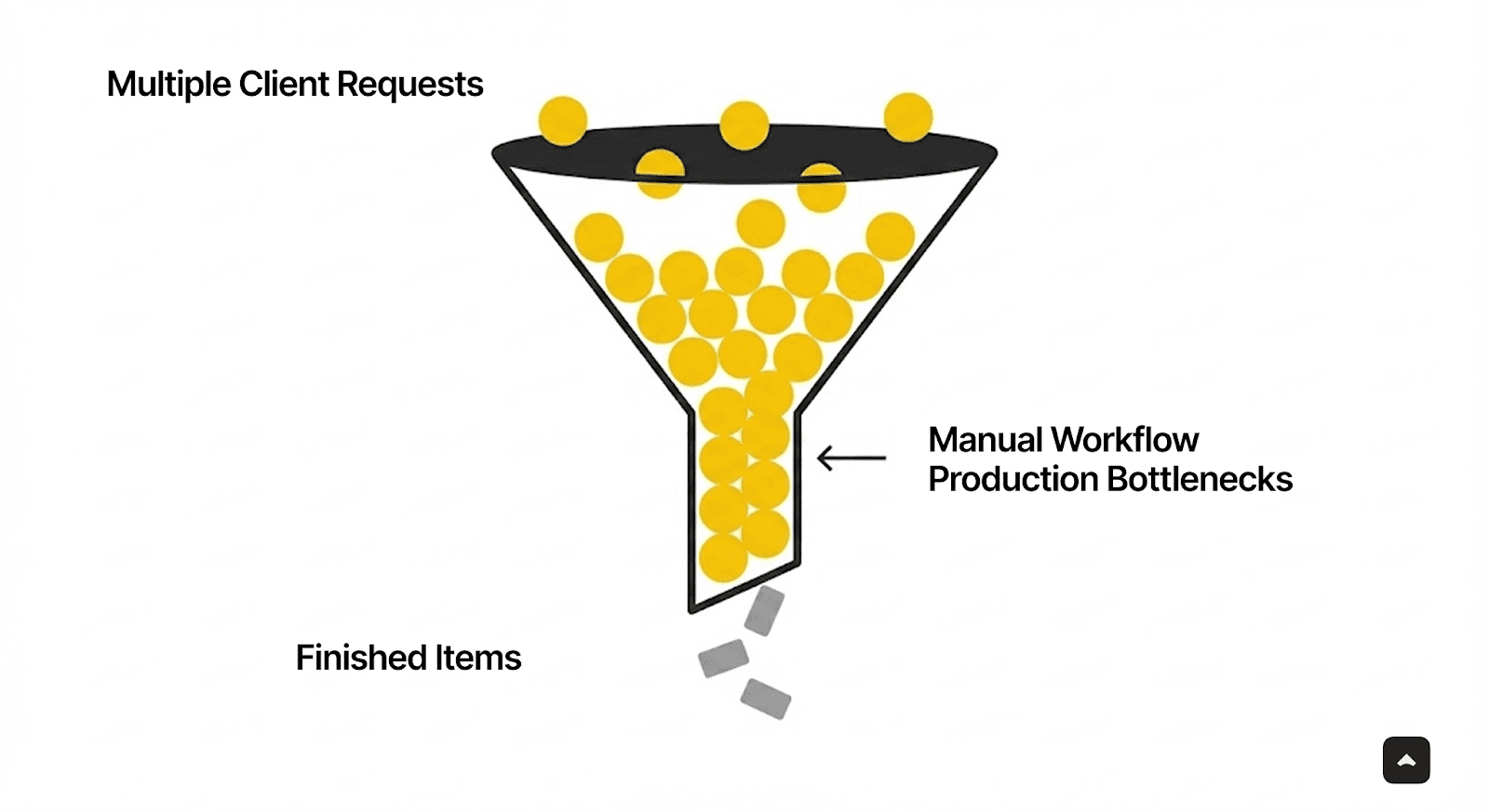
When agencies manage fewer than 10 clients, manual ad production still works.
Beyond that, it breaks predictably.
What breaks first
1. Creative turnaround time
Every additional client multiplies:
Requests
Variations
Revisions
Ad production does not scale linearly. It compounds.
2. Designer dependency
Designers become a shared bottleneck across accounts. Priority conflicts increase. Output slows.
3. Feedback loops
Client feedback arrives asynchronously. Internal feedback stacks up. Ad iteration slows down exactly when speed matters most.
4. Brand inconsistency
As volume increases, tone, visuals, and messaging drift. Especially when multiple people touch the same accounts.
5. Team burnout
Performance teams spend more time chasing creatives than improving results.
The core constraint agencies underestimate
Scaling ads is not a creative problem.
It is a production and coordination problem.
Traditional agency models assume:
Fewer ads
Longer lifecycles
Slower iteration
Modern performance environments demand the opposite.
This is the gap AI ads are meant to fill. But only if agencies change how ads are produced, reviewed, and optimized.
What “Scaling AI Ads” Actually Means for Agencies
Most agencies misunderstand what it means to scale AI ads.
They assume scaling equals:
Generating more ads
Using an AI ad maker more frequently
Replacing designers with automation
That assumption is wrong and dangerous.
Scaling AI Ads Is Not About Volume
If you only increase output, you get:
More ads
More noise
Faster fatigue
Lower average quality
This is why many agencies abandon AI after early experiments. Output increases, but results do not.
Scaling AI ads means scaling decision-making, not just creation.
The Difference Between Scaling Ads and Scaling a System
Agencies that succeed with AI separate two ideas:
Scaling ads
More creatives
Faster generation
Lower cost per asset
Scaling a system
Repeatable workflows
Clear constraints
Predictable quality
Controlled variation
AI ad makers are useful only inside a system. Without structure, they amplify inconsistency.
What Agencies Usually Get Wrong About AI Ad Makers
Common failure patterns:
Letting AI decide tone and messaging
Using generic prompts across clients
Treating AI output as final creative
Skipping human review to save time
This leads to ads that look similar across clients and erodes trust.
An AI ad maker should execute within boundaries, not invent strategy.
The Real Role of AI in Agency Ad Production
In scaled agencies, AI is used to:
Compress creative cycles
Expand variation safely
Reduce coordination overhead
Speed up learning loops
AI is not the creative brain.
It is the production engine.
Human teams still define:
Brand voice
Strategic angles
What “good” looks like
AI handles everything else.
Why This Matters Before You Scale Further
If an agency scales AI usage before defining:
Brand constraints
Review checkpoints
Ownership of quality
The agency creates more problems faster.
Scaling AI ads successfully means deciding what must stay human and what can safely be automated before touching volume.
The Agency AI Stack: Where AI Fits (and Where It Should Never Be Used)
Agencies that scale AI ads successfully do not “use AI everywhere”.
They draw hard boundaries around where AI is allowed to operate and where it is explicitly blocked.
This distinction is what prevents quality collapse at scale.
Where AI Ad Makers Create Real Leverage
AI ad makers work best in execution-heavy zones, where speed matters more than originality.
Agencies use AI to:
1. Generate first-draft creatives
AI accelerates the jump from idea to visual. It removes blank-canvas friction.
2. Expand variations safely
Once an angle is approved, AI can produce multiple versions without reinventing strategy.
3. Adapt formats across platforms
Turning one concept into multiple formats without restarting the creative process.
4. Explore hooks and openings
AI is effective at generating multiple hook directions for testing.
5. Reduce coordination overhead
Fewer back-and-forths between media buyers, designers, and copy teams.
In these areas, AI compresses time without introducing strategic risk.
Where AI Should Never Be Used in Agencies
This is where most agencies make expensive mistakes.
AI should not be responsible for:
1. Defining brand voice
Brand tone cannot be crowdsourced or inferred reliably by AI.
2. Setting creative strategy
AI lacks context around positioning, market nuance, and client politics.
3. Final approvals
Shipping AI output without human review is how agencies lose trust.
4. Cross-client creative decisions
AI does not understand client boundaries unless explicitly constrained.
5. Performance interpretation
AI ad optimization at the creative level still requires human judgment.
When AI crosses these lines, ads start looking interchangeable across clients.
The Practical Rule Agencies Follow
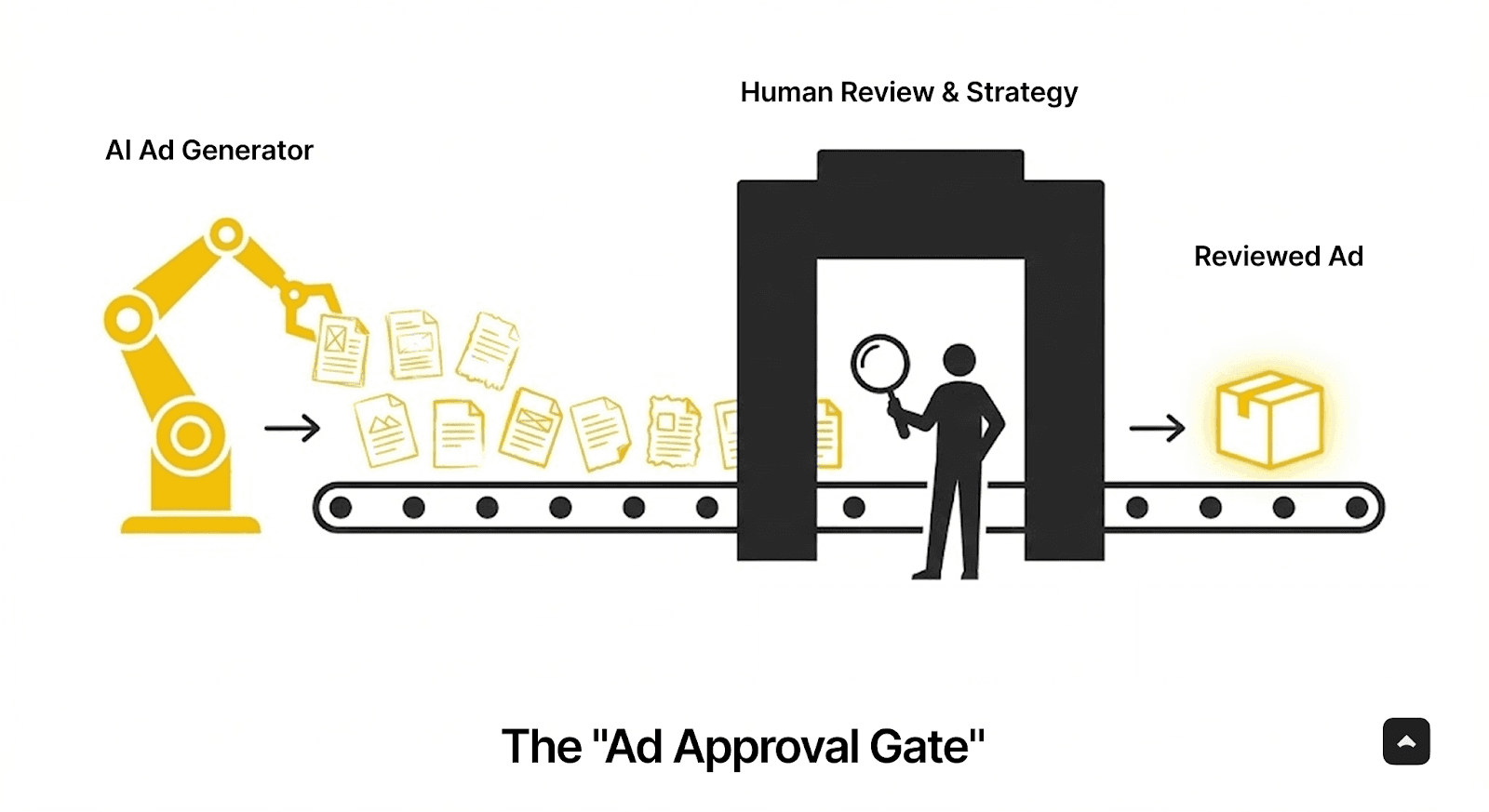
High-performing agencies operate on a simple rule:
Humans decide direction. AI executes within constraints.
AI ad makers are treated like production assistants, not strategists.
This is why agencies that succeed with AI scale output without scaling chaos, while others see quality decline rapidly.
How This Stack Enables AI Ad Optimization Later
By restricting AI to execution roles:
Creative performance becomes easier to compare
Learning loops become cleaner
AI ad optimization works on controlled variables, not noise
This is what allows agencies to scale AI ads across 20+ clients while still improving results.
The 5-Layer Operating Model Agencies Use to Scale AI Ads
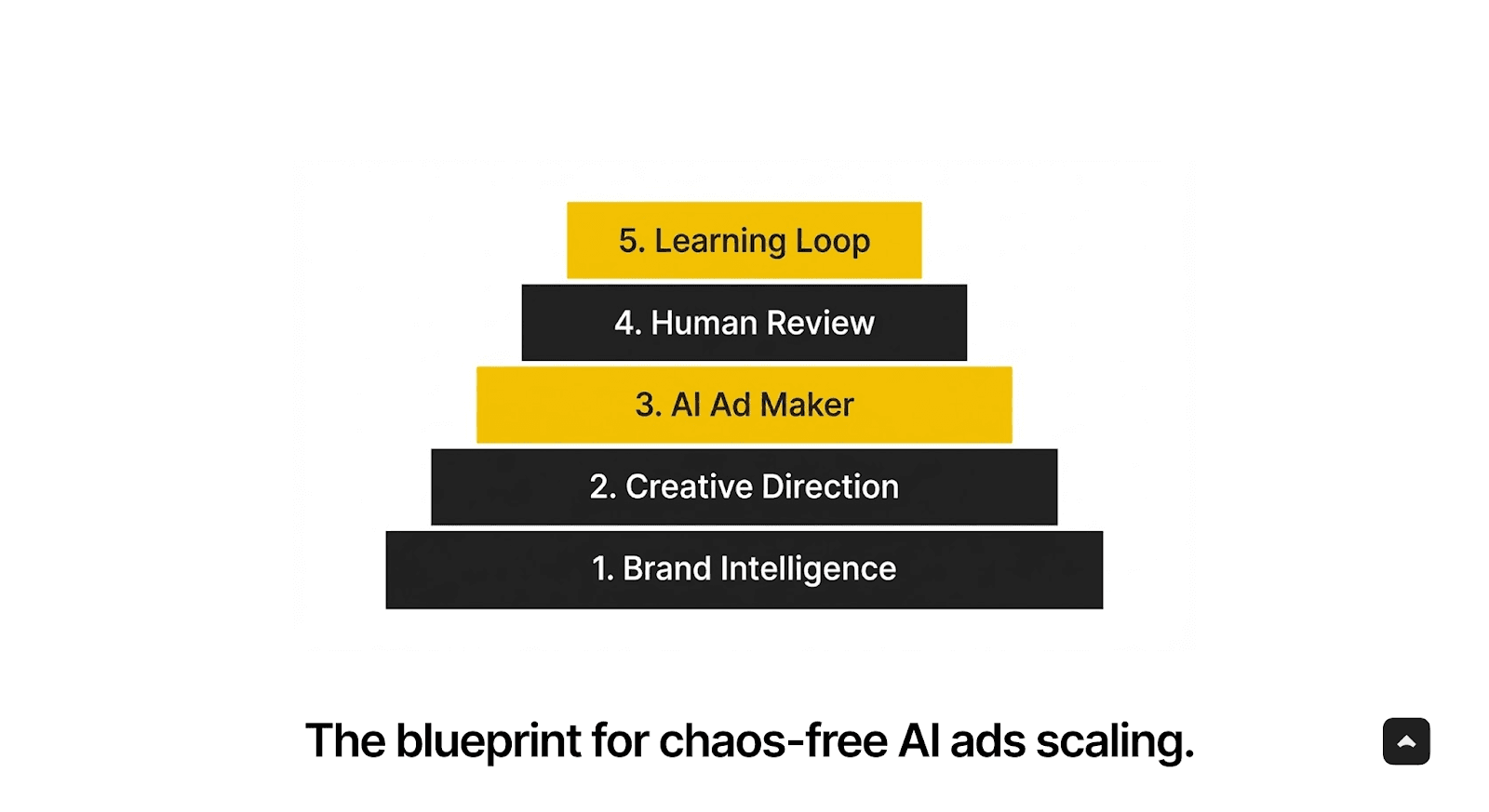
Agencies that scale AI ads across 20+ clients do not rely on tools.
They rely on a layered operating model that prevents quality collapse as volume increases.
Each layer has a single responsibility.
No overlap. No ambiguity.
Layer 1: Brand Intelligence Layer
This layer defines the non-negotiables for each client.
It includes:
Brand voice and tone boundaries
Visual identity rules
Offer positioning constraints
Compliance and legal exclusions
Forbidden phrases, claims, and angles
This layer exists before any AI ad maker is used.
If this layer is weak, every other layer produces noise.
Rule:
AI can reference brand intelligence.
AI must never invent it.
Layer 2: Creative Direction Layer
This layer translates brand rules into approved creative lanes.
It defines:
Which angles are allowed
Which emotional tones are acceptable
Which formats are in scope
What success looks like creatively
This prevents AI from “getting creative” in the wrong direction.
Without this layer, agencies get:
Random output
Inconsistent messaging
Ads that look clever but fail performance
Layer 3: AI Ad Maker Layer
This is where AI ad makers actually operate.
Responsibilities of this layer:
Generate first-draft ads
Expand approved angles into variants
Adapt creatives across formats
Produce volume without redefining strategy
At this layer:
AI follows instructions
AI does not make decisions
AI output is never final
Agencies that treat this layer as “fire and forget” lose control quickly.
Layer 4: Human Review Layer
This layer exists to protect:
Brand trust
Client confidence
Long-term performance
Human reviewers check for:
Tone drift
Visual inconsistency
Over-automation signals
Repetition across clients
Importantly, reviewers are not rewriting ads.
They are approving or rejecting based on predefined rules.
This keeps review fast and scalable.
Layer 5: Distribution and Learning Layer
(AI ad optimization happens here)
This is where AI ad optimization becomes meaningful.
This layer handles:
Mapping creatives to campaigns
Tracking performance by angle and format
Identifying fatigue patterns
Feeding learnings back into creative direction
Optimization here is not about tweaking copy.
It is about deciding what gets produced next.
Without this layer, agencies generate content without learning.
Why This Model Scales When Others Fail
Each layer answers one question:
What defines the brand?
What creative is allowed?
How is volume produced?
Who protects quality?
How does learning compound?
When agencies skip layers, AI amplifies chaos.
When agencies respect layers, AI ads scale cleanly across dozens of clients.
AI Ad Optimization at the Creative Level (Not Just Bids)
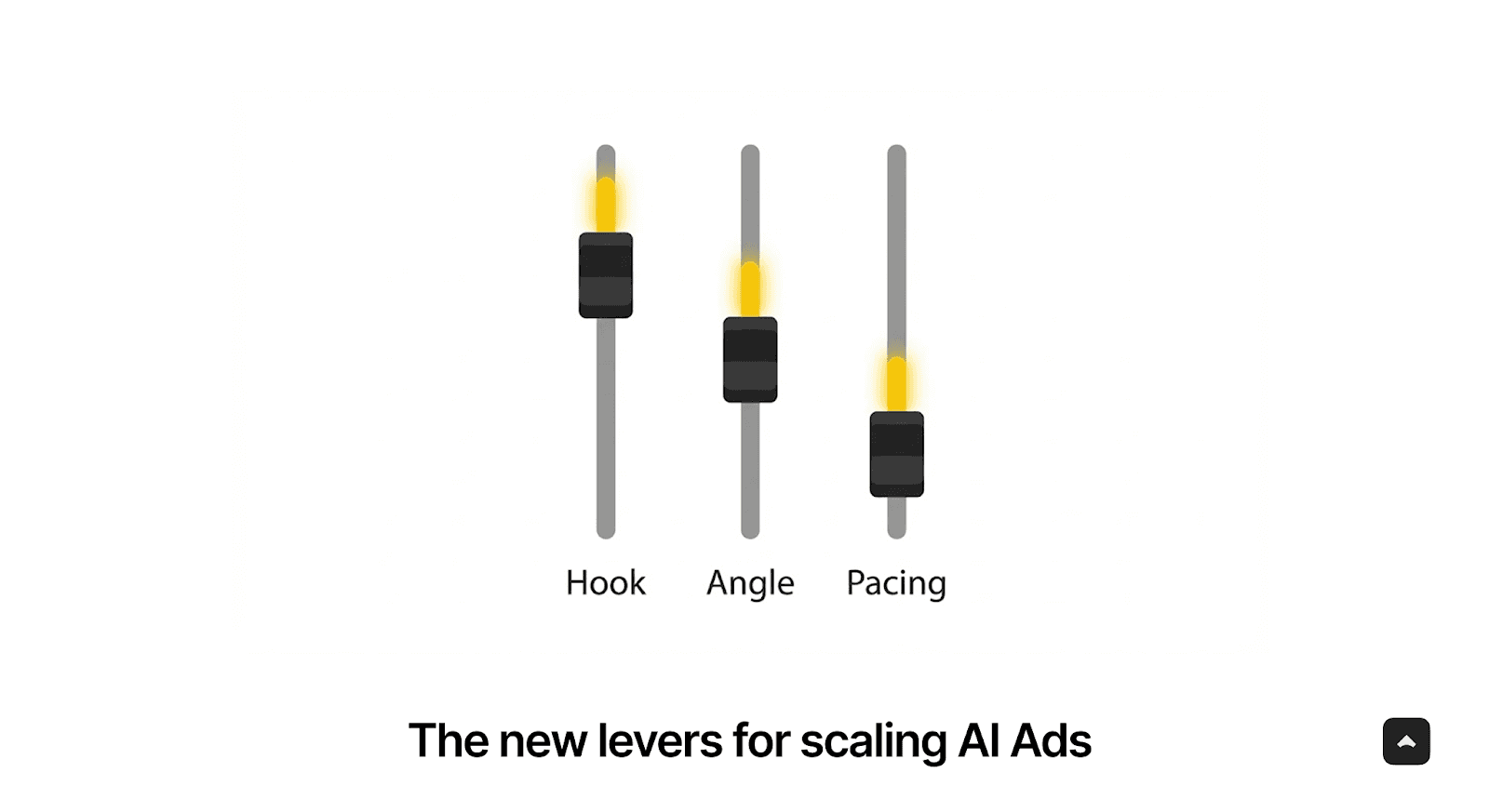
Most agencies associate AI ad optimization with bidding, budgets, or targeting.
That is no longer where the biggest gains are.
At scale, creative optimization becomes the dominant performance lever.
Why Creative-Level Optimization Matters More at Scale
When agencies manage 20+ clients:
Media buying logic becomes repeatable
Targeting frameworks stabilize
Marginal gains from bid tweaks shrink
Creative, however, decays continuously.
Every client faces:
Creative fatigue
Audience saturation
Declining engagement over time
This is where AI ads create leverage.
AI allows agencies to optimize what people see, not just how ads are delivered.
What Creative-Level AI Optimization Actually Looks Like
Agencies use AI to optimize inputs, not outcomes.
Instead of asking:
“Which ad should we push harder?”
They ask:
Which hooks decay fastest?
Which angles hold attention longer?
Which formats fatigue slower?
Which tone sustains engagement?
AI helps answer these questions by:
Generating structured variants
Mapping performance to creative attributes
Feeding learnings back into production
This creates a closed creative loop.
How Agencies Extend the Lifespan of Winning Ads
A common mistake is replacing winning ads too early.
Scaled agencies use AI to:
Keep the core concept intact
Rotate surface-level elements
Refresh delivery without resetting trust
Examples:
Same angle, new opening
Same message, different pacing
Same structure, alternate framing
This approach delays fatigue while preserving performance signals.
Why AI Ad Optimization Requires Creative Discipline
AI cannot optimize chaos.
If creatives are:
Inconsistent
Unstructured
Over-randomized
AI ad optimization produces misleading signals.
This is why agencies that follow a layered operating model see better results. Creative attributes remain stable enough for learning to compound.
The Outcome Agencies Actually Care About
When creative-level AI ad optimization works:
Fewer “creative emergencies”
Predictable refresh cycles
Faster scaling decisions
Less team burnout
AI stops being reactive and becomes preventive.
How AI Ad Managers Replace Manual Coordination, Not Strategists
As agencies cross 20+ clients, their biggest hidden cost is not media spend.
It is coordination.
Emails, Slack threads, version confusion, duplicate creatives, mismatched naming, missed updates. None of this improves performance, but all of it slows teams down.
This is where AI ad managers add leverage.
What an AI Ad Manager Actually Manages
An AI ad manager does not decide strategy.
It manages structure and flow.
At scale, agencies use AI ad managers to handle:
Creative versioning
Naming conventions
Mapping ads to campaigns and angles
Tracking which variants are live where
Preventing duplicate or conflicting creatives
This removes the cognitive load from performance teams.
Why Manual Coordination Breaks at 20+ Clients
Human coordination does not scale linearly.
As client count increases:
Each creative change touches more systems
Each update risks inconsistency
Each mistake costs time and trust
Performance teams end up acting as traffic managers instead of optimizers.
AI ad managers compress this complexity by enforcing structure automatically.
The Key Distinction Agencies Must Understand
AI ad managers do not replace decision-makers.
They replace:
Spreadsheet tracking
Naming discipline enforcement
Manual QA
Cross-client contamination risks
Humans still decide:
What to test
What to pause
What to scale
What to kill
This separation keeps agencies fast without losing accountability.
How This Improves AI Ad Optimization Downstream
When coordination is clean:
Performance data maps cleanly to creatives
Learning loops tighten
Optimization decisions become clearer
Without an AI ad manager layer, creative-level AI ad optimization turns into guesswork because attribution is messy.
Why Clients Feel the Difference Immediately
Clients do not care about your internal tools.
They notice:
Faster turnaround
Fewer errors
Consistent messaging
Confident explanations of what is running and why
This is why agencies that adopt AI ad managers early retain clients longer as they scale.
Managing 20+ Client Brands Without Losing Consistency
When agencies scale AI ads across dozens of clients, the fastest way to lose trust is brand drift.
Not obvious mistakes.
Subtle ones.
The wrong tone.
The wrong visual cue.
The wrong phrasing repeated across clients.
At scale, these errors compound.
Why Brand Consistency Breaks First With AI Ads
AI does exactly what it is told.
If brand rules are:
Vague
Implicit
Stored in people’s heads
AI will fill the gaps with generic patterns.
That is how agencies end up with:
Similar-looking ads across unrelated clients
Repeated language structures
“Same voice, different logo” problems
This is not an AI failure.
It is a governance failure.
How Scaled Agencies Encode Brand Rules Explicitly
Agencies that succeed with AI ads externalize brand knowledge.
They define, in writing:
Allowed tones
Forbidden phrases
Visual do’s and don’ts
Emotional range limits
Regulatory or compliance constraints
This information lives outside individual team members and feeds every creative decision.
AI references these rules.
It does not infer them.
Preventing Cross-Client Creative Contamination
One of the most dangerous risks at scale is cross-client leakage.
This happens when:
Similar prompts are reused
Output patterns bleed across accounts
Review teams miss repetition
High-performing agencies prevent this by:
Isolating brand contexts completely
Using client-specific creative lanes
Running duplication checks across accounts
This protects both performance and credibility.
Why Visual Consistency Matters More Than Copy
Most agencies focus too much on language and too little on visuals.
In practice:
Viewers recognize visuals faster than words
Visual repetition builds familiarity
Visual inconsistency creates doubt
Scaled AI ads maintain:
Consistent color usage
Familiar framing styles
Repeated layout rhythms
This allows ads to feel cohesive even as messaging evolves.
Brand Consistency Enables Faster Scaling
Consistency is not a creative limitation.
It is a scaling advantage.
When brand rules are clear:
AI ad makers produce usable output faster
Review cycles shrink
Creative fatigue becomes easier to manage
Client confidence increases
This is why agencies that invest in brand governance early scale faster with AI ads than those that chase volume.
The New Roles Agencies Are Creating Because of AI Ads
When agencies scale AI ads across 20+ clients, the biggest shift is not tooling.
It is role design.
AI does not eliminate work. It redistributes it. Agencies that fail to adjust roles end up with confusion, duplicated effort, and quality gaps.
Why Old Agency Roles Stop Scaling
Traditional agency roles assume:
Designers create
Media buyers optimize
Account managers coordinate
At scale, this model breaks.
Designers become bottlenecks.
Media buyers spend time chasing creatives.
Account managers turn into traffic controllers.
AI changes where human effort creates the most value.
Role 1: Creative Systems Manager
This role owns the ad production system, not individual ads.
Responsibilities:
Defining creative workflows
Maintaining production rules
Ensuring consistency across clients
Deciding what gets automated
This role replaces ad-hoc decision-making with structure.
Role 2: Prompt Librarian (or Creative Playbook Owner)
This role maintains:
Approved prompt templates
Angle frameworks
Tone constraints per client
Format-specific instructions
The goal is not writing prompts.
The goal is preserving institutional knowledge.
When this role exists, output improves without retraining teams.
Role 3: Brand Guardrail Owner
This role protects:
Brand voice
Visual identity
Compliance boundaries
They do not create ads.
They approve or reject based on rules.
This keeps review fast and scalable while protecting trust.
Role 4: AI Ops Lead
This role connects:
Production
Review
Distribution
Learning
They ensure:
Clean versioning
Proper mapping of creatives to campaigns
Feedback loops stay intact
Without this role, AI ads create chaos instead of leverage.
What Happens to Designers and Strategists
Designers:
Shift from execution to system design
Focus on visual rules, not one-off assets
Strategists:
Spend less time writing ads
Spend more time defining angles and direction
AI handles volume. Humans handle judgment.
Why This Role Shift Enables Scale
Agencies that redesign roles:
Produce more ads with fewer conflicts
Reduce burnout
Improve quality consistency
Retain clients longer
Those who do not redesign roles end up blaming AI for problems caused by outdated structures.
Common Mistakes Agencies Make When Scaling AI Ads
Most agencies do not fail because AI ads do not work.
They fail because they scale them poorly.
Mistake 1: Scaling output before fixing process
More ads without structure equals more confusion.
Mistake 2: Letting AI decide brand voice
AI should execute within boundaries, not invent tone.
Mistake 3: Removing human review too early
Speed without oversight erodes trust fast.
Mistake 4: Treating AI as a replacement for strategy
AI accelerates execution, not thinking.
Mistake 5: Using the same prompts across clients
This creates lookalike ads and brand contamination.
Avoiding these mistakes alone puts agencies ahead of most competitors.
What a Scaled AI Ad Agency Actually Looks Like in Practice
In agencies that scale AI ads well:
Creative production is predictable, not chaotic
Ad refresh cycles are planned, not reactive
Teams spend less time coordinating and more time optimizing
Clients see consistency, speed, and confidence
AI does not make agencies reckless.
It makes disciplined agencies faster.
The difference is not tools.
It is operational design.
Conclusion: Scaling AI Ads Is an Operating Decision, Not a Tool Choice
Agencies that succeed with AI ads do not chase the newest AI ad maker or rely on a free AI ad generator.
They redesign how ads are:
Produced
Reviewed
Optimized
Governed
AI works when it strengthens systems.
It fails when it is layered onto broken workflows.
For agencies managing 20+ clients, the path forward is clear:
Scale structure first.
Then scale output.
That is how AI ad optimization becomes a competitive advantage instead of a liability.
Keep reading