How to Build Dropshipping UGC Ads That Still Convert in 2026


Written by Vinay Jain · Updated May 2026 · 15 min read

TLDR
Dropshipping UGC ads still work in 2026, but the way they are created has completely changed. Traditional creator-based user-generated ads are slow, expensive, and unreliable for fast-moving dropshippers. AI now makes it possible to create UGC video ads that feel realistic, human, and on-brand without relying on creators. This guide breaks down how to build high-performing UGC style ads using only AI by focusing on psychology, realism, and systems instead of shortcuts.
Introduction: Why Dropshipping UGC Ads Look Different in 2026
If you are running a dropshipping store in 2026, you already know one thing:
UGC ads still dominate performance.
They stop the scroll.
They build trust faster than polished brand creatives.
They convert cold traffic better than most traditional ads.
But there is a growing problem.
Traditional user-generated ads are becoming harder to scale. Finding creators takes time. Paying for videos does not guarantee performance. And by the time a creator delivers content, competitors have already tested ten new angles.
This is where AI fundamentally changes how ugc ads are created.
AI does not replace the psychology that makes UGC work. It removes the bottlenecks that slow dropshippers down. When done correctly, AI-powered ugc style ads can feel just as natural and trustworthy as creator content while allowing you to test, iterate, and scale at a speed that human workflows cannot match.
The problem is that most dropshippers approach AI UGC the wrong way.
They focus on speed instead of realism.
They generate content instead of building trust.
They chase volume and end up with obvious AI slop.
This guide is designed to prevent that.
You will learn how to create ugc video ads for dropshipping using only AI, without making them look fake, off-brand, or generic. More importantly, you will learn how to think about AI UGC as a system, not a hack, so your ads stay effective as competition increases.
Why UGC Ads Still Work for Dropshipping (Even in 2026)
Despite constant changes in ad platforms, formats, and algorithms, one thing has stayed consistent:
UGC ads still outperform most polished brand creatives in dropshipping.
This is not because they look better.
It is because they feel different.
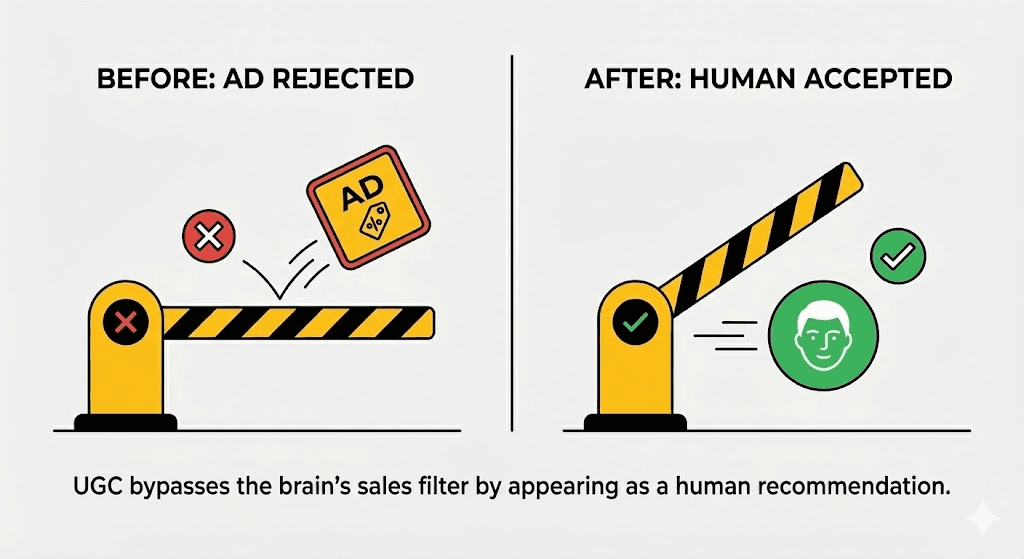
At a psychological level, user-generated ads work because they bypass the mental filters people use against advertising. When someone sees a traditional ad, their brain categorizes it instantly as a sales message. When they see a ugc style ad, it feels closer to a recommendation than a promotion.
That distinction matters even more in dropshipping, where:
The brand is often unfamiliar
The product is discovered for the first time
Trust must be built in seconds, not weeks
UGC Ads Trigger Trust Faster Than Brand Ads
Dropshipping succeeds or fails on speed. You do not have the luxury of long brand-building cycles. Your ads need to establish credibility immediately.
UGC ads do this by leveraging three trust signals:
A human face instead of a logo
Casual, conversational delivery instead of polished copy
Product discovery framed as personal experience
This is why even low-production ugc video ads often outperform high-budget creatives. They lower skepticism instead of trying to overcome it.
Why Dropshipping Relies on UGC More Than Established Brands
Established brands can rely on reputation. Dropshippers cannot.
When a user sees a brand they have never heard of, the only question that matters is:
“Why should I trust this?”
UGC style ads answer that question implicitly. They suggest that someone else has already tried the product, evaluated it, and decided it was worth talking about. That perceived social proof matters more than features, pricing, or claims.
This dynamic has not weakened in 2026. It has intensified.
As feeds become more crowded and consumers become more skeptical, ads that feel human consistently outperform ads that feel manufactured.
The Difference Between Real UGC and Effective UGC
Here is an important distinction most dropshippers miss:
UGC does not work because it is real.
UGC works because it feels real.
A video does not need to be filmed by a real creator to function as a high-performing ugc ad. It needs to:
Sound natural
Look believable
Follow real human speech patterns
Avoid obvious advertising cues
This is why AI-generated ugc video ads can outperform creator content when they are designed around realism instead of automation.
The moment an ad starts signaling “this is an ad” instead of “this is a person sharing something,” performance drops.
That principle is the foundation of everything that follows in this guide.
The Real Problem With Traditional Dropshipping UGC
Traditional creator-based UGC ads helped dropshipping scale for years.
But in 2026, the same model is showing clear cracks.
The issue is not that creators stopped being effective.
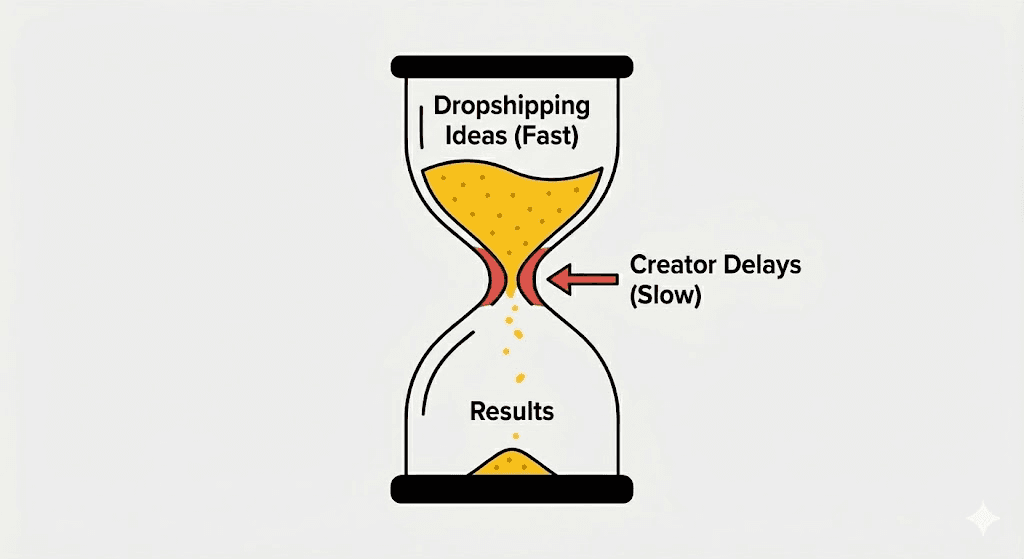
The issue is that the creator workflow does not match how fast dropshipping now moves.
Creator UGC Is Slow in a Game That Rewards Speed
Dropshipping is fundamentally a testing business.
You are constantly testing:
New products
New angles
New hooks
New objections
Traditional user-generated ads introduce friction at every step:
Finding creators
Negotiating rates
Waiting for delivery
Revising content
Hoping it converts
By the time a creator delivers a video, the market may have already shifted. Competitors may already be testing new angles. What once felt fast now feels rigid.
In a landscape where iteration speed determines survival, creator timelines become a bottleneck.
Cost Does Not Equal Performance in UGC Ads
Another hidden problem is cost certainty.
Paying for creator content does not guarantee performance. A $300 video can fail just as easily as a $30 test. But traditional workflows force dropshippers to commit upfront before knowing whether an angle works.
This is risky in an environment where:
Most products fail
Most hooks do not convert
Most tests are inconclusive
Effective ugc video ads require volume and iteration, not perfection. Creator-based models were never designed for that level of experimentation.
Inconsistency Breaks Trust at Scale
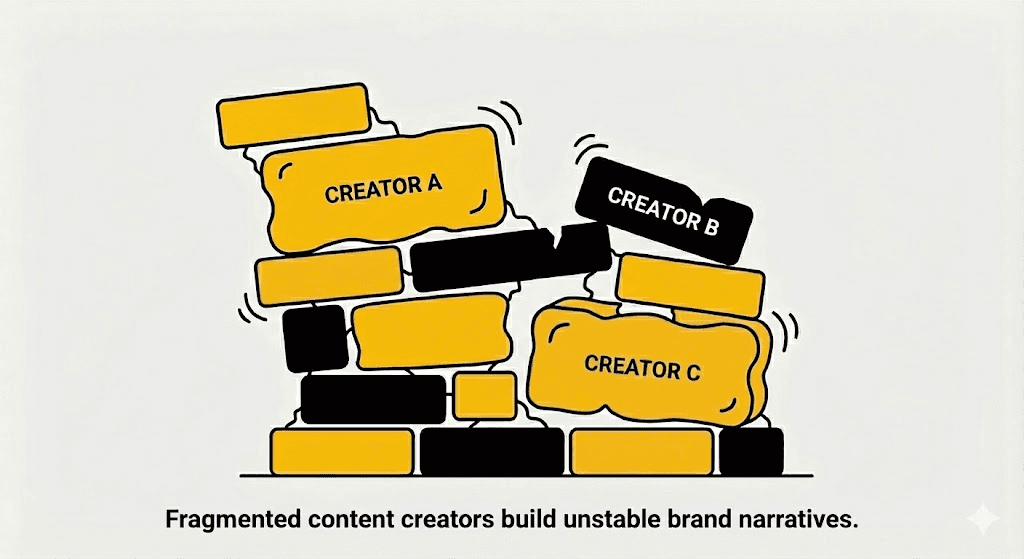
Creators bring variety, but they also bring inconsistency.
When every ugc ad features a different person, a different tone, and a different delivery style, trust resets each time. This makes scaling harder, not easier.
For dropshipping, where repeat exposure matters, inconsistency becomes a silent performance killer. Audiences need familiarity before persuasion. Traditional creator UGC often prioritizes novelty over recognition.
Why This Problem Is Worse in 2026
In 2026, three forces amplify these issues:
More competition
More dropshippers are testing the same products and angles.Shorter attention spans
Audiences decide whether to trust an ad in seconds.Higher creative fatigue
Winning ugc style ads burn out faster than ever.
Traditional workflows cannot keep up with this reality.
This does not mean creators are obsolete.
It means dropshippers need a way to test, iterate, and refresh ugc ads without waiting on external dependencies.
That is the gap AI now fills.
How AI Changed Dropshipping UGC Ads Completely
AI did not make UGC ads work.
UGC already worked.
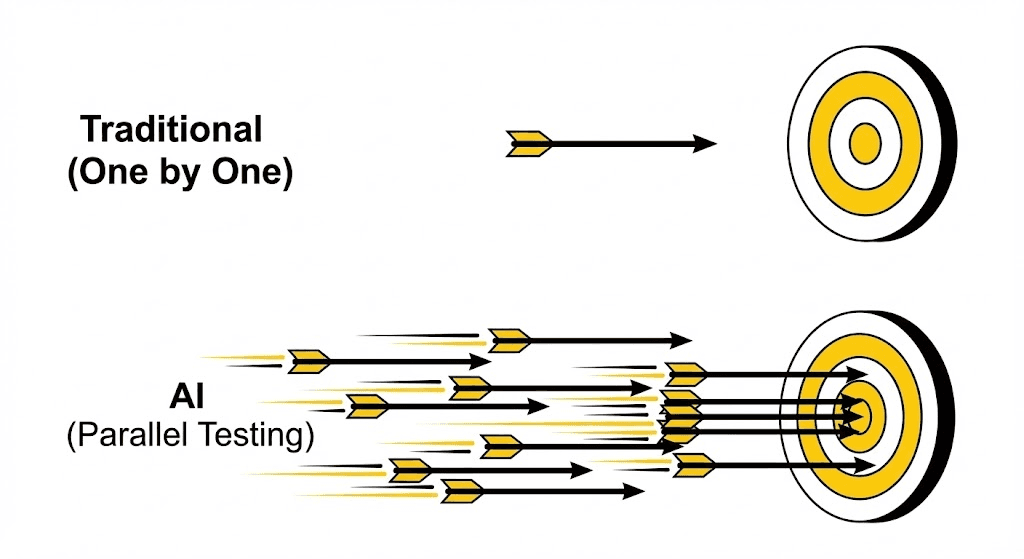
What AI changed is who controls speed, cost, and iteration.
In dropshipping, that shift matters more than any single creative breakthrough.
AI Removes the Bottlenecks, Not the Psychology
The biggest misconception about AI in ugc ads is that it replaces human behavior.
It does not.
AI replaces the slow parts of the workflow:
Waiting for creators
Paying upfront for untested angles
Repeating the same coordination steps
Losing momentum between tests
The psychology that makes user-generated ads convert stays the same. What changes is how fast you can apply that psychology across dozens of variations.
Instead of testing one or two ideas per week, AI allows dropshippers to test many ideas in parallel.
Speed becomes the advantage.
Why “Real People” Matter Less Than Realism
One of the most important shifts in 2026 is this:
UGC ads do not need real people.
They need believable people.
Audiences are not verifying whether a person exists. They are subconsciously evaluating:
Does this person sound natural?
Does the delivery feel unscripted?
Does the interaction with the product feel normal?
Does this feel like a recommendation or an ad?
When ugc style ads satisfy those conditions, performance follows regardless of whether the content was created by a human or AI.
This is why AI-generated ugc video ads can outperform creator content when realism is prioritized over novelty.
AI Enables Testing Psychology, Not Faces
Traditional creator workflows test people.
AI-powered ugc ads test ideas.
This is a critical distinction.
With AI, you can:
Hold delivery style constant
Keep visual identity familiar
Change only the hook, angle, or objection
Isolate what actually drives conversion
This level of control is nearly impossible with creators. Each creator brings their own personality, tone, and delivery style, which adds noise to testing.
AI reduces that noise.
Why This Matters Specifically for Dropshipping
Dropshipping rewards early signal detection.
The faster you learn:
What hook stops the scroll
What objection matters most
What framing builds trust
…the faster you can decide whether a product is worth scaling.
AI-powered ugc ads turn creative testing into a repeatable system instead of a gamble. That is why AI is no longer optional in 2026. It is the infrastructure layer behind competitive dropshipping.
The 3-Phase System to Create Dropshipping UGC Ads Using AI
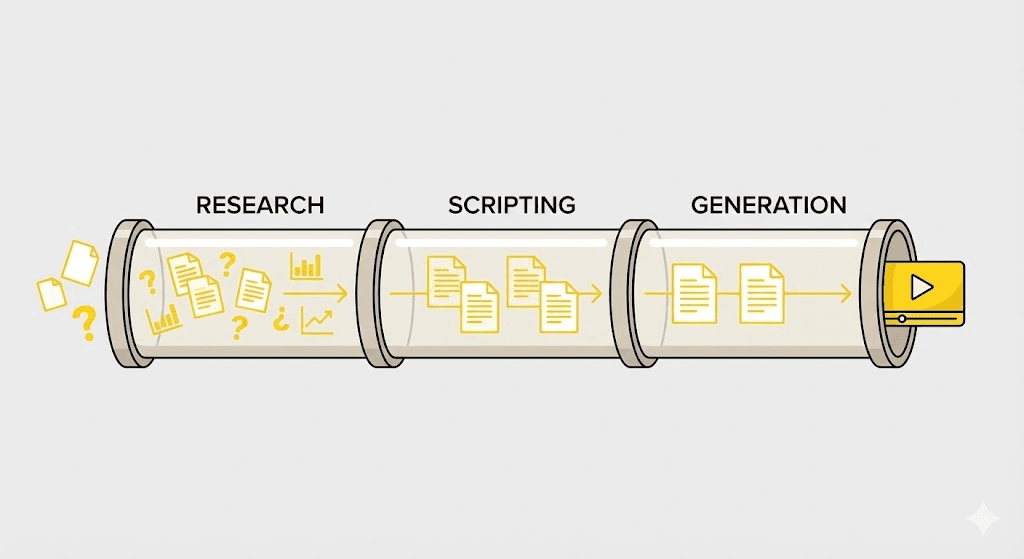
AI only works when it is applied to the right system.
Most dropshippers fail with UGC ads not because AI is weak, but because they skip the thinking and jump straight to generation. High-performing ugc style ads follow a simple but disciplined three-phase loop:
Research what already converts
Write scripts that sound discovered, not written
Generate realistic UGC video ads that preserve trust
Everything else is noise.
We start with research.
Phase 1: Research What Already Converts
If you skip research, AI will only help you fail faster.
Winning user-generated ads are not creative accidents. They are patterns that have already been validated by real spend, real audiences, and real buying behavior.
Your goal in this phase is not to copy ads.
Your goal is to extract psychological structure.
Why Research Matters More in AI-Driven UGC Ads
AI can generate infinite variations.
That makes research more important, not less.
Without constraints, AI produces generic ugc ads that feel disconnected from real buying motivations. Research gives AI direction. It tells you what type of conversation actually converts.
Step 1: Identify Proven Brands, Not Random Competitors
Start by searching for established brands selling products similar to yours.
Do not look for:
New dropshipping stores
Short-lived viral ads
Overhyped launches
Instead, look for brands that:
Rank well organically
Appear consistently in ads
Have been advertising for months
Longevity is the strongest signal that an ugc ad framework works.
Step 2: Use Ad Longevity as a Conversion Signal
When analyzing ads, ignore aesthetics at first.
Focus on how long the ad has been running.
Ads that run for weeks or months are rarely unprofitable. No advertiser keeps losing ads live for long. These long-running ugc video ads become your control examples.
Your job is to study:
How the hook is framed
When the product is introduced
What objection is addressed first
How the CTA is positioned
These elements form the psychological skeleton of the ad.
Step 3: Study Organic Virality for Emotional Resonance
Paid ads show what converts.
Organic virality shows what resonates.
Platforms like short-form video feeds surface ugc style ads that people voluntarily engage with. High saves, comments, and shares indicate emotional alignment, not just conversion pressure.
This is especially useful for dropshipping, where emotional framing often matters more than features.
What to Extract (And What to Ignore)
Extract:
Hook structure
Story progression
Objection handling
Tone and pacing
Ignore:
Exact wording
Specific visuals
Creator personality quirks
Copying ads produces tired creatives. Extracting frameworks produces scalable ugc ads.
This research phase gives AI a clear lane to operate in. Without it, generation becomes guesswork.
Phase 2: Writing High-Converting UGC Scripts With AI
Once you know what converts, the next mistake most dropshippers make is trying to “write ads.”
That mindset kills UGC ads.
High-performing ugc style ads do not sound written. They sound discovered. The script should feel like a thought forming in real time, not a message engineered to persuade.
AI can help here, but only if you use it correctly.
Why Script Quality Determines Whether UGC Ads Feel Real
Most failed ugc video ads collapse at the script level.
Not because the words are wrong, but because the delivery intent is wrong.
Bad scripts:
Explain too much
Lead with claims
Sound confident too early
Stack selling points
Good user-generated ads:
Start with curiosity or friction
Reveal the product naturally
Focus on one idea
Feel conversational, not convincing
AI should be used to reshape psychology, not to speed-write sales copy.
Step 1: Transcribe Winning Ads to Understand Structure
Before generating anything new, break down what already works.
Take long-running ugc ads from your research phase and transcribe them. The goal is not to reuse language, but to see patterns such as:
Where the hook appears
How quickly the product shows up
When objections are addressed
How the CTA is framed
You will notice something important.
Winning ugc style ads rarely “pitch.”
They narrate an experience.
That narrative structure is what you want AI to replicate.
Step 2: Use AI to Rewrite, Not Invent
The biggest cause of AI slop in ugc video ads is asking AI to “write a UGC script from scratch.”
That produces generic output.
Instead, you want AI to:
Keep the same psychological flow
Use completely different words
Speak to one specific customer pain
Sound like a real person discovering something
Each script should feel like it came from a different individual, even if the structure is the same.
This is how you scale ugc ads without repeating yourself.
Step 3: Write for One Idea, Not the Product
A common mistake in dropshipping is trying to sell the entire product in one ugc ad.
That does not work.
High-performing user-generated ads focus on:
One frustration
One moment of discovery
One small win
If your product has five benefits, that is five different ads, not one script.
AI becomes powerful when it helps you isolate and test ideas, not when it compresses everything into a single message.
Step 4: Make Scripts Sound Spoken, Not Read
Scripts that look fine on paper often fail when spoken.
Good ugc video ads include:
Short, uneven sentences
Casual phrasing
Minor repetition
Natural pauses
Avoid:
Perfect grammar
Formal transitions
Marketing language
If a line would sound strange in a voice note to a friend, it does not belong in a ugc ad.
Step 5: Create Multiple Angles From the Same Framework
Once you have one solid framework, generate multiple variations:
Different hooks
Different emotional entry points
Different objections
Keep the structure. Change the perspective.
This allows you to test faster without confusing the audience or resetting trust. It is how dropshippers turn AI into a performance lever instead of a content machine.
Phase 3: Generating Realistic UGC Video Ads Using AI
This is the stage where most AI-powered UGC ads either work exceptionally well or completely fall apart.
The difference is not video quality.
It is human realism.
Audiences forgive imperfect lighting, framing, and pacing in ugc video ads. What they do not forgive is content that feels artificial, over-produced, or emotionally disconnected.
Why Realism Matters More Than Resolution
In dropshipping, viewers are not evaluating production value. They are evaluating trustworthiness.
High-performing ugc style ads feel like:
A person talking to a phone
A casual moment, not a setup
A recommendation, not a pitch
Low-performing ads feel like:
A performance
A script being read
A sales message disguised as UGC
AI must be used to simulate human behavior, not studio output.
Step 1: Choose Actors for Believability, Not Beauty
The most common mistake in UGC ads is choosing actors that look too perfect.
Perfect faces trigger skepticism.
Believable user-generated ads use actors who:
Look relatable
Fit the target demographic
Appear ordinary, not aspirational
The goal is not to impress.
The goal is to blend in with the feed.
When an actor looks like someone the viewer could realistically be, trust increases immediately.
Step 2: Make Product Interaction Feel Incidental
Real creators do not “present” products.
They interact with them casually:
Holding it mid-sentence
Using it while talking
Showing it briefly, then moving on
High-performing ugc video ads replicate this behavior.
If the product becomes the visual focus too early or too often, the ad starts feeling manufactured. The product should support the story, not dominate it.
This is one of the fastest ways to avoid AI slop.
Step 3: Voice Realism Is More Important Than Visual Realism
Many AI-generated ugc ads fail because the voice sounds wrong.
Even when visuals look realistic, unnatural speech breaks immersion instantly.
Believable delivery includes:
Slight pacing irregularities
Natural emphasis
Incomplete sentences
Emotional consistency
Avoid voices that sound:
Overly confident
Too smooth
Perfectly paced
In ugc style ads, a slightly imperfect voice sounds more human than a flawless one.
Step 4: Use Simple Scenes to Maintain Authenticity
Complex scenes do not improve trust.
In fact, they often reduce it.
High-performing ugc video ads usually stick to:
One environment
Minimal camera movement
Simple actions
Multiple scenes can work, but only if they feel natural and relevant. The more complex the setup, the higher the risk of breaking realism.
For dropshipping, simplicity scales better than sophistication.
Step 5: Keep Visual Branding Subtle but Consistent
UGC does not mean unbranded.
The best user-generated ads maintain brand presence without announcing it.
This happens through:
Consistent color tones
Familiar background styles
Repeated visual patterns across ads
The viewer may not consciously notice this, but recognition builds over time. Consistency makes ugc ads feel familiar instead of random.
Why Phase 3 Completes the System
By this stage:
Phase 1 ensures you are testing what already works
Phase 2 ensures your message sounds human
Phase 3 ensures your delivery feels believable
When all three phases work together, AI becomes a force multiplier instead of a liability.
At this point, ugc ads stop feeling like experiments and start functioning like a scalable system.
Common AI UGC Mistakes Dropshippers Must Avoid
Most UGC ads fail for predictable reasons. These mistakes show up repeatedly in dropshipping campaigns and quietly destroy performance.
Mistake 1: Treating AI as a shortcut, not a system
Generating videos without research or structure leads to fast output and fast fatigue. AI amplifies whatever process you already have. If the process is weak, results get worse faster.
Mistake 2: Writing scripts like ads instead of conversations
Over-explaining, listing benefits, or sounding confident too early kills trust. UGC style ads should feel like discovery, not persuasion.
Mistake 3: Choosing actors that look too perfect
Highly polished or “model-like” faces trigger skepticism. Believable user-generated ads look ordinary, not aspirational.
Mistake 4: Rotating everything at once
Changing actor, script, tone, and environment simultaneously creates noise. Testing works best when one variable changes at a time.
Mistake 5: Ignoring visual consistency
Even casual ugc video ads need subtle visual patterns. Completely random visuals make ads feel disposable instead of familiar.
Avoiding these mistakes alone puts you ahead of most dropshippers using AI today.
When AI UGC Ads Outperform Human-Created UGC
AI does not replace creators in every situation. But in dropshipping, there are clear moments where AI UGC ads perform better than traditional creator content.
AI-driven ugc ads outperform human-created UGC when:
You need to test many products quickly
Speed matters more than emotional storytelling
Budgets cannot support creator churn
Creative fatigue requires frequent refreshes
You are validating demand, not building a long-term brand narrative
Human-created user-generated ads still win when:
Deep emotional storytelling is required
The creator’s personal story is the main hook
Long-term brand trust is already established
The strongest dropshipping setups use both. AI handles speed and iteration. Humans handle depth and credibility where needed.
In 2026, the competitive edge is not choosing one. It is knowing when to use each.
FAQs
Do UGC ads still work for dropshipping in 2026?
Yes. UGC ads still outperform polished brand creatives because they build trust faster, especially for unknown products and brands.
Can AI-generated UGC ads really convert?
Yes, when realism is prioritized. UGC video ads fail only when they feel scripted, generic, or artificial.
How realistic do AI UGC ads need to be?
They need to be believable, not perfect. Viewers stop evaluating authenticity once the ad feels human.
Are AI UGC ads safe to use for dropshipping?
They can be, as long as tone, visuals, and messaging remain consistent and responsible. Most risk comes from careless execution, not AI itself.
Can AI completely replace creators for UGC ads?
No. AI replaces speed and scale constraints. Creators still matter for storytelling, credibility, and long-term brand building.
Dropshipping UGC in 2026 Is a System, Not a Hack
In 2026, winning with dropshipping UGC ads is no longer about finding the perfect creator or chasing viral luck.
It is about building a system that:
Tests fast without sacrificing trust
Feels human without looking fake
Scales without breaking brand consistency
AI makes this possible, but only when used intentionally.
Dropshippers who treat AI as a shortcut will flood feeds with forgettable content. Dropshippers who treat AI as an infrastructure layer will quietly out-test, out-learn, and out-scale their competition.
The difference is not the technology.
It is how thoughtfully it is applied.
Keep reading