Meta Ads 2026: Understanding Auction, Ad Quality, and the Hidden Creative Signals

Written by Vinay Jain · Updated May 2026 · 17 min read
Meta Ads 2026: Understanding Auction, Ad Quality, and the Hidden Creative Signals
TLDR- Key Takeaways
Meta’s auction does not choose winners by budget — it chooses by predicted user experience and probability of meaningful action.
Creative fatigue is the #1 degradation signal Meta uses to downgrade your ads in the auction, even if everything else looks fine.
The algorithm gives temporary delivery boosts to fresh creatives, making variation and diversity the only sustainable way to stabilize costs.
Winning the Meta auction is not a targeting trick. It’s a creative operating system built around fast iteration, diverse angles, and high-quality early signals.
Updated: Dec 2025
1. Introduction: Meta’s Auction Isn’t a Marketplace- It’s a Prediction Engine
Every advertiser experiences a moment that feels personal.
A winning ad suddenly dies. CPM doubles. Delivery throttles.
You stare at the dashboard, and nothing makes sense.
The instinct is to blame the familiar villains:
“Competition probably increased.”
“My audience got saturated.”
“The algorithm is moody this week.”
“Budget was too low.”
“Meta is pushing automation, so my manual setup is punished.”
These explanations feel true because they’re intuitive. But they are almost always wrong.
The real reason performance collapses is deeper and far more structural:
Meta doesn’t reward the highest bidder — it rewards the advertiser who gives it the highest predicted value outcome per impression.
This is the part most marketers miss.
Meta’s ad auction is not built like Google’s keyword bidding marketplace.
It’s a multi-layer predictive system, constantly recalculating:
which user is most likely to respond
which ad is most likely to deliver positive signals
which creative will maintain feed quality
whether showing your ad is better than showing your competitor’s
And underneath this predictive machinery sits one brutal truth:
Creative performance is the most powerful input Meta evaluates.
Not budget. Not the audience. Not placements.
Creative governs:
Ad Quality
Estimated Action Rate
Delivery trust
Early signal strength
Feed relevance
Fatigue trajectory
In other words:
If your creative doesn’t align with Meta's learned behavioral expectations, your budget cannot save you.
This is why the same account, same product, same audiences can swing from “CPAs are beautiful” to “burning money” within days.
Meta is not reacting to your target.
Meta is reacting to your creative’s predicted behavior.
Why this blog exists
This breakdown focuses on the three most important pillars performance marketers should care about today:
1. How Meta’s ad auction actually works in detail
Not the shallow “Bid × Quality × Relevance” diagram.
But the behavioral mathematics behind why some ads get premium inventory and others get whatever is left.
2. Why creative fatigue silently destroys your auction score
Not “ad died.”
But the invisible decline in user probability signals that Meta interprets as:
“Stop showing this.”
3. Why fresh, diverse creative variations are the only reliable way to win repeatedly
Because Meta rewards novelty, variation, and consistent creative momentum with better predictive scores — and better inventory.
Why this matters more in 2026 than ever
Three macro shifts make this topic critical:
A. Meta is accelerating toward automation
Advantage+, auto-targeting, auto-placements, auto-budgeting.
The more Meta automates the backend, the more your strategic edge must come from creative systems — not media-buying mechanics.
B. Content density has exploded
Users scroll faster.
They identify “ad patterns” instantly.
Boredom kills Estimated Action Rate faster than before.
C. Auction competitiveness is creative-driven now
You’re not competing against all advertisers.
You’re competing against advertisers in your category who are launching more diverse and fresher creatives than you.
The battlefield has shifted.
This blog is a map of that battlefield.
Where we’re heading next
The rest of this guide walks you through:
The exact mechanics Meta uses to score ads
How creative fatigue mathematically collapses your score
Why creative diversity multiplies Auction Value, even with the same bid
How to design a creative operating system that Meta prefers
How Meta’s Ad Auction Really Works (The Full Breakdown)
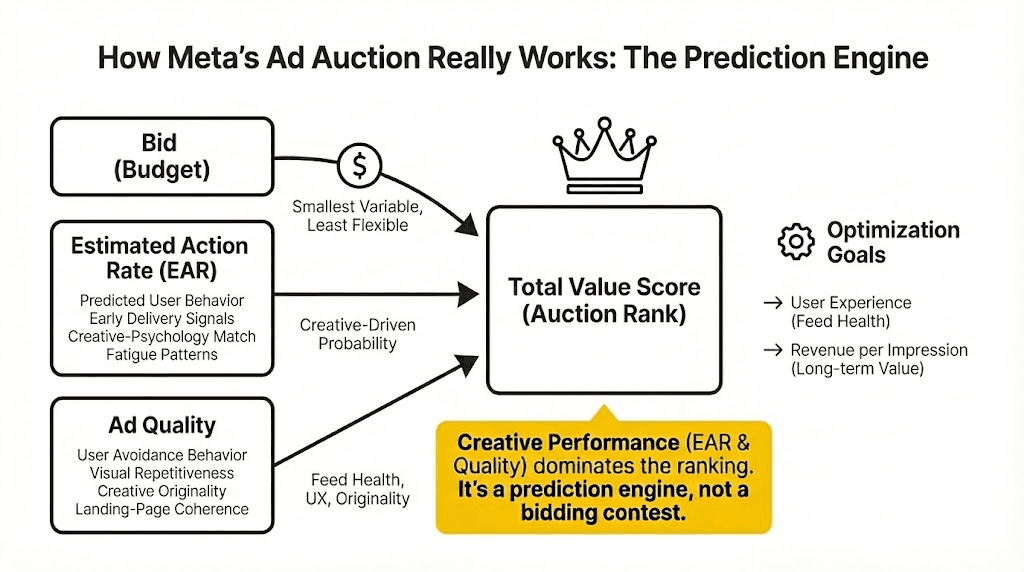
Meta’s ad auction is one of the most misunderstood systems in performance marketing.
Most blogs oversimplify it into a neat formula.
Most marketers treat it like a bidding contest.
Most advertisers think higher spend = higher priority.
But inside Meta, the auction behaves less like an auction and more like a real-time prediction engine optimized for two things:
User experience — keep the feed enjoyable
Revenue per impression — maximize long-term advertiser value
To accomplish this, Meta scores every ad in the moment the auction happens.
Let’s break that scoring into its true components.
2.1 The Core Equation: Total Value Score
Every creative is evaluated by a composite score Meta calls Total Value.
It looks simple on paper:
Total Value = Bid × Estimated Action Rate × Ad Quality
But each piece of this equation is built from dozens of hidden behavioral signals.
The important insight:
Bid is the smallest variable.
Creative-driven probability signals dominate the ranking.
If Meta believes your creative generates worse predicted outcomes than your competitor’s, you lose the auction even if you bid more.
This is why marketers who “increase budget to fix performance” often see no improvement.
Let’s go deeper.
2.2 Estimated Action Rate (EAR): Meta’s Prediction of Human Behavior
EAR is Meta’s core superpower.
It estimates the probability that a specific user will take a meaningful action if shown your ad.
Not just “click.”
Not just “view.”
But the desired action based on your campaign objective.
For example:
Purchase → likely to buy
Lead → likely to sign up
View content → likely to engage with the page
Add to cart → likely to add something because of curiosity or intent
EAR is built from thousands of signals, but here are the big drivers:
1) Behavior history of that user
Meta predicts how certain people behave based on:
scroll patterns
click depth
time-on-ad
micro-engagements
content affinities
purchase categories
session speed
2) Early delivery signals from your creative
The first 50–300 impressions matter the most.
Meta uses them to determine:
Did people pause?
Did they rewatch?
Did they bounce instantly?
Did they click deeper than usual?
Did the ad feel repetitive?
These micro-signals influence EAR instantly.
3) Similarity match between the ad's story and the user’s psychology
Meta is effectively asking:
“How similar is this creative to ads that historically performed well for similar people?”
If the match is strong → EAR rises.
If the match is weak → EAR tanks.
4) Creative fatigue patterns
If a creative has been shown too often, Meta learns:
“People aren’t reacting anymore.”
EAR drops accordingly.
Big takeaway:
EAR is 100% creative-dependent.
Not your audience.
Not your budget.
Your creative.
2.3 Ad Quality: Meta’s Invisible Sentiment Meter
Ad Quality determines how healthy your creative looks across the feed.
It measures:
hidden negative signals
user avoidance behavior
fast-scrolling
low watch-time
low retention in first 3 seconds
negative feedback (“hide ad”, “not relevant”)
visual repetitiveness
creative originality
landing-page coherence
excessive ad-like patterns (too polished, too templated, too predictable)
Meta doesn’t want the feed to feel like Times Square.
It wants the feed to feel personal, entertaining, and native.
Ads that feel like ads damage the feed.
Ads that feel like content elevate it.
So Meta quietly boosts creatives that:
feel story-driven
feel native to the feed
show natural pacing
use human emotions
break pattern recognition
don’t fatigue fast
This is why “template-looking” ads often fail without explanation.
Meta evaluates ad quality using your creative’s clarity and relevance, which is why having a structured brand knowledge base matters. See how Creative Brain organizes it.
2.4 Budget Doesn’t Save You (And Can Even Hurt You)
Here’s the harsh truth:
If EAR and Ad Quality drop, increasing spend accelerates your loss.
Why?
Because Meta tests faster when you raise the budget.
And if early signals are bad, Meta learns faster that your ad is low-value.
This causes:
limited delivery
higher CPM
throttled reach
loss of inventory priority
So instead of “spend your way out,” you actually speed-run the death cycle of a fatigued creative.
Real operators know:
When an ad is failing, spending amplifies the decline.
2.5 The Competitive Layer: You’re Not Competing Globally - You’re Competing in a Micro Category
Meta’s auction doesn’t compare your creative to the entire platform.
It compares your creative to:
ads targeting similar users
ads in your product category
ads with similar intent signals
high-performing competing creatives
accounts with better historical trust
If your category gets suddenly aggressive with new creative angles, your CPM goes up — not because competition increased, but because your relative creative score dropped.
This explains why:
new brands get cheap CPM
matured brands get expensive CPM
categories with bland creative have lower costs
categories with high novelty (beauty, fitness, fashion) have higher costs
The auction isn’t neutral.
It is a competitive meritocracy where freshness and creativity determine who gets the best inventory.
2.6 The Smartest Insight You Can Take From This Section
Meta’s auction rewards advertisers who feed the algorithm high-probability signals, not high budgets.
The strongest signals are:
creative quality
creative relevance
creative novelty
creative freshness
creative diversity
fast iteration
user-level psychological match
In simple terms:
Creative is 80% of auction success.
Everything else fights over the remaining 20%.
Creative Fatigue Is the Silent Auction Killer (The Brutal Breakdown)
There is one problem that destroys more Meta ads than competition, targeting, seasonality, or budget combined:
Creative fatigue.
Fatigue is not an aesthetic issue.
It is not a “my ad got old” problem.
It is not a “change the headline” problem.
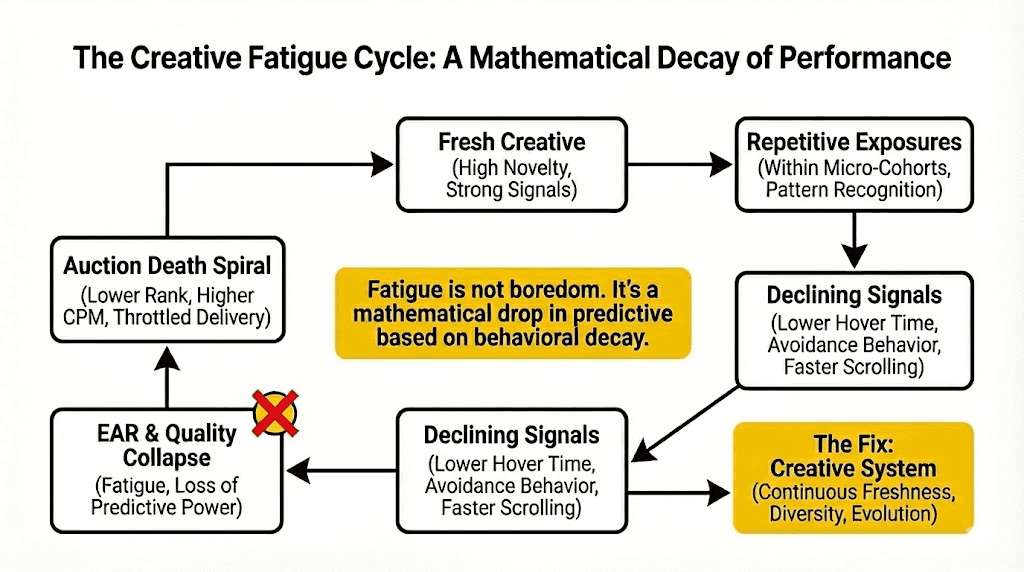
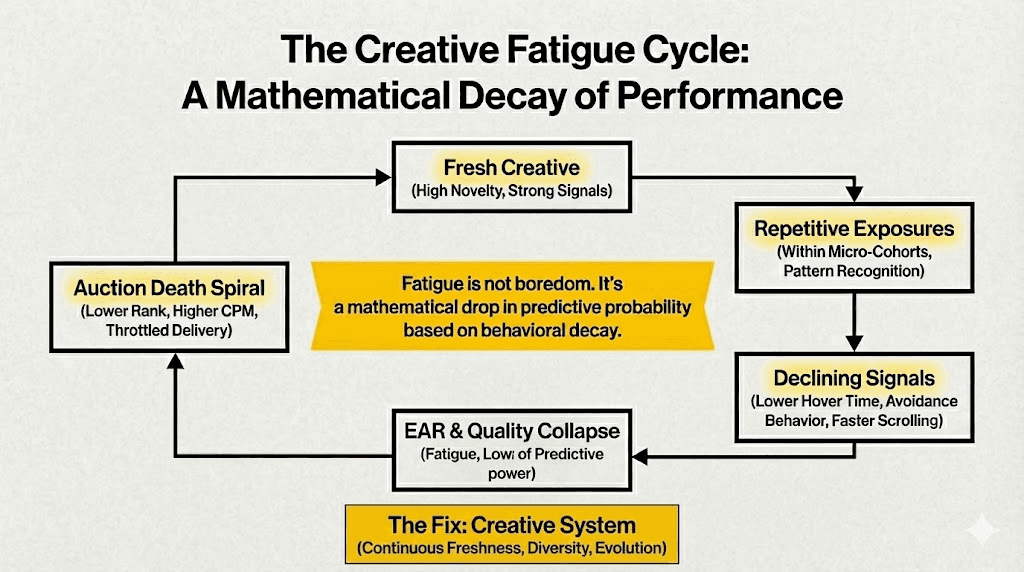
Fatigue is a mathematical collapse inside Meta’s prediction engine — and it is the fastest way to lose the auction even if everything else is perfect.
Let’s break the truth open.
3.1 What Creative Fatigue Actually Is (Not What You Think)
Most marketers think fatigue = people get bored.
But Meta doesn’t measure boredom. It measures behavioral probability decay.
Creative fatigue =
A drop in how users behave when exposed to your ad, relative to earlier exposure.
Meta interprets this drop as:
“Users no longer respond to this creative; stop showing it.”
And when Meta stops showing your ad, it isn’t emotional.
It is mathematical.
Fatigue collapses performance because the algorithm sees declining signals, which is exactly what automated refresh ads with AI are designed to prevent.
What triggers fatigue?
1) Repetitive exposures within a micro-cohort
Not your entire audience — small hidden pockets within it.
2) Diminished interaction intensity
Not just clicks — micro metrics like:
scroll pauses
watch-time milliseconds
repeated frame views
hover behavior
mid-scroll reversals
3) New competitor creatives outperform you
Relative drop, not absolute drop.
4) Pattern recognition (the enemy of performance)
If your creative looks the same as your previous ones:
Meta predicts lower novelty
→ predicts lower response
→ reduces delivery
5) Psychological saturation
Users stop reacting because the frame is old, not the product.
This is why “refresh creatives” is not about updating a color or swapping a headline.
Fatigue is a total collapse of Meta’s confidence in your creativity.
Once that confidence drops, the auction is gone.
3.2 Fatigue Is Not Universal - It’s Cluster-Specific
This is where most people get destroyed.
Your ad doesn’t fatigue “among all your audience.”
It fatigues inside specific micro-behavior cohorts that Meta builds.
For example:
People who pause on testimonials
People who swipe quickly on UGC-style videos
People who prefer devices or creators similar to your vibe
People who respond based on time-of-day emotional triggers
Fatigue happens when one cluster stops responding.
Meta reallocates delivery to another cluster — until that one fatigues too.
Eventually, every cluster you match becomes exhausted.
This is the invisible death cycle:
Micro-cohort exhaustion → forced expansion → higher CPM → worse users → worse signals → lower EAR → auction loss.
Marketers misdiagnose this as:
“Broad isn’t working.”
“Audience size is too small.”
“My budget is too high.”
“Frequency went up.”
But again…
Fatigue is the root.
The rest are symptoms.
To counter fatigue, many advertisers refresh motion and pacing. This guide breaks down how animated ads improve retention.
3.3 The First Sign of Fatigue: Hover Time Drops
Most marketers track CTR, CPC, and CPM.
Meta tracks:
how long a user pauses before scrolling
micro-second lingering behavior
eye-tracking proxies
spontaneous rewatches
frame-level retention curves
The moment hover time declines, Meta assumes:
“This creative is losing its predictive power.”
EAR drops instantly.
And your auction performance collapses.
This decline usually happens before CTR drops, which is why fatigue shocks many advertisers — “It was doing so well yesterday!”
No — the signals were already dropping.
You just couldn’t see them.
3.4 Why Fatigue Hits Faster Today Than 3 Years Ago
1) Content density exploded
Users consume 10× more content per minute than they did in 2019.
Novelty dies fast.
2) User pattern-recognition evolved
People instantly identify “template ads” and ads with predictable pacing.
3) Creative trends now spread through AI faster
Everyone copies everyone.
Formats die in weeks, not months.
4) Meta’s feed protects the user at all cost
If showing your ad weakens the feed experience → Meta pulls you out.
5) Automation accelerates fatigue visibility
With Advantage+ and automated placement models, Meta tests ads faster.
Faster testing = faster fatigue.
The algorithm isn’t harsher.
The environment is.
3.5 How Fatigue Creates a Death Spiral Inside the Auction
Fatigue impacts the auction through a clear chain reaction:
Step 1: Users stop reacting
Meta sees micro-avoidance behavior (scrolling faster, no pause).
Step 2: Ad Quality Score drops
Meta thinks your creativity isn’t valuable anymore.
Step 3: Estimated Action Rate collapses
Meta predicts lower outcomes.
Step 4: Auction priority falls
You start losing impressions to fresher, more engaging creatives.
Step 5: CPM rises
You're being forced into low-quality inventory.
Step 6: Performance dies
Even higher budgets cannot overcome low EAR.
This is why so many marketers say:
“I increased the budget, and performance got worse.”
Yes — because you accelerated the death cycle.
Fatigue is the villain.
Everything else is a symptom.
3.6 Why Most Marketers Misdiagnose Fatigue (And Burn Money Because of It)
Here are the common wrong explanations marketers use:
“My audience is too small.”
No, the creative fatigued within hidden micro-clusters.
“Targeting is the problem.”
No, Meta is extremely good at matching users.
Fatigue breaks predictive matching.
“It’s competition season.”
Competition matters.
But fatigue is what makes you lose the competition.
“My CTR dropped because people didn’t like the ad.”
No, CTR dropped because the pool of responsive users shrank.
“Creative testing didn’t work.”
No, you tested too few variations, too slowly.
“Meta hates my account.”
No, Meta loves predictable ads.
Yours became unpredictable.
In truth:
Fatigue is the unseen structural force killing 70% of Meta ad performance.
And the solution is not “find a better audience” or “raise budgets.”
The only real solution is freshness and diversity.
3.7 The Only Real Fix for Creative Fatigue (And Where Systems Matter More Than Ideas)
Once fatigue sets in, no amount of targeting tricks, budget shuffling, or campaign restructuring can revive a dying ad.
Because fatigue isn’t a media problem.
It’s a creative probability problem.
Meta doesn't downgrade fatigued creative because it dislikes your brand — it simply sees declining behavioral signals and reallocates impressions to something more promising.
This means the only sustainable way to avoid fatigue is to operate with:
Fresh creatives are launched frequently
Multiple angles that hit different micro-cohorts
Variations that avoid pattern recognition
Creative diversity at a pace faster than fatigue
A predictable rhythm of refreshes before collapse
In practice, this is extremely hard for human teams to do manually.
Most teams:
brainstorm too slowly
produce too few angles
repeat formats that once worked
rely on intuition instead of systematic diversity
refresh only after performance dies
lack a cycle for proactive creative evolution
This is why the most successful modern ad accounts don’t rely on “creative ideas.”
They rely on creative systems.
Systems that:
analyze winners
generate structured variations
bring new hooks weekly
pull insights from past performance
diversify formats in bulk
refresh before fatigue
adapt cross-persona angles
maintain constant novelty velocity
A tool like Notch happens to operate in that exact creativity-at-scale layer —
but more importantly, it represents a broader shift in how top advertisers win today:
The auction is no longer won by the best idea.
It’s won by the team with the most consistent creative evolution.
And consistent evolution only happens when you have a system designed for it.
Which leads perfectly into the final pillar.
Want to build a creative system rather than chase one-off winners?
Explore how modern teams automate refresh cycles and diversify creative effortlessly →
4. How Meta Rewards Fresh, Diverse Creative Variations (The Real Advantage)
Meta’s auction doesn’t just punish old creative.
It also actively rewards fresh creative — especially when the variations are structurally different from one another.
This is not speculation.
It’s baked into Meta’s predictive engine, the same one that controls delivery, cost, and auction winning probability.
Let’s break down exactly why.
4.1 Fresh Creative Triggers a Temporary “Confidence Window”
When you launch a new creative, Meta enters what operators call the trial window.
This window is where Meta tests your creative against micro-cohorts to determine:
How engaging the creative is
Whether it matches user psychology
Whether it improves the feed experience
Where it should place your creative in inventory priority
During this period, Meta gives your creative disproportionately high opportunities.
Why?
Because Meta loves unknowns with potential.
A fresh creative is unpredictable — and unpredictability is valuable when it leads to possible upside.
This creates a short-term auction advantage built into the system.
Fresh creative =
High initial EAR → high delivery priority → lower CPM → more scale potential.
But freshness alone isn’t enough.
4.2 True Creative Diversity Extends the Life of Your Performance
Most advertisers confuse “variations” with “diversity.”
Changing colors, cropping a video, or adding text overlays are not diverse.
Meta recognizes these micro-edits instantly because the behavioral patterns remain identical.
Real creative diversity means changing the structural story pattern, such as:
New hooks
New angles
New emotional frames
New narrative pacing
New persona positioning
New problem framing
New archetypes (UGC vs cinematic vs founder story)
New visual languages
This matters because Meta doesn’t compare your creative to your past creatives alone.
It compares your creative to:
other ads targeting similar users
other ads in your product category
other creatives with similar narrative structure
If your creative is structurally different, Meta detects it as new information.
That resets clusters, resets fatigue, and resets probability patterns.
Diversity multiplies your chance of matching high-EAR micro-cohorts, increasing your auction-level competitiveness.
4.3 Multiple Variations Allow Meta to Better Match Psychology to Personas
Meta doesn’t target people.
It targets behavioral patterns.
These patterns are not broad, logical, or demographic.
They are micro-level segmentations like:
“users who respond to chaotic edits”
“users who slow-scroll when shown emotional storytelling”
“users who click on satisfying visuals”
“users who watch founder-facing content longer”
If you only create one type of ad, you only reach a tiny slice of these segments.
When you produce multiple variations with different psychological triggers:
Meta can match the right creative to the right micro-behavior cluster.
This directly increases Estimated Action Rate.
And as EAR increases, you start winning more auctions—even with lower bids.
4.4 Diversity Helps You Compete Against Your Competitors’ Creative Momentum
Meta’s auction is relative.
You are ranked next to your competitors running ads in your category.
If they are launching:
UGC testimonials
POV skits
Cinematic ads
Aggressive countdown videos
Product demos
Explainer-style hooks
Meme-style cuts
…and you launch one type of ad repeated 6 times…
Meta has to choose their creatives over yours simply because:
They give Meta more behavioral probability options than you.
Diversity ≠ more ads.
Diversity = more opportunities for Meta to find a winning match.
That’s why advertisers with consistent creative variation tend to:
stabilize CPM
avoid sudden performance crashes
scale more smoothly
maintain auction competitiveness longer
It's not magic.
It’s math.
4.5 Freshness + Diversity Improves All Three Auction Inputs
Let’s map it:
Bid
Indirect effect:
Fresh, diverse creatives often convert cheaper → raising budget becomes safer.
Estimated Action Rate (EAR)
Direct effect:
Novelty + persona match boosts probability scores.
Ad Quality
Direct effect:
Meta loves feed-friendly variation and story-led content.
Fatigue signals disappear when variety appears.
Creative diversity is like giving Meta new data — data it can use to trust your ad again.
4.6 The Human Insight: Meta Rewards Creative Momentum, Not Creative Genius
Meta doesn’t care if your creative is a masterpiece.
It cares whether users respond.
A mediocre fresh ad with a new angle can outperform a beautifully crafted but overused one.
Why?
Because novelty carries more weight than polish in early testing.
The algorithm optimizes for user energy, not aesthetic quality.
Marketers who treat creative as a once-in-a-while asset lose.
Marketers who treat creative as an ongoing evolutionary system win.
This is the psychological shift of 2025:
Creative momentum > Creative ideas.
4.7 Subtle But Important: This Is Why Modern Teams Use AI-Powered Creative Systems
Not as a shortcut.
Not as a designer replacement.
Not as a trend-hack.
But because the auction system requires:
More variation than a human team can manually produce
Faster iterations than creative teams can handle
More angles than marketers naturally think of
More freshness cycles than traditional agencies can supply
More narrative diversity than one creative director can create
More dynamic and refreshing than manual workflows allow
This is where systems like Notch become useful — not as shiny AI tools, but as engines that operationalize creative momentum.
They help teams:
generate diverse versions of the same product story
refresh winners before fatigue
experiment with new hooks and frames
adapt creative to different personas
explore alternative formats (UGC, cinematic, product-led)
run creative at the speed the auction demands
Notch doesn’t “win the auction for you.”
It enables you to feed the auction what it already rewards:
freshness, diversity, novelty, and consistent evolution.
5. Conclusion: Winning Meta’s Auction Is a Creative Operating System, Not a Budget Strategy
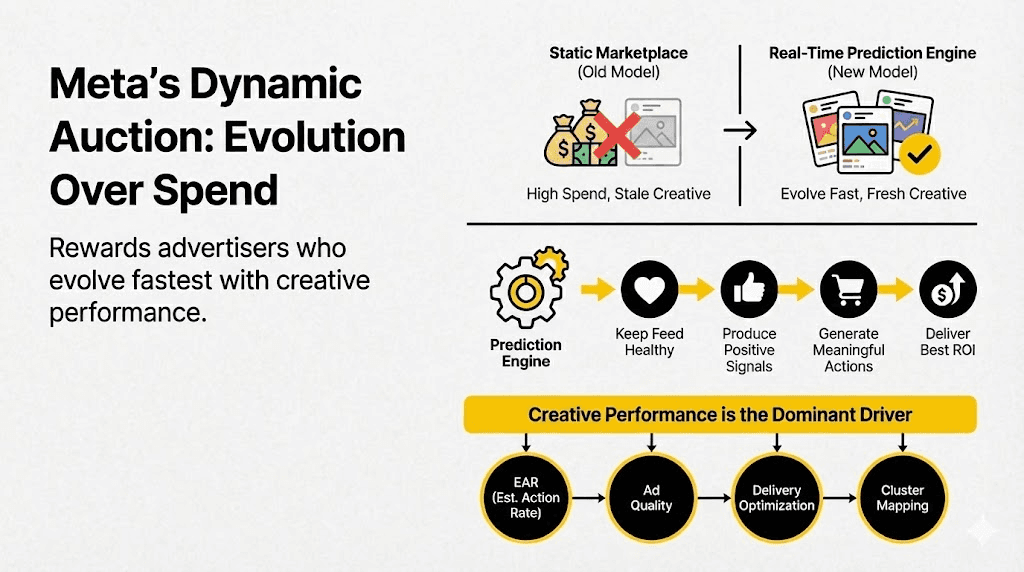
If you take only one idea from this guide, take this:
Meta doesn’t reward the advertisers who spend the most.
Meta rewards the advertisers who evolve the fastest.
The auction is not a static marketplace.
It is a dynamic, real-time prediction engine making judgment calls every millisecond about which creative will:
keep the feed healthy
produce positive user signals
generate meaningful actions
deliver the best impression-level ROI
And across all its internal systems — EAR, Ad Quality, delivery optimization, cluster mapping — creative performance is the dominant driver.
Let’s bring the three pillars together:
Pillar 1: How the auction actually works
Meta ranks your ad based on:
Estimated Action Rate (the probability your creative will drive meaningful action)
Ad Quality (based on deep, hidden user behavior signals)
Bid (important, but the least flexible variable)
This means you don’t lose the auction because of bad targeting or insufficient budget.
You lose because your creative isn’t giving Meta the probability signals it needs to trust your ad.
Pillar 2: Creative fatigue kills your auction score
Fatigue is not cosmetic.
It’s not “people got bored.”
It’s not “the ad is old.”
Fatigue is a probability decay event inside Meta’s prediction engine.
It lowers EAR, tanks Ad Quality, and forces your ad into low-quality inventory.
This is why performance doesn’t decline gradually.
It falls off a cliff.
Most marketers see the cliff and blame media.
But the cliff is creative.
Always creative.
Pillar 3: Fresh, diverse creative is the only reliable way to win repeatedly
Freshness gives you a trial window advantage.
Diversity gives you multiple psychological matches across micro-cohorts.
Momentum gives you ongoing EAR boosts that keep CPM stable and delivery strong.
The accounts that scale in 2025 are not the ones with the most clever angles.
They are the ones with the most creative momentum:
new hooks
new personas
new frames
new stories
new structures
new formats
new emotional triggers
Not once a month.
Weekly.
Sometimes daily.
Because Meta rewards novelty with trust.
And trust wins auctions.
The final insight: Your creative system is your auction strategy
If performance marketers could summarize the Meta auction in one sentence, it would be:
“Win the creative battle, and you win the auction.”
A system that:
identifies early winners
refreshes before fatigue
diversifies creative structurally
explores new psychological angles
adapts to cohort-level behaviors
evolves continuously
…will always outperform ad accounts running static, guess-based creative.
This is why teams are shifting to AI-supported creative systems.
Not for shortcuts.
Not for aesthetics.
But because the auction demands more creative evolution than humans can produce manually.
Systems like Notch make that evolution repeatable —
but the underlying principle exists regardless of tool:
Auction advantage belongs to advertisers who treat creative as an evolving system, not a set of assets.
If you want to build a creative operating model that keeps you competitive in Meta’s evolving auction landscape, start here:
Study your top-performing creatives
Extract the psychological frames behind them
Build variations across formats and emotions
Refresh before fatigue, not after
Systemize creative momentum
Your budget doesn’t win auctions anymore.
Your creative evolution system does.
If you’re exploring AI-assisted creative workflows, this guide covers the best tools marketers rely on today.
Keep reading