Meta Ads Update 2025 - How Paid Marketers Should Tackle Andromeda

Written by Vinay Jain · Updated May 2026 · 11 min read
Why this meta ads update matters (TL;DR)
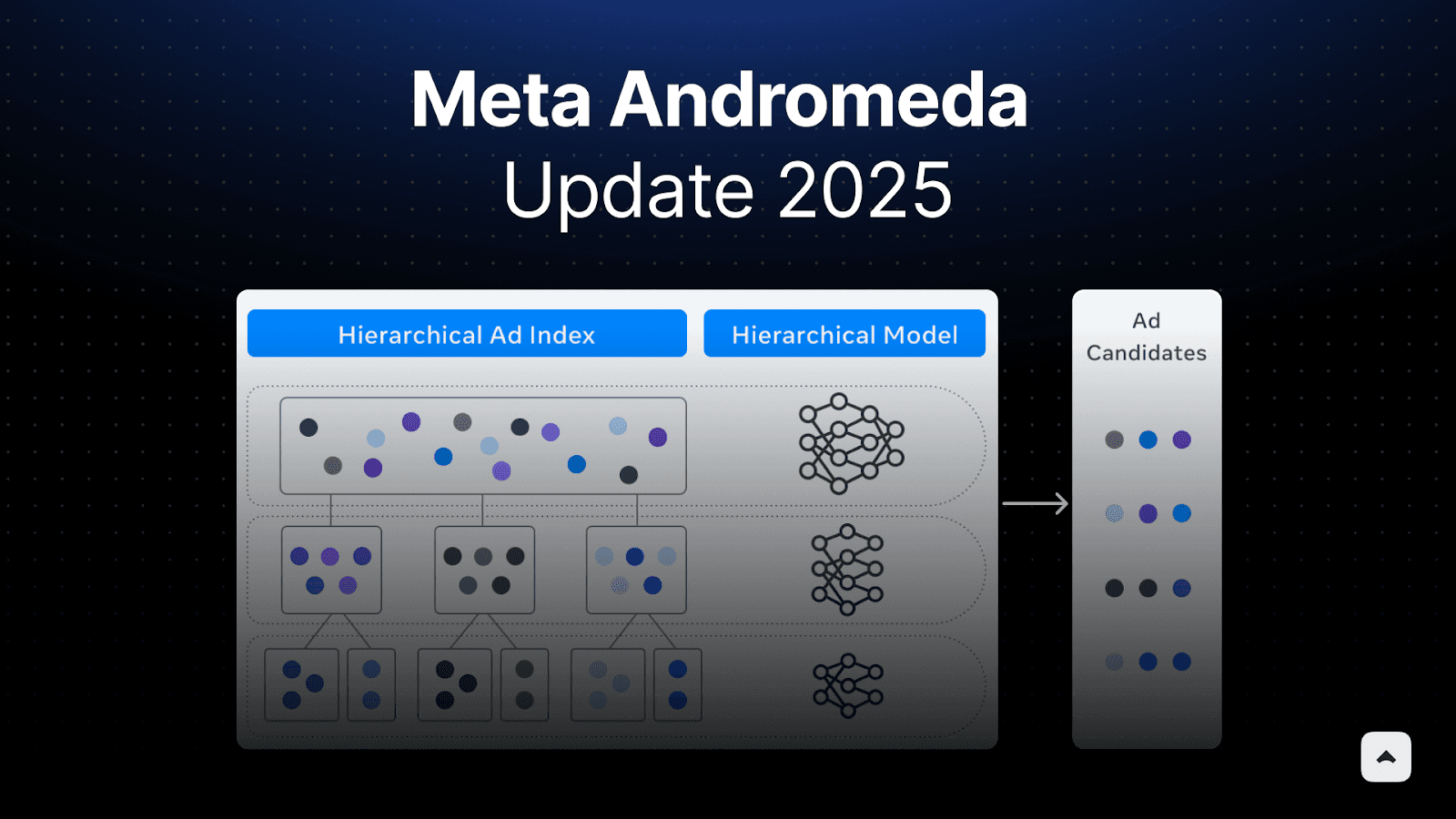
Quick answer: Meta’s Andromeda meta ads update moves the system from rule-based targeting to a transformer-style retrieval engine that matches creative semantics to user behaviour, so creative is now the primary signal for delivery and relevance.
Why you should care:
The platform is matching users to ads by interpreting creative meaning (not just demographics).
That increases hit-rate (relevance) but punishes stale / low-information creatives.
Winners will be teams that run creative pipelines like data pipelines (fast iterations, persona-driven concepts, continual refresh).
What is Andromeda?
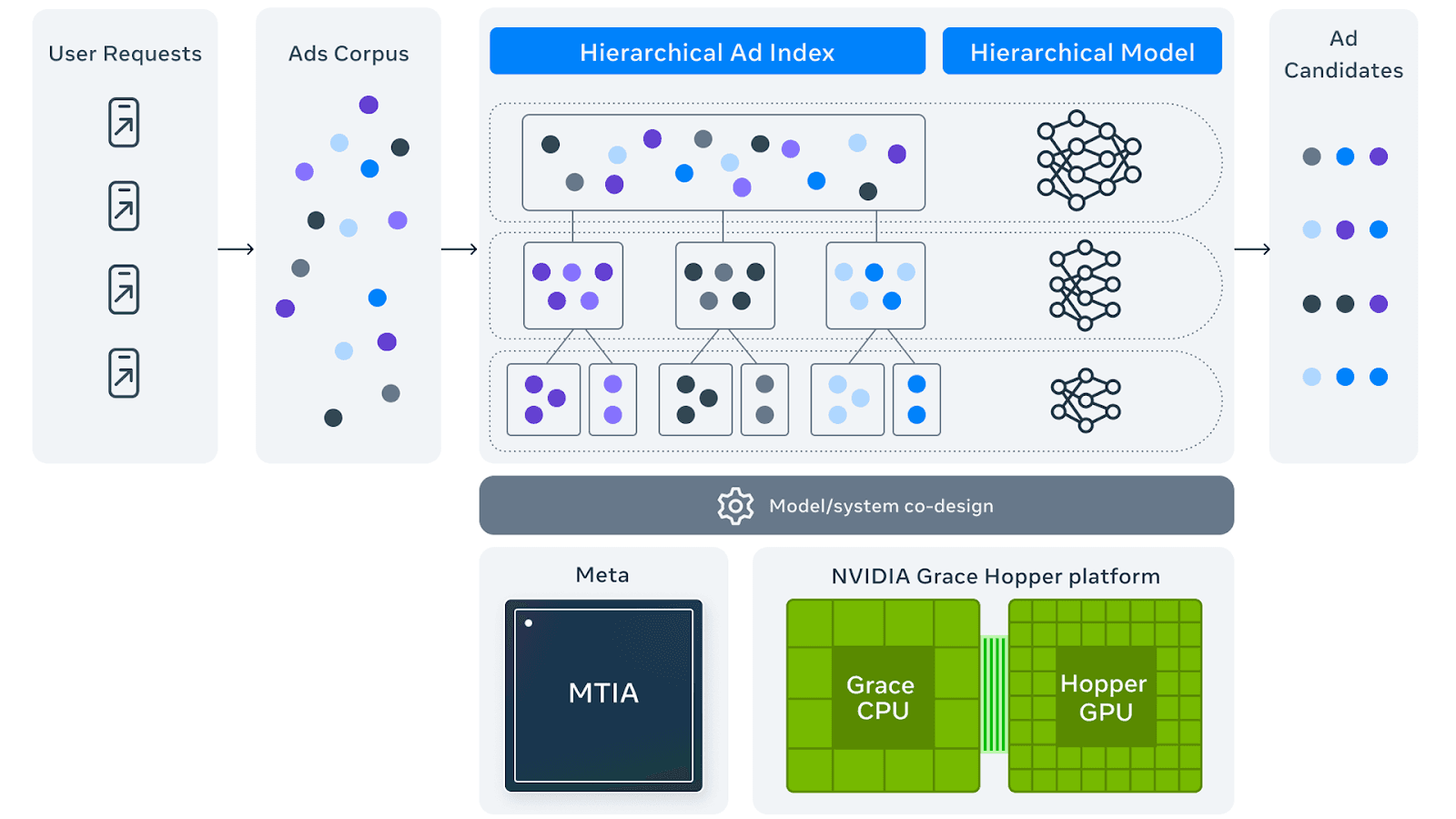
Quick answer: Andromeda is Meta’s new ads retrieval engine, a transformer/retrieval architecture that selects candidate ads by analysing creative features, user signals, and contextual behaviour and then ranks them for each person in real time.
The Andromeda meta ads update is Meta’s biggest algorithmic shift since the launch of Advantage+.
At its core, Andromeda transforms ad delivery from rule-based targeting into AI-driven creative understanding using the same transformer architecture that powers tools like ChatGPT and recommendation engines on Reels.
Before Andromeda
Meta’s ad system relied heavily on explicit targeting features such as demographics, interests, and lookalikes. The system fetched ~10,000 candidate ads, ranked them on those rule-based filters, and selected the “best fit.”
But this approach had limits; it couldn’t interpret why a user might resonate with an ad; it just followed the rules you set.
After Andromeda
The new update introduces semantic retrieval and contextual matching.
The system now understands what’s inside your ad: the visuals, tone, caption text, and even emotional cues like humour or aspiration.
It then matches these attributes to users who display similar engagement patterns (e.g., users who watch “dog videos” or interact with “motivational stories”).
In short, your creative has become the new targeting layer.
Andromeda learns what your ad “means” and finds who it fits even if you never defined that audience manually.
This is a paradigm shift for paid marketers: audience performance will increasingly depend on creative clarity and diversity, not granular targeting inputs.
How Meta’s delivery pipeline works post-Andromeda (step-by-step)
To understand how the Andromeda meta ads update reshapes performance marketing, we need to look at what actually happens behind the scenes when a user opens Instagram or Facebook.
Every ad impression goes through three algorithmic layers; however, after Andromeda, each stage now uses semantic understanding instead of rule-based filters.
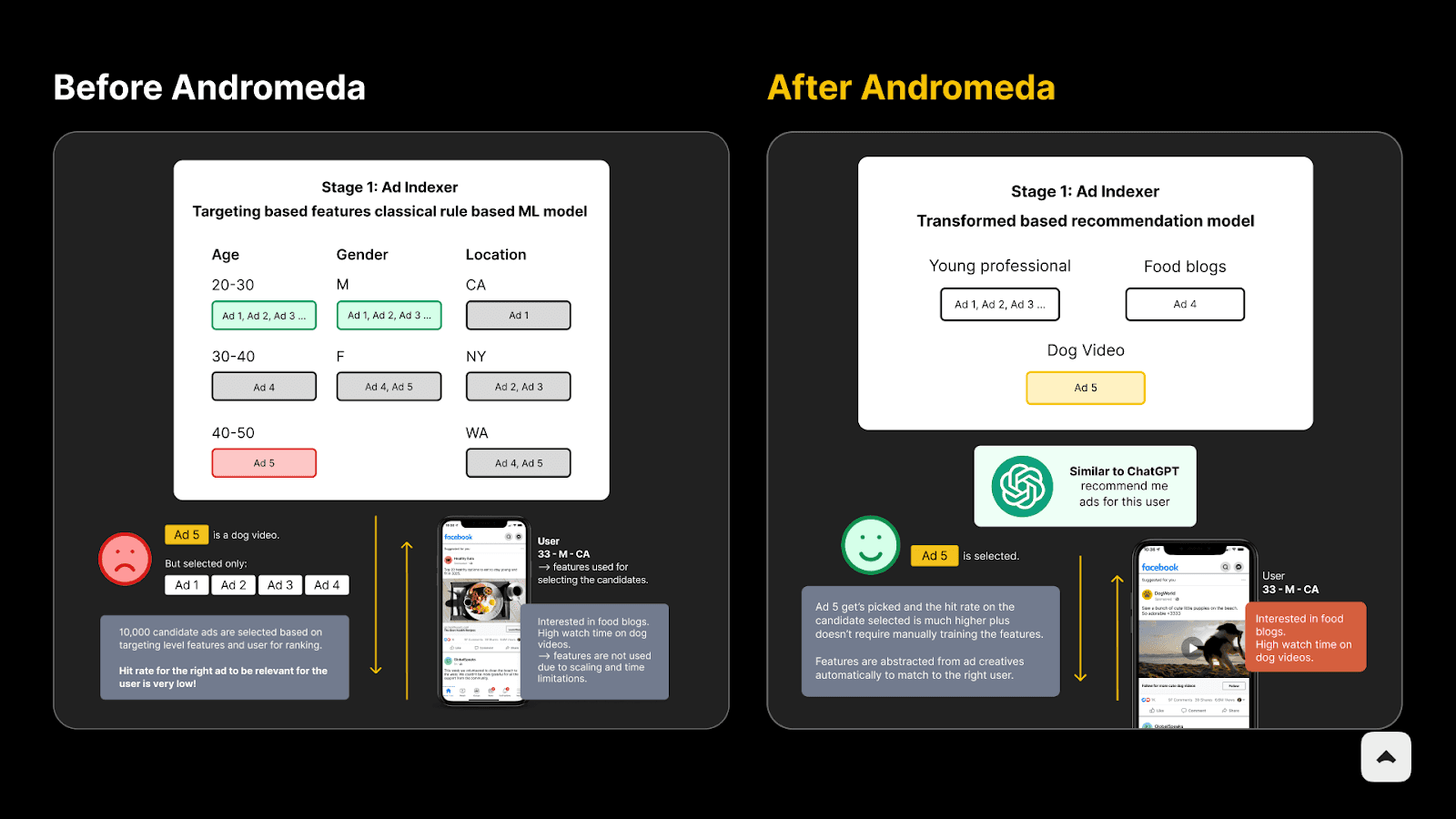
Old System vs. Andromeda System
Stage | Legacy (Before Andromeda) | New (After Andromeda Update) | Key Outcome |
1. Ad Indexer | Pulled ~10 M ads → shortlisted ~10 k candidates based on targeting rules (age, location, interest). | Uses a transformer-based retrieval model that scans creative meaning, caption text, tone, and visual elements to find relevant candidates. | Candidate pool now reflects contextual fit instead of explicit targeting. |
2. Ad Ranker | Scored candidates by click likelihood using historical CTR + demographic data. | Evaluates semantic similarity between the ad message and user behaviour signals (watch time, comment type, click depth). | Dramatically higher hit-rate and reduced wasted impressions. |
3. Platform Ranker | Selected final ads per placement using static CTR data. | Tailors each creative to platform-specific context (Feed, Reels, Marketplace, Messenger) using real-time engagement feedback. | Delivery becomes fluid — the same creative can adapt its priority per platform. |
Illustrative Example Flow
User opens Instagram Reels.
The system detects recent behaviour: the user liked a “healthy recipe” video and watched “puppy reels” for 18 seconds.Ad Indexer retrieval:
The transformer engine scans millions of active ads and identifies candidates with similar semantics — e.g., pet-friendly food brands, fitness lifestyles, and emotive UGC ads with pets.Ad Ranker scoring:
It compares engagement patterns (watch time, clicks) to rank the top 10 ads that semantically match the user’s recent interests.Platform Ranker decision:
The algorithm finally serves the most contextually aligned ad, perhaps a dog-food UGC clip or protein snack reel, that visually and thematically fits the user’s feed.
All this happens within ~500 milliseconds.
Key Takeaway for Marketers
The Meta Ads update turns ad delivery into a meaning-matching system, not a targeting-filter system.
This means:
Creatives must carry clear, discernible themes that AI can interpret.
Diversity of concept gives the algorithm more semantic surface area to find users.
Campaigns with one creative style risk “semantic narrowness”, limiting reach even at high budgets.
Marketer mindset shift: Your job is no longer to “target” audiences; it’s to feed the algorithm narratives it can understand, learn from, and distribute precisely.
What this meta ads update means for performance metrics & campaigns
Quick answer: CPMs and costs may move, but relevance and ROAS depend more on creative semantic fit than narrow audience splits. Expect creative win rates to matter more and segmented micro-audiences to matter less.
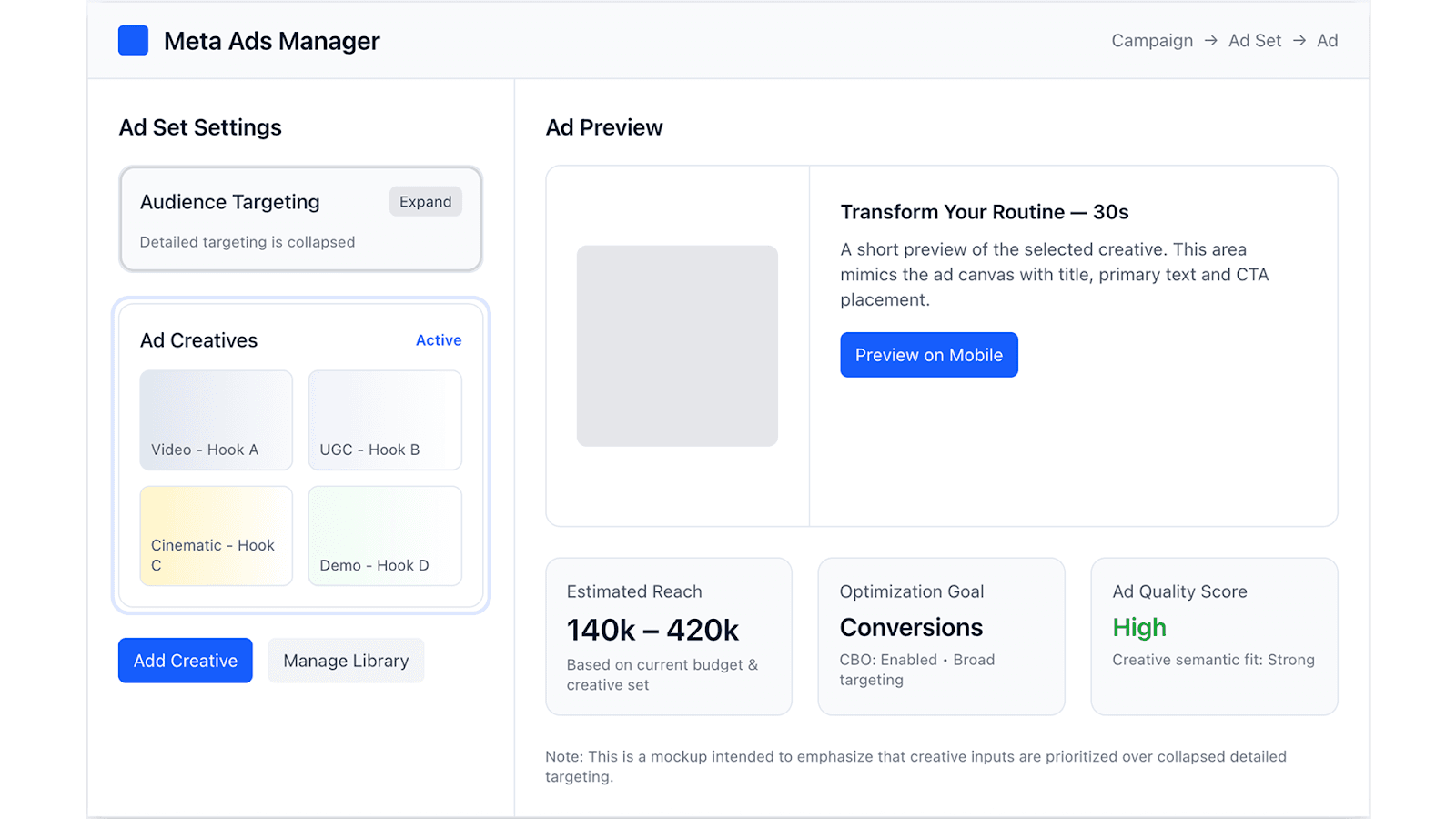
The Andromeda meta ads update fundamentally changes how marketers should think about performance optimisation.
Where we once fought to outsmart the algorithm through targeting, we now win by feeding it smarter creative data.
This shift has consequences across your targeting, testing, reporting, and creative strategy. Let’s break them down.
1. Targeting Is No Longer Your Edge - Creative Is
Under the new Meta ads update, audience targeting inputs (age, gender, and interest clusters) have been largely abstracted into AI inference.
That means Meta’s system now predicts who will resonate with your creative, not just who matches your demographic parameters.
Old reality:
Campaign success depended on detailed targeting and audience splits.
You’d create lookalikes and segment by micro-interests (e.g., “Fitness + Vegan + Age 25–34”).
New reality:
Broader targeting works better as long as you give Meta enough creative variety to find contextual matches.
Over-segmentation now hurts performance, because it reduces the volume of creative-data interactions the system can learn from.
Best practice:
Run broader CBO campaigns with multiple creatives designed for different personas or emotional hooks.
Meta’s new algorithm will discover micro-audiences automatically but only if you give it the raw material to work with.
2. Ad Fatigue Arrives Faster - Refresh Rates Must Accelerate
Meta’s transformer model “learns” what works extremely fast. That’s both a blessing and a curse.
Creatives that perform well will peak earlier.
But they’ll also decline faster, as the algorithm saturates all high-affinity users quickly.
Without regular creative refreshes, CPMs creep up even when your ROAS stays momentarily stable.
What this means:
The lifecycle of a winning ad has shortened from 6–8 weeks (pre-Andromeda) to roughly 2–4 weeks in most verticals.
Solution: Build a creative refresh system not a creative project.
Your team should be launching new concepts weekly, not monthly.
Benchmark: Top agencies now run a 15–30% weekly creative refresh rate, rotating in 12–15 new variations while retiring fatigued ones.
3. Testing Strategy Must Evolve Beyond A/B
Before the meta ads update, marketers relied on A/B tests: testing a single variable (like headline or CTA).
But Andromeda’s multi-dimensional learning means simple A/B logic no longer maps cleanly. Meta’s system considers dozens of variables at once.
Old playbook:
“Let’s test headline A vs headline B.”
“Let’s change background color and measure CTR.”
New playbook:
Test concept clusters, not micro-edits.
Compare emotionally distinct creative ideas (e.g., “Product as status symbol” vs “Product as lifestyle utility”).
Identify winning creative frameworks, not isolated features.
Example:
A fitness brand found “aspirational transformation” videos beat “how-to workout” demos by 32% in CTR.
Instead of A/B-testing hundreds of taglines, they now focus on reinterpreting that theme each week, letting Meta handle the micro-optimizations.
4. Reporting Must Shift From Audience Metrics to Creative Intelligence
Marketers used to report performance by audience segment. Now the real insight lives at the creative and persona layer.
Old reporting lens:
“Men 25–34, interest: football — $24 CPA”
“Women 18–25, interest: yoga — $19 CPA”
New reporting lens:
“Hook: Problem–Solution – 1.9% CTR – 1.2 ROAS”
“UGC Emotional Hook – 2.1% CTR – 1.5 ROAS”
“Cinematic Aspirational – 1.4% CTR – 1.1 ROAS”
This creative-level intelligence lets you feed back winning patterns into your ad generation pipeline, effectively teaching the system what kind of creative language converts best for each persona.
Pro tip: Use tagging in Meta Ads Manager or tools like Notch to classify each creative by hook type, persona, and format.
Over time, you’ll discover clear creative “recipes” that repeatedly win under Andromeda.
5. Strategic Reframe - The New Power Equation
Element | Pre-Andromeda | Post-Andromeda |
Edge | Manual targeting | Creative intelligence |
Optimization driver | Bid strategies | Concept diversity |
Testing cadence | Monthly | Weekly |
Creative fatigue cycle | 6–8 weeks | 2–4 weeks |
Success measure | Audience ROAS | Creative win-rate |
This shift rewards AI-forward marketers who treat ad creation like a learning system, not a campaign-by-campaign grind.
“Marketers used to think in audiences.
Now, they must think in concept ecosystems.”
— Notch Creative Science Team, 2025
6. The Bottom Line
The meta ads update is a wake-up call:
If your workflow still depends on manual audience logic and slow creative turnover, your CPMs will rise and delivery will flatten.
The winners of this new era will be the marketers who:
Build persona-driven creative frameworks,
Automate refresh cycles using AI tools,
And analyze performance concept-first, not audience-first.
In this ecosystem, creative intelligence is performance intelligence.
Tactical playbook: step-by-step for winning after the meta ads update
Quick answer: Treat creative like data. Build persona-driven concept libraries, run rapid refresh loops, feed first-party signals, and automate creative generation and remixing.
A. Creative & persona foundations (what to build first)
High-quality personas from 1P signals: mine CRM, purchase history, reviews, and call transcripts (not just surveys). Use these to map persona → messaging pillars.
Creative portfolio per persona: prepare 10–12 concepts per persona across formats: UGC, static, short product video, carousel, and cinematic.
B. Weekly creative cadence (practical schedule)
Refresh cadence: 12 new concepts weekly (3 formats × 2 personas × 2 hooks) — measure Monday and label winners/losers.
Testing rule: stop endless A/B micro-testing; test 3–5 distinct concepts per persona and scale winners.
C. Campaign structure (how to set it up)
Use CBO / broad targeting with creative variety in a single ad set; set tight exclusions to avoid overlap cannibalisation.
Avoid many micro ad sets — Andromeda performs better when it can choose among many creatives for a broad cohort. Five Nine Strategy
D. Data pipeline & tracking
Use CAPI + event-based tracking to give Meta richer first-party signals beyond the pixel (product page visits, micro-conversions).
Tag creatives with metadata (persona, hook, format) so you can measure creative-level performance and feed that back into generation loops.
E. Creative production options (how to scale)
Hybrid approach: rapid internal UGC + AI-generated remixes for scale → human polish in Figma/Canva for top winners. Notch-style systems automate from URL → ad and can remix winners pre-emptively.
Creative playbook: What to make (templates + examples)
Quick answer: Build persona-led concepts across three anchor formats, each with 3 hooks.
Formats:
UGC (authentic testimonial / problem→solution) — short 15–30s vertical.
Product video (60s/30s) — demo + single strong CTA.
Cinematic / avatar explainer — emotive brand story for consideration touchpoints.
Hooks to test per persona:
Problem intensity (pain + quick fix)
Social proof (micro-testimonials / user stats)
Utility / hack (how product saves time/money)
Example (persona: early-career fitness buyer):
UGC Hook A: “I was stuck — then I tried X and lost 6 kg.”
Product video Hook B: a short demo showing how to use it in 30s.
Cinematic Hook C: an aspirational day-in-life with a product cameo.
Measurement & KPIs you must track (creative-first)
Quick answer: Add creative-centric KPIs and keep classic account KPIs.
Core KPIs (ranked):
Creative win rate (share of creatives that become “winners” each cycle). Use a clear definition (e.g., spent ≥ $750 and ROAS ≥ threshold).
Pre-creative CTR & CVR (by persona/hook/format).
Creative similarity / novelty index (how distinct is a new creative from your active set). Check regularly to prevent Meta from grouping near-duplicates.
ROAS, CPA (account-level) — still required for budget decisions.
Event-level quality from CAPI (engagement, add-to-cart micro conversions).
Reporting cadence: weekly creative review (winners/losers), monthly portfolio health (diversity + fatigue signals).
Tech & tooling recommendations (what to use)
Quick answer: Invest in systems that (a) generate persona-driven creatives, (b) remix winners automatically, and (c) enforce brand rules.
Tools / stack (examples & why):
Creative automation / generator: platforms like Notch (Creative Brain, Breakthrough AI, Successor AI, StyleGuard) to auto-generate, remix, and keep creatives on-brand; helps scale URL→ad workflows and auto-refresh winners.
Data capture: Server-side CAPI + enriched events (product_view, add_to_cart, checkout_initiate).
Creative analytics: internal sheet or dashboard tracking creative metadata, win rate, and similarity metric. (Tag each ad with persona/hook/format.)
Example week-by-week execution plan (first 4 weeks)
Quick answer: Start small, generate volume, then tighten on winners.
Week 0 (prep):
Extract 1P signals → 2 personas. Build a persona brief. Build a baseline library of 12 seed concepts (3 formats × 2 personas × 2 hooks). Add tracking tags.
Week 1 (launch):
Launch 1 CBO campaign per funnel stage with all 12 creatives. Turn on full CAPI events. Measure creative-level metrics daily.
Week 2 (measure + prune):
Tag winners (per your win definition), pause the bottom 60%, and generate 12 new concepts (mix 6 remixes + 6 new).
Week 3 (scale):
Scale winners 2–3x, use Successor-style remixes to create variants prior to fatigue.
Week 4 (optimise):
Consolidate top winners into direct-response ad sets; keep a “learning” ad set with the new concepts for continuous input. Repeat the cycle.
Common pitfalls & how to avoid them
Quick answer: Don’t mistake volume for relevance; avoid near-duplicate creatives; feed Meta with strong event signals.
Pitfalls and fixes:
Pitfall: Launching hundreds of near-identical ads → the engine collapses them into one cluster and you lose signal.
Fix: Ensure creative novelty; track similarity metrics.Pitfall: Over-segmentation of ad sets.
Fix: Consolidate; let Andromeda pick among many creatives for broad cohorts.Pitfall: Relying only on pixel events.
Fix: Implement CAPI for robust first-party signals.
Checklist to launch an Andromeda-ready campaign (copyable)
Personas built from 1P data (CRM, reviews, calls).
12 initial concepts per persona (3 formats × 2 hooks).
Campaigns consolidated (CBO) with exclusions set.
CAPI + key micro-events enabled.
Creative metadata tags added (persona/hook/format).
Weekly winner review cadence scheduled.
Tooling to auto-generate/remix creatives (Notch or similar).
Short case tactics you can run today (3 quick wins)
Consolidate five similar ad sets into one CBO ad set and load 25 creatives — measure conversion rate / CPA delta in 7–14 days. (Several agencies reported better conversions after consolidation.) Five Nine Strategy+1
Add micro-conversion events via CAPI (e.g., product detail open) so Andromeda gets richer signals.
Create 3 UGC variants (different hooks) for your top funnel creative and run them in the same ad set. The engine will find pockets of users who respond to each hook. Facebook
Tools & resources (further reading)
Meta engineering brief on Andromeda (technical results & +6% retrieval recall, +8% ad quality in test segments). Engineering at Meta
MindBees' practical breakdown of Andromeda implications (a good quick read). Mindbees
Notch Andromeda deck — tactical creative playbook, weekly refresh schedule, and tooling recommendations you can adapt.
FAQ (quick answers for readers)
Q: Does Andromeda mean targeting is dead?
A: No, targeting still matters for measurement and upper-funnel reach but creative semantics now play a leading role in who sees your ad.
Q: Should I stop A/B testing?
A: Stop endless micro A/Bs. Move to concept testing: test distinct concepts (3–5) per persona and scale winners.
Q: How fast must I refresh creatives?
A: A cadence of weekly concept refresh is recommended (12 concepts/week) for many accounts; adjust based on spend and win-rate.
Final takeaways
The meta ads update (Andromeda) makes the creative itself the primary targeting signal.
Winners will be teams who run creative like a data pipeline: persona-first, high-velocity, and automated remixing with strong first-party signals.
Tactical next step: consolidate campaigns, enable CAPI, build persona-driven creative portfolios, and adopt automation to scale refresh cycles.
Keep reading